Accelerating solar design: introducing QuickYield for agile design iteration

Abstract geometric art of two large, glowing interlocking 2D mechanical gears fitting together perfectly in a void. One piece is etched with technical CAD blueprints of a solar farm and solar panel schematics and is colored in tech blue; the other piece is made of translucent amber glass containing shifting data charts and a single "Yield %" symbol. The point where they meet emits a bright, clean white light, symbolizing the "Single Source of Truth."
Max HailerCopywriter
March 24, 2026
PVcase Products

QuickYield at a glance

  • The bottleneck: Slow external simulations create a 2-week "wait-and-see" loop.

  • The solution: Instant, directionally accurate energy metrics (AC Yield & PR) inside PVcase.

  • The impact: Shift from sequential design to rapid, real-time iteration.

  • The tech: Powered by PVLib and PVGIS TMY data.

The traditional solar design process is a linear, often agonizingly slow, marathon. Engineers and managers frequently find themselves trapped in a "wait-and-see" loop, where minor layout adjustments require hours—or days—of external simulation before its impact on energy production is understood. 

This friction stalls productivity and actively discourages the kind of rigorous iteration required to find the true "sweet spot" of a project’s ROI. Furthermore, it leads whole projects into the “rework trap,” stifling solar workflows and eroding financial margins.

How external yield simulations slow down the solar design process

Traditional solar workflows suffer from simulation latency, where slow feedback loops prevent designers from exploring multiple layout variations. This sequential process creates a bottleneck that increases project risk and limits the ability to optimize for the best possible energy yield.

Standard industry workflows typically treat energy modeling as a final, "bankable" milestone rather than an active design tool. Because traditional physics-based modeling is extremely resource-intensive, these simulations are often siloed. What should be a rapid design iteration frequently spirals into a two-week modeling ordeal as data moves between departments.

This transforms the design phase into a series of disjointed hand-offs. A design manager might want to test a 5-degree tilt adjustment, but the time-cost of localized shading recalculations is too high.

The bottleneck is only worsened on hilly sites, as they introduce non-uniform irradiance and localized shading that standard "flatland" models simply cannot approximate without extensive, manual adjustment. 

Increased data risk in the design process

Beyond the clock, these silos create profound data risk. Every time a design is exported from a CAD environment to an external yield tool, the probability of data corruption or loss spikes. Mismatched assumptions between the engineer and the yield analyst lead to a "corrupted" single source of truth.

Our recent State of the Solar Project Development report highlights the severity of this logistical failure: 52% of solar professionals report that more than a quarter of their projects require significant design revisions.

Consequently, teams are forced to commit to "good enough" layouts early on, potentially leaving megawatts of untapped potential on the table simply to keep the project on schedule.


What is QuickYield?

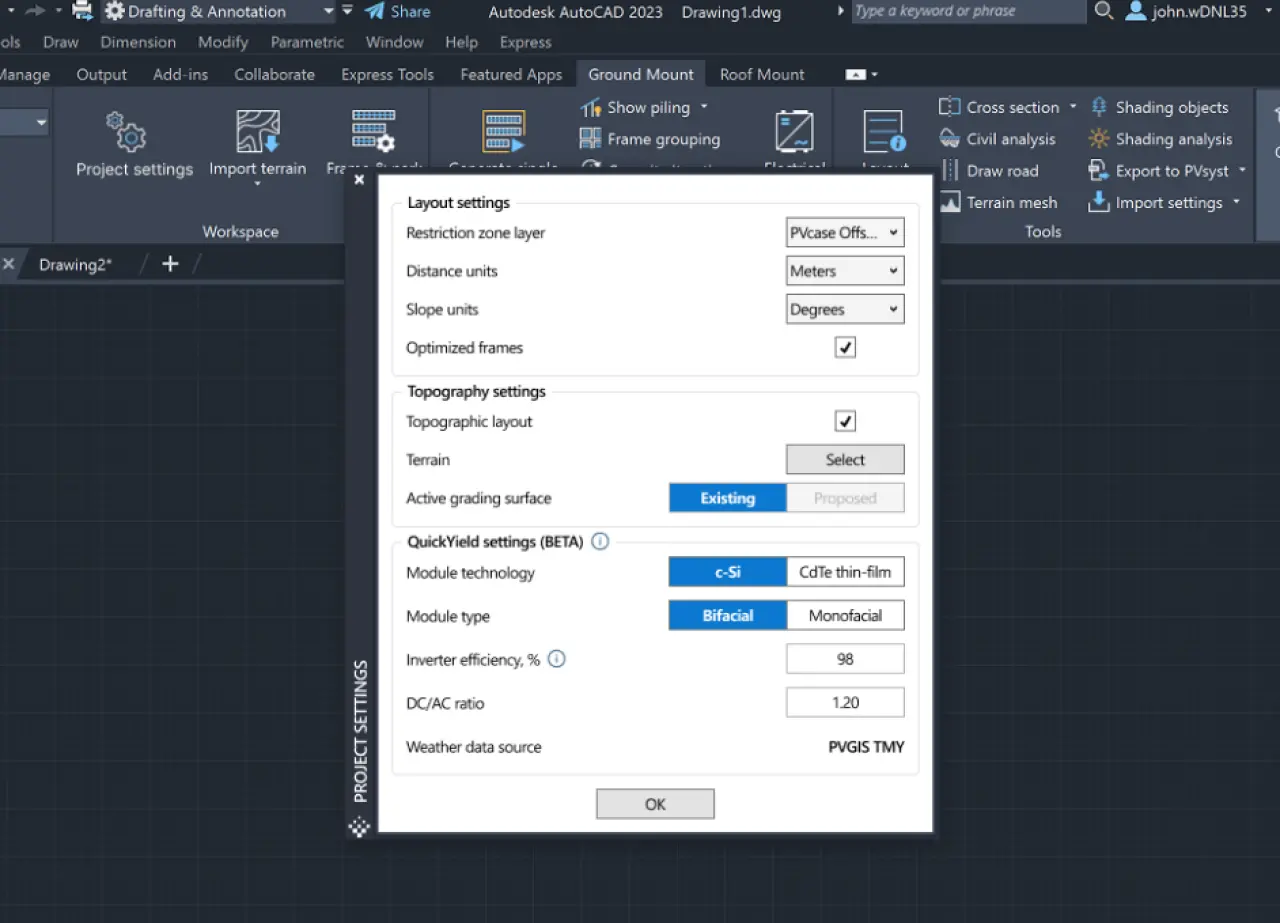
QuickYield provides instant energy metrics in PVcase using PVLib and TMY data, bypassing complex files for rapid design iteration.

QuickYield is a foundational feature within the PVcase ecosystem designed to deliver instantaneous energy performance metrics during the preliminary design phase. By integrating directly into PVcase Ground Mount and PVcase Prospect, it provides immediate visibility into a site's energy potential without leaving the design environment.

Technically, QuickYield leverages the power of PVLib, a well-established open-source library, alongside proprietary PVcase performance models. It utilizes hourly TMY (Typical Meteorological Year) weather data via the PVGIS service to calculate yield based on the geometry already present in your layout. 

To maintain its remarkable speed, it utilizes high-level module and inverter parameters, bypassing the need for complex PAN and OND files during the iterative phase.

How does QuickYield impact the solar design workflow?

QuickYield transforms solar design from a slow, sequential process into a rapid, iterative workflow. By providing instant performance feedback within the CAD environment, it eliminates departmental silos, prevents data corruption, and empowers engineers to optimize layouts in real-time.

Shifting from a sequential workflow to an iterative one changes the flow of solar engineering. Instead of designing in the dark and waiting for a "lightbulb moment" from an external report, managers can now foster a culture of continuous optimization. This transition effectively collapses the two-week modeling ordeal into a two-second feedback loop.

Velocity becomes the primary competitive advantage. When a designer adjusts the module pitch in PVcase Ground Mount, QuickYield updates the Annual Yield and Performance Ratio (PR) instantly. This real-time feedback loop allows for a "fail fast, succeed faster" mentality.

Designers can now validate dozens of scenarios in the time it previously took to set up a single external simulation.

By bringing yield calculation directly into the CAD solar system environment, the "disjointed hand-off" of traditional workflows is eliminated. There is no longer a need to export files, wait for a specialist's queue, or risk the data corruption inherent in fragmented toolsets. 

Instead, the design engineer maintains total control over the performance impact of their layout decisions, ensuring that the "single source of truth" remains intact from the first parcel screen to the final design tweak.

A cinematic 3D render of a sprawling solar power plant overlaid with glowing, holographic digital data streams and flowing light-trails of cyan and electric blue. In the foreground, a translucent, sleek user interface (UI) floats in the air, showing a "Yield Meter" gauge rapidly moving into a bright green "Optimal" zone.

Why 'directionally accurate' yield estimates de-risk early to mid-stage design

Directional accuracy allows teams to compare design alternatives with confidence. By focusing on relative performance changes rather than absolute bankability, QuickYield de-risks projects by ensuring only the most efficient, high-potential layouts move forward to the final simulation stage.

A common misconception in solar engineering is that absolute accuracy is required at every stage. However, for preliminary site selection and layout refinement, relative accuracy — or "directional accuracy" — is far more valuable than bankable precision.

In the early stages of a solar project, the goal isn't to secure a loan, but to avoid a bad investment.

QuickYield is highly reliable for measuring the delta — the percentage of improvement or decline — between two design choices. If Scenario A shows a 3% higher yield than Scenario B in QuickYield, that relationship will almost certainly hold true in a final, bankable report.

Eliminating the "good enough" compromise

By providing these metrics instantly, QuickYield directly addresses the more than 25% of projects suffering from late-stage revisions.

  • Risk mitigation: Identifying sub-optimal designs in seconds prevents "sunk cost" engineering.

  • Terrain-adaptive confidence: On complex, hilly terrain where non-uniform irradiance is a factor, QuickYield provides an immediate approximation of shading impacts. 

  • Data integrity: Because the tool uses the BOM and geometry already present in PVcase, the risk of mismatched assumptions between engineers and analysts is gone.

By the time a project reaches the final 1% of design polish, you aren't guessing—you’re confirming. Developers can save the computationally heavy, resource-intensive simulations for the final validation, knowing the layout has already been tested through hundreds of instant iterations.

How to leverage QuickYield for solar site selection

QuickYield automates site qualification in Prospect and provides real-time optimization scorecards in Ground Mount, accelerating "Go/No-Go" decisions and layout refinement.

The utility of QuickYield spans the entire project lifecycle, but its impact is most visible during the transition from site selection to mid-stage design.

In the early "Go/No-Go" phase, the goal is to qualify parcels as quickly as possible. QuickYield runs in the background of PVcase Prospect, automatically populating yield information into Parcel Data Tables and reports. This allows developers to screen hundreds of sites based on AC Yield and Specific Yield, ensuring they only acquire land with a viable energy profile.

Once a site is secured, the focus shifts to optimization. Engineers use the Capacity Iteration tool to test different configurations. QuickYield provides the instant "scorecard" for these iterations, allowing the engineer to balance GCR (Ground Coverage Ratio), shading losses, and total energy production in real-time.

Getting started with QuickYield

Integrating QuickYield into your existing workflow requires zero additional setup or data migration.

  1. Update: Ensure your team is running PVcase Ground Mount V2.57 or later.

  2. Iterate: Open the "Capacity Iteration" or "Layout Information" panels in PVcase Ground Mount to see instant AC yield and PR data.

  3. Screen: In PVcase Prospect, simply generate a layout; the yield data will populate automatically in your parcel reports.

Everything you need to know about QuickYield

A solution for slow processes and the “rework trap”

To avoid the risk of falling into costly redesign cycles, developers have to move away from waiting for a single 'perfect' report and focus on the hundreds of iterations that happen before that report is ever run. 

By integrating QuickYield, PVcase isn't just adding a feature—we are removing the friction that holds solar engineering back.

Whether you are a project developer screening parcels in PVcase Prospect or a design engineer refining layouts in PVcase Ground Mount, the goal remains the same: move faster, reduce risk, and maximize ROI.

background imagebackground image

Try PVcase now

See our AutoCAD-based PV design solution in action and learn how it can benefit your business. PVcase leverages automation, a high level of precision, and intelligent algorithms to improve the efficiency, accuracy, and quality of PV designs.

© 2026 PVcase