
Customer stories
How Ideematec achieved 3x faster layout production with PVcase
January 20, 2026
Customer
Sol Source Power
Location
United States
Industry
Community solar and energy storage development
Employees
~30
Sol Source Power develops community solar and battery storage projects across the U.S., primarily in New York and Illinois. Over the past five years, it has built a 2.5+ GW pipeline and advanced more than 100 MW toward construction, taking projects from site identification through permitting and utility approvals before selling shovel-ready assets to long-term owners and operators.
For Sol Source Power, project success depends on moving quickly. In competitive interconnection markets, delays can mean losing queue position, increasing project risk, or missing opportunities altogether. Yet the engineering team was spending valuable time navigating disconnected software systems and manual design processes.
Before adopting PVcase Ground Mount, many layout adjustments required manually moving equipment, copying and pasting blocks, and rebuilding portions of the design. Even simple requests could become time-consuming exercises. “Before, I was copying and pasting blocks. It was not fun,” says Owen Burns, Director of Development Engineering at Sol Source Power.
The team relied on different software tools for site prospecting, layout design, and performance analysis. While each solution served a purpose, moving data between platforms created friction and slowed decision-making.
Community solar projects rarely stay static. Municipal requirements change. Utilities introduce new conditions. Landowners request modifications. Every new constraint required engineering teams to revisit layouts, rerun calculations, and validate project assumptions — often under tight deadlines.
Owen Burns
Director of Development Engineering, Sol Source Power
.jpg/4d2713a4d2caf5d3f55ca1a16e300fef/cce-testimonial-(1).webp)
Sol Source Power consolidated its workflow around PVcase solar project development platform — PVcase Prospect, PVcase Ground Mount, and PVcase Yield, relying on a connected ecosystem that supports every stage of early project development.
With PVcase Prospect, the team can evaluate potential sites, review interconnection opportunities, analyze constraints, and visualize project risks in one place. Instead of gathering information from multiple sources, engineers quickly determine whether a site is worth pursuing before investing significant development resources.
Once a site moves forward, data transfers directly into PVcase Ground Mount. Topography, terrain, exclusions, vegetation buffers, and other constraints can be incorporated into the layout process from the beginning, helping engineers generate designs that reflect real-world conditions.
The biggest impact comes when projects encounter unexpected changes. Rather than rebuilding designs manually, Sol Source Power now quickly adjusts layouts, reruns stringing calculations, evaluates alternatives, and generates updated designs within the same workflow. Such flexibility enables the team to remain responsive without sacrificing engineering quality.
Before assessing the final project output in PVcase Yield, the team can now validate layout performance in QuickYield — a built-in feature within PVcase Prospect and PVcase Ground Mount. Sol Source Power mentioned QuickYield as a game-changer that eliminates manual handoffs and enables engineers to compare options faster while maintaining confidence in project assumptions.
Owen Burns
Director of Development Engineering, Sol Source Power
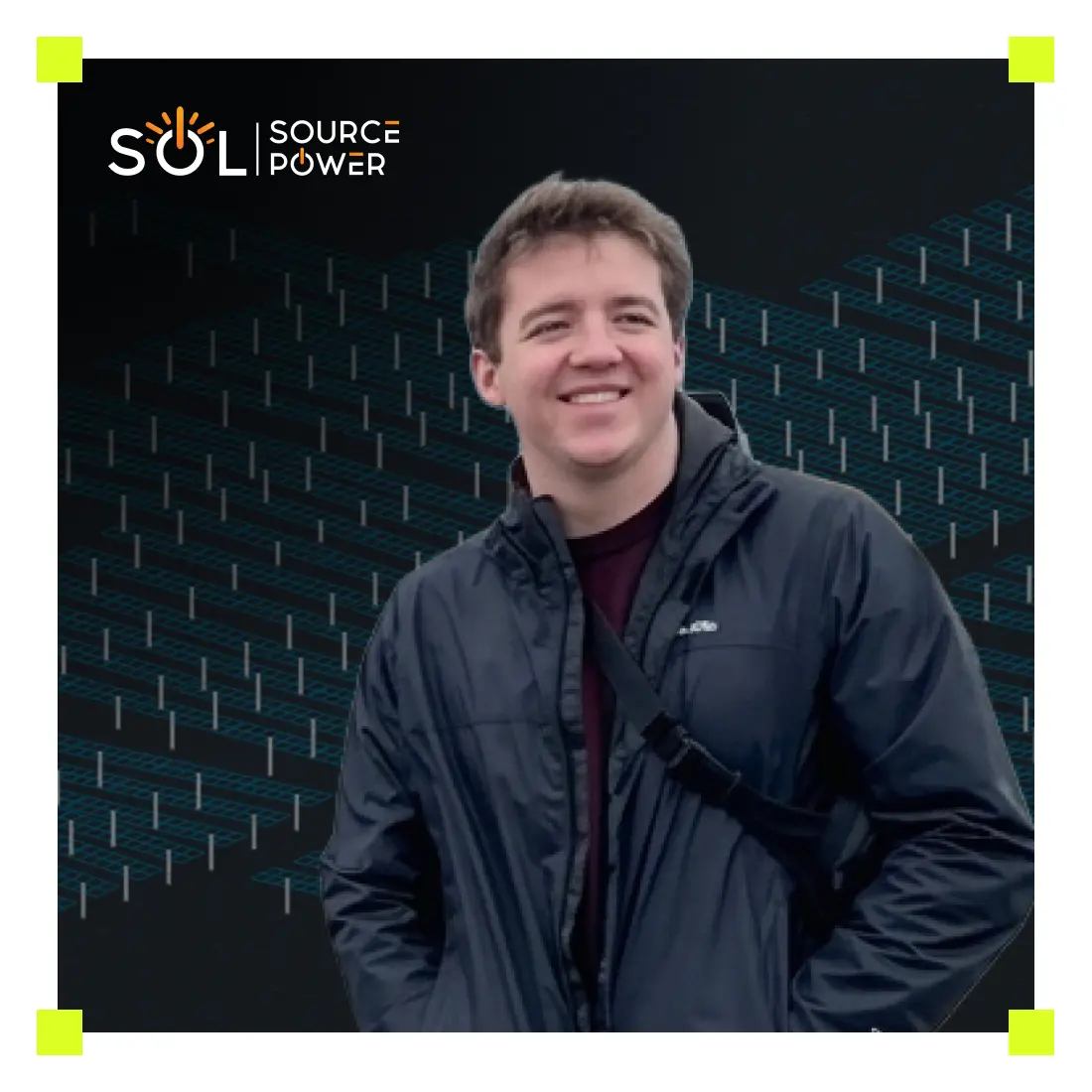
Sol Source Power successfully unified its prospecting, site design, and yield optimization under a single PVcase’s solar project development family, eliminating data loss and software friction.
Engineering teams can evaluate more options, respond to stakeholder requests faster, and make informed decisions earlier in the development process.
Layout adjustments that once required significant effort can now be generated quickly, helping teams respond to landowner questions and requests in real time.
When municipalities, utilities, or site conditions introduce new constraints, Sol Source Power can adapt quickly — improving the likelihood that projects continue progressing toward construction.
One recent community solar project in New York highlighted the value of this approach.
Late in development, the municipality introduced multiple last-minute requirements that required significant redesign work. Under a traditional workflow, the project could easily have become financially unviable.
Instead, Sol Source Power was able to quickly revise layouts, rerun stringing calculations, update design assumptions, and adapt to the new requirements.
“Most of the time, these things would kill a project. We were able to pivot and do things really quickly and rerun everything that was complicated. That would have taken days and days and thousands of dollars.” — Owen Burns
The project remained viable and continued moving forward.
Owen Burns
Director of Development Engineering, Sol Source Power
Turn complexity into clarity and confidently move your solar project forward with one powerful PVcase workflow.