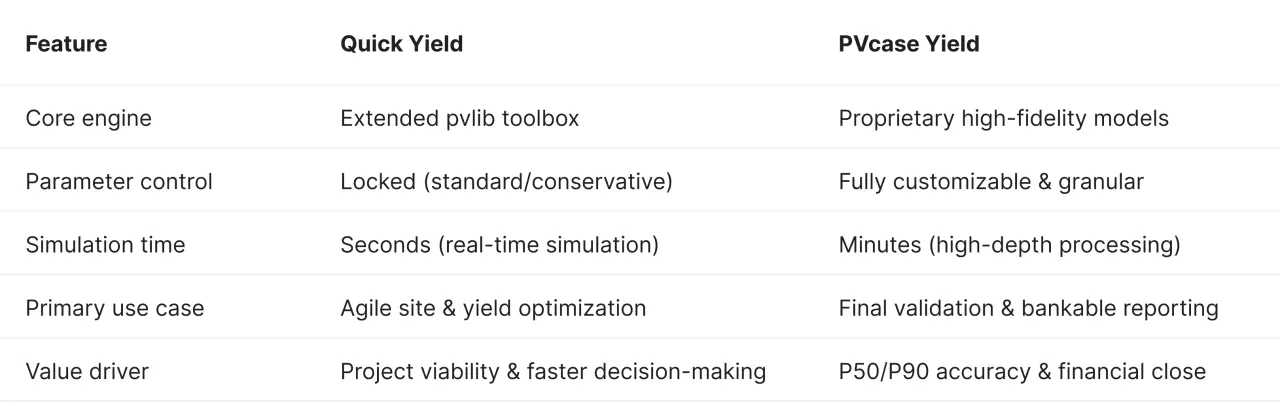
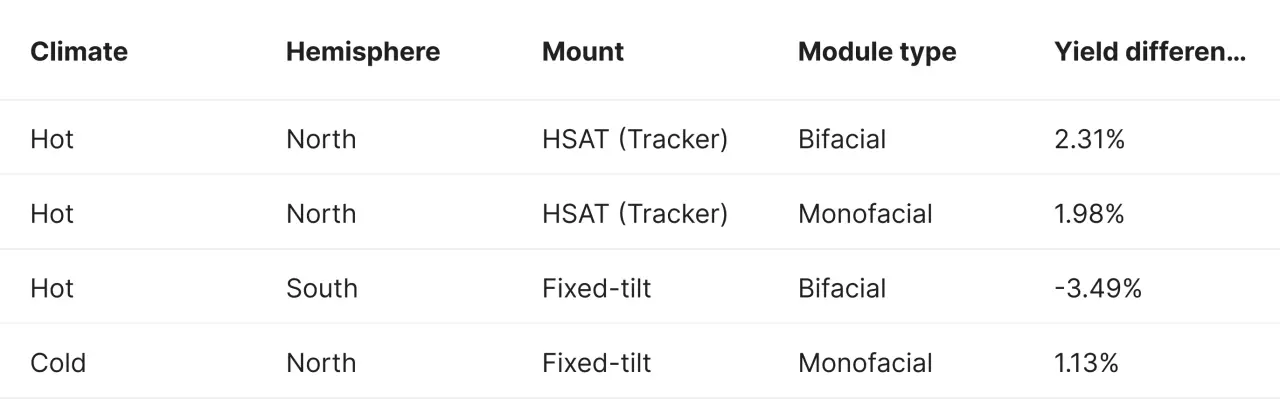
Modern solar development has evolved beyond simple site selection. Developers are increasingly managing topographical complexity, where shifting a row by a few meters on a slope can drastically impact shading and energy output. Establishing consistency between QuickYield and Yield is a strategic necessity for these sites.
"Fail fast" site viability
Use QuickYield to determine if a site is worth the investment before committing engineering hours. By providing immediate feedback during initial scenario exploration, teams can discard unviable land parcels in minutes.
Rapid site & yield optimization
Once a site is secured, the synergy between Capacity Iteration and QuickYield becomes your primary competitive advantage. While Capacity Iteration automates the testing of multiple layout parameters—such as row spacing and GCR—QuickYield powers these iterations with real-time yield feedback.
This loop allows for the "fine-tuning of the trend" without the compute-heavy overhead of a full simulation.
Final validation with PVcase Yield
Once the layout is finalized, transition to PVcase Yield to provide the definitive, accurate energy yield analysis and generate the final production numbers required for financial or bankable reporting.
To speed up final validation, PVcase Yield enables multi-calculations in parallel, allowing engineers to simulate several layout scenarios or technology configurations simultaneously. Once complete, its multi-export capabilities allow for the bulk generation of detailed reports, ensuring all stakeholders have the technical backing required for financial close.
High-performing teams, like New Leaf Energy, leverage this speed to make data-driven decisions early in the development cycle and cutting development time by 50%.
Scientifically validated modeling
To move from preliminary estimates to final investment, engineers require a "predictive bridge." PVcase Yield has been independently validated and benchmarked against industry standards like PVsyst and by firms such as Black & Veatch (B&V).
This validation confirms that the software delivers results with minimal bias and high accuracy across fixed-tilt, tracking, and bifacial configurations.