
PVC 2.0 creates a dynamic digital twin where updated exports from PVcase Ground Mount map new physical asset locations to existing IDs in the XML schema. This ensures the downstream O&M platform maintains a continuous, accurate record without breaking historical data links.
Blog
PVC 2.0: the new industry standard for solar data exchange
PVsyst 8.1 and other yield simulation engines, and financial due diligence with sub-centimeter accuracy.

PVC 2.0 AT A GLANCE
What: A universal, XML-based data exchange format (PVCollada) for utility-scale solar.
Who: An open-source initiative hosted in pvlib GitHub in collaboration with multiple organizations solar companies (including PVcase, Sandia National Laboratories, PVsyst, and DNV).
What for: “Evolves” data transition by ensuring sub-centimeter accuracy between CAD design, financial simulations, and O&M.
Availability: Supported natively in PVcase Ground Mount (v2.60+) and PVsyst (v8.1+).
Legacy CAD-to-simulation handovers have historically suffered from "data amnesia," where essential project intelligence is stripped away during file transfer. This creates a bankability gap, forcing engineers into hours of manual re-entry and exposing portfolios to the risk of late-stage redesigns.
To solve this, the industry is adopting PVC 2.0 (PVCollada). This open-source standard provides a universal language to synchronize solar solutions within the branch (PVcase Ground Mount with PVsyst, for example). This ensures data integrity across the asset's entire lifecycle.
Beyond "geometry-only": the 2x data density advantage
QUICK TAKE
Standard: Built on COLLADA 1.5, moving from "flat" geometry to granular design.
Data Gain: 2x metadata density vs. legacy formats, embedding logical electrical topology directly into the XML.
Primary Benefit: Eliminates "data amnesia" during simulation handovers.
Traditional design handovers rely on legacy formats like DXF or DWG. For a simulation engine, these are "dumb" shapes—isolated lines and blocks that lack the underlying system context required for high-fidelity modeling.
PVC 2.0 (based on the COLLADA 1.5 schema) structurally overhauls this process and moves the industry from simple layouts to granular designs.
By offering twice the metadata density of legacy formats, PVC 2.0 defines not just where an object sits, but what it is and how it functions within the broader system hierarchy. It natively embeds the following into the XML schema:
Granular MPPT logic and specific string-to-inverter mapping.
Mechanical constraints and 3D structural data.
Sub-centimeter geospatial precision to eliminate coordinate shifts during import.
Technical comparison: legacy vs. PVC 2.0
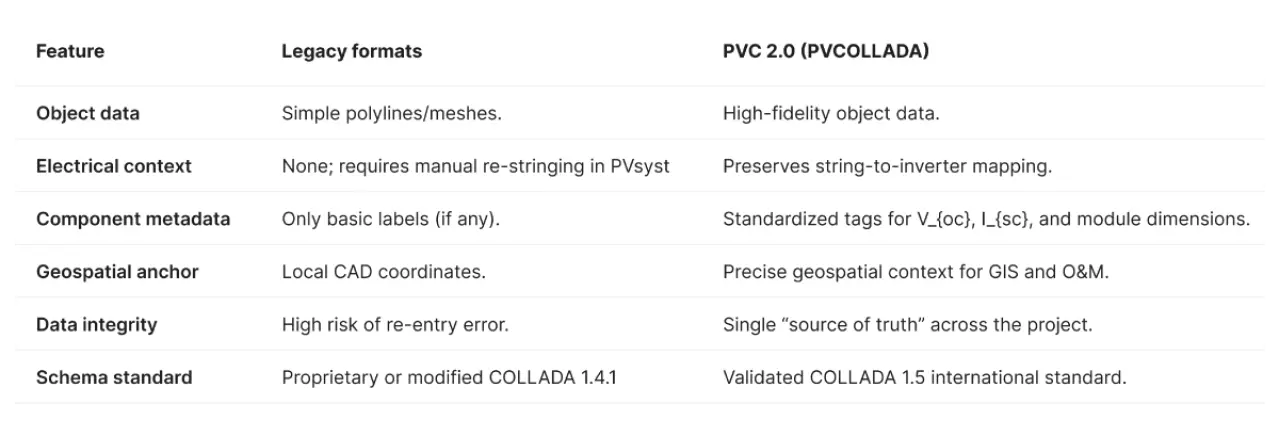
Table 1: Technical evolution from legacy geometry-only formats to the high-fidelity PVC 2.0 (PVCollada) standard.
The global mandate: PVC 2.0 as an open-source initiative
QUICK TAKE
PVC 2.0 is an open-source, vendor-neutral solar standard hosted on GitHub, unifying CAD and simulation data to accelerate financial close.
In an industry often fragmented by proprietary software silos, PVC 2.0 (PVCollada) stands out as a community-led standard. This initiative is hosted in pvlib GitHub with the collaboration of organizations like Sandia National Laboratories, to ensure the format remains an open-source, vendor-neutral foundation for the entire solar ecosystem.
By moving away from "closed" formats, PVC 2.0 ensures that project data remains accessible, transparent, and consistent, regardless of which software tools are used across the lifecycle of a utility-scale asset.
Building industry consensus for bankability
The strength of any standard is defined by its adoption. PVC 2.0 is the result of intensive collaboration between the market’s major design and simulation tool providers.
Market Integration: Industry leaders like PVsyst and DNV SolarFarmer are actively integrating PVC 2.0 importers to ensure a seamless data handshake.
Risk Mitigation: When major simulation engines and Independent Engineers (IEs) align on a single data format, it creates a "universal language" that financial institutions trust.
Accelerated Financing: Adopting this universally accepted standard ensures designs meet the rigorous requirements for technical due diligence, clearing the path to Financial Close.
Why PVC 2.0 is a bankability requirement
QUICK TAKE
Problem: The "Bankability Gap" caused by manual re-entry errors during technical due diligence.
Solution: A transparent audit trail accepted by lenders and Independent Engineers (IEs).
Workflow: Direct 1:1 design-to-simulation mapping via PVsyst 8.1 integration.
In utility-scale solar project development, the "Bankability Gap" occurs when an Independent Engineer (IE) finds discrepancies between CAD construction drawings and the yield report. These inconsistencies—often from manual data re-entry—stall projects at the finish line.
Reducing financial friction
Because PVC 2.0 is a community-led, collaborative standard, it provides a transparent, verifiable audit trail. It transforms your design into a trusted data source that financial institutions and IEs accept without manual verification.
Native PVsyst 8.1 integration
With PVsyst 8.1 prioritizing PVC 2.0, the need for "intermediary translation" (like CSV or DXF) is gone. This eliminates rounding errors and coordinate shifts. The high-resolution geometry designed in PVcase Ground Mount is exactly what is analyzed in PVsyst.
The bankability workflow
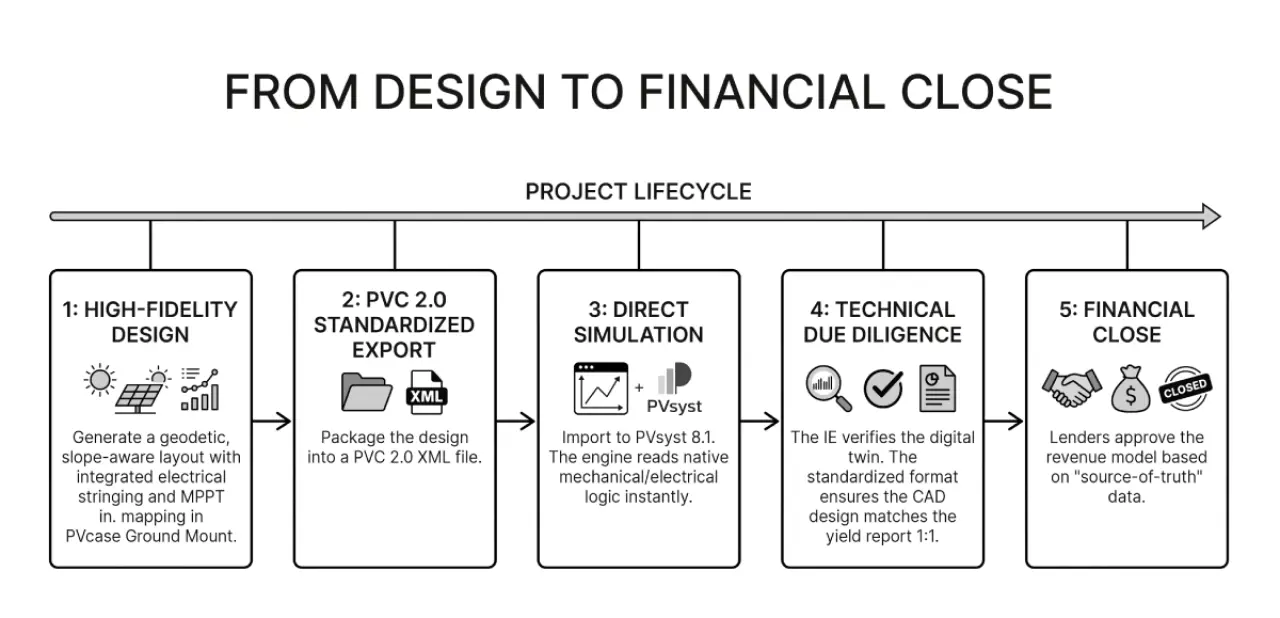
Eliminating manual data re-entry between PVcase Ground Mount and PVsyst 8.1 ensures exact alignment between CAD designs and yield simulations, accelerating technical due diligence for project lenders.
Universal interoperability: architectural foundations of PVC 2.0
QUICK TAKE
Schema: Migrates from modified COLLADA 1.4.1 to the rigorous COLLADA 1.5 international standard.
Accuracy: Sub-centimeter geospatial alignment for zero-friction GIS and CAD synchronization.
Architecture: Shift from isolated physical blocks to a relational Asset Hierarchy (Module > String > Inverter).
From an engineering perspective, PVC 2.0 marks a shift from "shapes" to "systems." Legacy formats like DXF or PVC 1.0 are "flat" files; they represent physical footprints but lack the "Electrical DNA"—circuit logic and mechanical constraints—required for high-level simulation.
Technical specs & precision standards
PVC 1.0 relied on a non-compliant COLLADA 1.4.1 schema that often stripped critical metadata. Conversely, the rigorous COLLADA 1.5 international standard provides the structural depth needed for complex, utility-scale data.
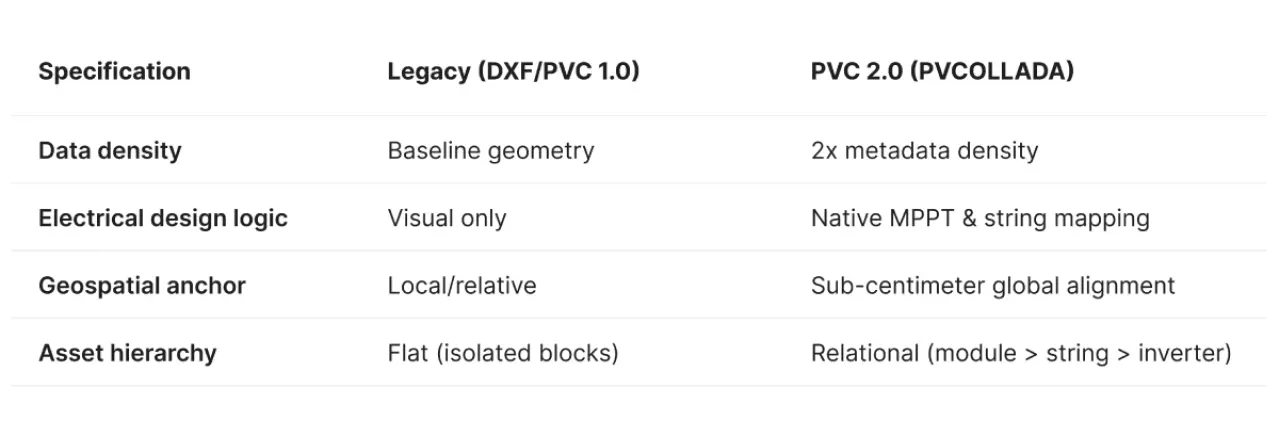
Table 2: Architectural foundations of PVC 2.0, contrasting precision standards against legacy PVC 1.0 and DXF formats.
Conclusion: setting the standard for the next 30 years
In a sector where assets are expected to perform for 30 years or more, data longevity is just as critical as hardware durability. PVC 2.0 (PVCollada) is a commitment to a transparent, silo-free solar industry.
By spearheading this initiative, PVcase ensures that your project data remains a high-value asset—not a legacy liability—throughout the entire lifecycle of the plant.
However, while PVC 2.0 provides the universal bridge to the wider industry, the most direct path to maximum bankability remains within the PVcase ecosystem.
By pairing the interoperability of the new PVC 2.0 export with the zero-loss internal integration of PVcase Yield, engineers can maintain total data integrity while satisfying the rigorous demands of external stakeholders and financial institutions.

Ready to bridge the gap?
Experience the precision of PVC 2.0 and start generating finance-ready, high-fidelity designs.