In 2026, 80% of projects fail due to grid congestion. Early injection studies prevent "stranded capital" by uncovering multi-million dollar thermal overloads before high-stakes land acquisition or $250,000 interconnection deposits.
A managerial guide to utility-scale solar project development process in 2026


Max HailerContent project manager
April 15, 2026
PV Insights
Executive summary
2026 solar development requires a grid-first site selection strategy backed by slope-aware 3D engineering. By unifying grid and land data with design, developers gain the necessary transparency to avoid interconnection risks, optimize complex terrain, and can integrate battery energy storage systems (BESS) to ensure project bankability and financial viability.
The utility-scale solar project development timeline
Our 2026 development roadmap identifies critical technical gates and risk-mitigation actions required at each percentage of project maturity.
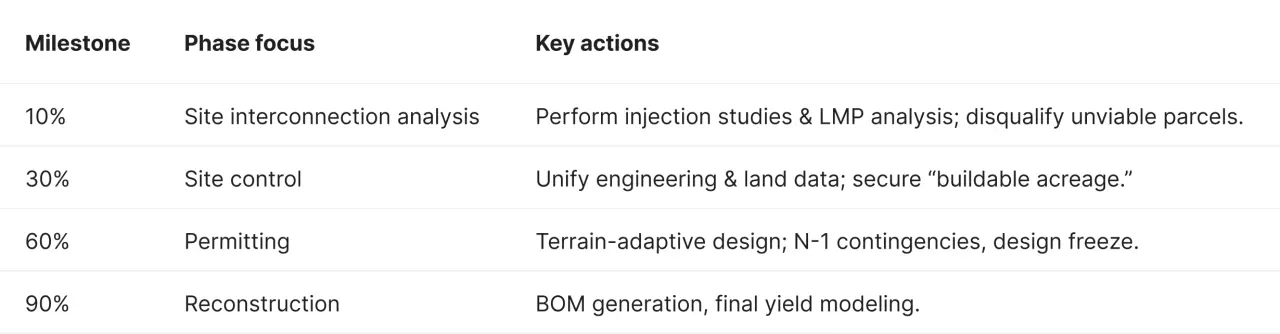
In 2026, bringing a utility-scale solar power plant from concept to commercial operation has evolved into a high-stakes energy asset development challenge. The industry has reached a critical threshold where traditional, "business as usual" methods now represent a significant financial risk. Navigating today’s saturated markets and congested grids requires a fundamental shift: replacing siloed, manual research with a unified, grid-first strategy powered by integrated data intelligence.
This guide provides a strategic roadmap for modern developers to mitigate interconnection risks, optimize complex terrain, and integrate hybrid storage solutions to ensure long-term financial viability.
Table of contents
- 1. Market intelligence: "Fail fast" siting for solar energy project development
- 2. Why unifying feasibility & site control is crucial for utility scale solar project development
- 3. How to de-risk solar power project development permitting
- 4. Design optimization & project development in the solar industry
- 5. Project maturation & contractual finalization
- 6. How are solar projects developed for financial close?
- 7. How to deal with labor shortages in solar power project development
- 8. A solar project developer’s best-practice checklist
- 9. Conclusion: Future-proofing your 2026 portfolio
Market intelligence: "Fail fast" siting for solar energy project development
Timeline progress: 10% | Milestone: Interconnection | Focus: Grid capacity
At this gate, developers must validate offtake capacity by stress-testing initial layouts against grid constraints. Utilizing high-fidelity capacity analysis early ensures project viability before capital is stranded in land acquisition.
Quick take
Traditional siting fails by prioritizing land over grid capacity. To "fail fast," managers must reverse the workflow: utilize ISO-aligned power flow studies and nodal pricing data to disqualify unviable parcels before committing significant development capital.
The traditional workflow
Historically, siting was a physical, sequential endeavor. Developers relied on manual site visits to assess topography and used static maps to estimate proximity to transmission lines. This siloed process prioritized land—seeking large, flat, inexpensive parcels—while treating grid feasibility as a secondary hurdle.
Critical failure points
Informational blind spots: Managers often rely on high-level public maps or historical averages that offer no insight into forward-looking grid stress.
Static data reliance: Using queue snapshots that ignore N-1 contingencies leads to selecting points of interconnection (POIs) that appear available but trigger multi-million dollar thermal overloads.
Interconnection bottlenecks: Traditional studies take weeks and often focus on unviable POIs, wasting hours in development efforts.
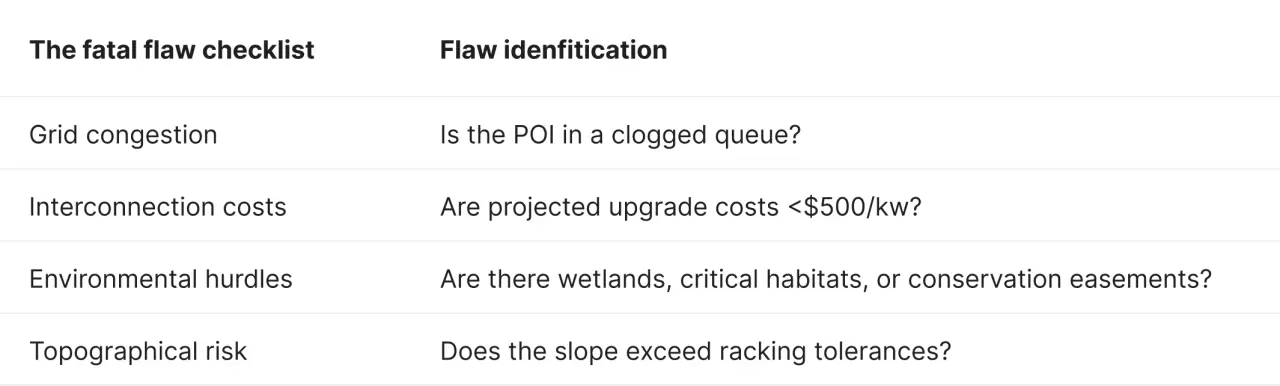
Use this checklist as a primary filter during the "fail fast" stage to protect development capital from high-risk land parcels.
The modern development standard
In the gigawatt era, a multidisciplinary strategy is required to transform site selection from a scavenger hunt into a portfolio-level strategy.
Grid-first strategy: Leading teams reverse the workflow, assessing grid capacity before land. Automated platforms run ISO-aligned injection studies to evaluate headroom and potential network upgrade costs nationwide.
Deep-node intelligence: Success requires analyzing Locational Marginal Pricing (LMP) and basis risk. This enables revenue models that account for geographic price discrepancies and negative pricing phenomena.
Bulk parcel filtering: Automation allows for the simultaneous screening of thousands of parcels against complex constraints like proximity, slope, and hazards. This "fail fast" approach identifies viable "diamonds in the rough" in minutes, not months.
Developer tip
Don't rely on static, publicly available queue maps which often lack predictive value and don't reflect the dynamic evolution of generation and load. Instead, use ISO-aligned power flow modeling to simulate N-1 contingency events early in site selection to uncover hidden thermal overloads that could cost millions in unplanned upgrades.
Why unifying feasibility & site control is crucial for utility scale solar project development
Timeline progress: 30% | Milestone: Preliminary | Focus: Site capacity (MWdc)
Developers must calculate "direct profit" by bridging the gap between land and buildability. Identifying unbuildable areas early ensures MWdc estimates are accurate before entering high-stakes site control.
Quick take
Traditional development gambles capital on unviable assets due to siloed land and engineering data. By unifying feasibility with site control, managers eliminate "blind" acquisitions, subtract unusable "slivers," and provide the high-fidelity due diligence required to secure landowner trust.
Approximately 80% of energy projects in interconnection queues fail to reach commercial operation because site selection is disconnected from grid and land constraints.
The traditional workflow
Historically, land acquisition and engineering teams operated in isolation. Land teams secured site control based on gross acreage, while engineers identified "fatal flaws"—such as slope or bedrock depth—only after significant capital was committed. This sequential process treated site control as a real estate transaction rather than an energy asset evaluation.
Critical failure points
Blind site control: Traditionally, land teams secured site control before engineers assessed the grid or topography. This frequently led to prohibitive interconnection costs and unrealistic buildable acreage
Broken collaboration: Without a "single source of truth," teams risk relying on mismatched data, leading to late-stage redesigns and eroding stakeholder trust.
60% of solar professionals explicitly identify the absence of a single source of truth for project documents as a primary bottleneck. [2025 State of Solar Development Report]
The modern development standard
Precise constraint mapping and "slivers"
Unifying feasibility ensures engineering data directly governs land acquisition strategy.
Filter out "slivers": Automated platforms identify and remove small, unusable fragments left between hazards that inflate lease costs while offering zero energy density.
Maximize energy density: Managers calculate net buildable acreage by subtracting all physical constraints (e.g., floodplains, bedrock depth) from the gross site area before signing a lease.
Data-driven stakeholder trust
Securing site control requires building trust with stakeholders.
Provide transparent due diligence: Present landowners with personalized automated marketing reports containing clear parcel images, defined boundaries, and buildable area analysis.
Establish bankability early: Show investors a clear vision of the proposed site area and preliminary analysis, demonstrating that the project is technically and financially viable from day one.
Protecting high-stakes capital
Interconnection study deposits for large projects can reach $250,000. Unified workflows ensure this capital isn't gambled on unviable POIs. Learn more about why smart capacity analysis wins at this stage.
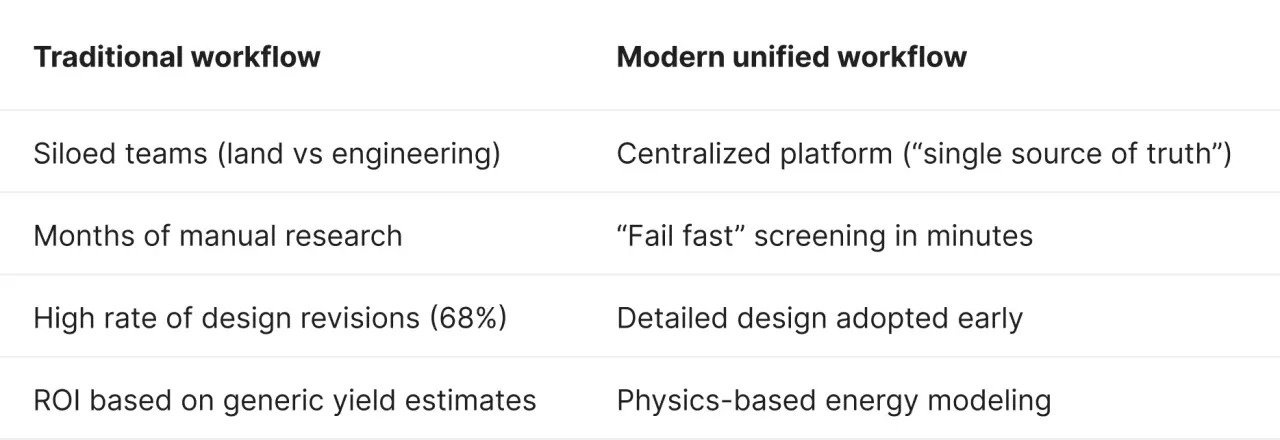
This comparison highlights the operational efficiency gains achieved by transitioning from manual, siloed research to a centralized, "fail fast" digital strategy.
Developer tip
When engaging landowners, use automated custom analysis to provide a clear map of buildable acres versus original lot size. This transparency establishes upfront trust and prevents you from over-committing to leases on land plagued by "slivers"—small, unusable areas between hazards that offer zero energy density.
How to de-risk solar power project development permitting
Timeline progress: 60% | Milestone: Permitting | Focus: System optimization
At this stage, the priority shifts to securing conditional municipal approval. Success requires transitioning from a "black box" submission process to a technically mature "Bid Set" that anticipates and neutralizes public and regulatory objections.
Quick take
Permitting fails when developers rely on reactive "redlining" cycles and fragmented data. To succeed, managers must implement proactive zoning analysis and early-stage 3D modeling, ensuring technical maturity and "investor-ready" documentation before entering the formal approval process.
The traditional workflow
Historically, permitting has been a reactive exercise where developers submit designs based on limited data and wait weeks for regulatory feedback.
Relying on non-specialized tools—such as static PDF zoning maps and disconnected spreadsheets—leaves managers without the resolution needed for confident decision-making. This leads to chronic "redlining," where repeated design revisions erode project timelines and investor trust.
Critical failure points
Solar project software fragmentation: Managing a patchwork of tools for different tasks such as zoning or 3D meshing creates data silos and version control chaos, killing project momentum.
'Opaque' workflows and perception gaps: Without integrated data, managers cannot predict permitting roadblocks or provide the "unusually clear documentation" investors demand.
Teams are currently juggling 7 to 10 different tools per project, which leads to significant rework and stubbornly high project failure rates. [2025 State of Solar Development Report]
The modern development standard
Modern workflows transform permitting into a proactive, data-driven exercise to mitigate permitting risk during site selection, rather than facing regulatory roadblocks, community objections, and technical non-compliance during a formal application.
Early-stage market intelligence & "fail fast" siting
Proactive zoning: Managers can mitigate local regulatory risks by analyzing specific land-use categories—such as "Industrial and Research" or "Mixed Use"—during initial research. Integrating zoning data directly into the site selection workflow allows teams to predict hurdles before they become legal barriers.
Precision Engineering and Integrated Data
To avoid data corruption, repetition of work, and high failure rates, developers must adopt these approaches:
Early-stage technical maturity: Adopting high-fidelity 3D modeling and slope-aware layouts early prevents the redesign cycles that force 50% of projects into significant rework.
Investor readiness: To prove project bankability, developers provide physics-based energy simulations. These models offer the precision needed to satisfy both local regulators and sophisticated financial partners.
Automated compliance: Integrated software ensures that site layouts, electrical designs, and the Bill of Materials (BOM) are consistently aligned. This reduces administrative errors during the permit submission process.
Continuous Risk Monitoring
Permitting risk is not a one-time assessment; it must be monitored throughout the project's lifecycle.
Portfolio visibility: Managers require a real-time overview of the project lifecycle to identify emerging grid congestion or infrastructure delays that could derail permitting.
Stakeholder transparency & engagement: Realistic visualizations and 3D simulations are essential for transparent communication with community members and local authorities to minimize public objections. They also provide the technical backing needed to close deals with investors faster.
Developer tip
Transition from a "black box" submission to a technically mature "Bid Set" by adopting high-fidelity 3D modeling at the 30% milestone. This proactive approach allows you to anticipate municipal objections and satisfy investor demands for "unusually clear documentation" before the formal approval process begins.
Design optimization & project development in the solar industry
Timeline progress: 90% | Milestone: Preconstruction | Focus: Safety & compliance
Managers ensure the design is "frozen" and officially Issued for Permit (IFP). All contractual engineering must align with the permit package to avoid late-stage technical failures.
Quick take
Traditional "flatland thinking" triggers catastrophic cost overruns through excessive grading. Modern developers must adopt slope-aware algorithms and integrated battery energy storage system (BESS) modeling to optimize yield, minimize civil works, and capture high-margin revenue during peak demand.
The traditional workflow
Historically, designers fought the land. Layout tools produced flawed rows that ignored complex terrain, forcing developers to rely on expensive, massive-scale mechanical earthmoving to fit standard module orientations. This "flatland" approach is a primary driver of civil cost overruns and environmental permitting delays.
Critical failure points
General-purpose tools: Using Excel or generic CAD for megawatt-scale layouts leads to "data risk" and project quality degradation.
Version chaos: Iterating through dozens of shading and electrical layouts without a single source of truth leads to a critical lack of solar project version control and costly errors in the design.
60% of the 331 different tools cited by professionals are general-purpose, non-specialized software. [2025 State of Solar Development Report]
The modern development standard
Precision engineering is still the most important factor for success for 96% of professionals. Here’s why:
Terrain Adaptability & Yield Balancing
Slope-aware algorithms: Intelligent algorithms adjust module rows to follow natural contours, preserving grading and preventing erosion—often a strict requirement for environmental compliance.
3D shading optimization: Managers must iterate layouts to find the "sweet spot" where energy density is high but inter-row shading on rolling hills is minimized. Accurate simulations ensure energy predictions are based on design-level realities.
As demonstrated in this case study on ground grading, automating pole length calculations and terrain analysis can lead to an 80% faster design process and a 50% decrease in execution time.
Agile layout iteration
In the modern market, the goal is not simply to maximize total capacity (kWp) but to optimize for actual energy production (kWh). Managers must iterate layouts using 3D modeling to find the "sweet spot" where energy density is high, but inter-row shading on rolling hills is minimized.
Utilizing specialized utility-scale solar design software allows developers to run multiple layout iterations in minutes.
Electrical & Efficiency Algorithms
Automated pathing: Algorithms optimize electrical layouts by finding the shortest possible route through cable trays. This reduces DC voltage drop and total cable length, directly lowering the Balance of System (BoS) costs.
BOM precision: Automated component counting eliminates the 2% estimation errors that can cost €15,000 on a typical 2 MW project.
For a deep dive into these efficiencies, watch our webinar on preliminary design with electrical generation to see how automation alleviates traditional design bottlenecks.
Hybrid optimization: Integrated BESS & storage sizing
In 2026, the reality of utility-scale projects is hybrid. Adding BESS is a core requirement for commercial and financial viability, with its own needs:
Revenue Stack Optimization: Advanced software now dynamically optimizes panel angles and BESS dispatch based on real-time market pricing, allowing operators to turn negative-pricing hours into high-margin storage opportunities.
Integrated Hardware Modeling: Modern design software must simulate the "round-trip" efficiency of a hybrid system, factoring in the electrical compatibility of inverters, DC-to-DC converters, and the specific discharge cycles of battery chemistry.
Coupling Architecture Decisions: One of the most critical early-stage engineering decisions is choosing between AC-coupled and DC-coupled BESS. This choice dictates system efficiency, equipment costs, and scalability:
Curtailment Mitigation: By designing BESS capacity alongside solar layouts, developers can store excess energy during peak sunlight—when grid prices may be negative—and release it during the evening net peak, effectively turning a "wasted" asset into a high-margin one.
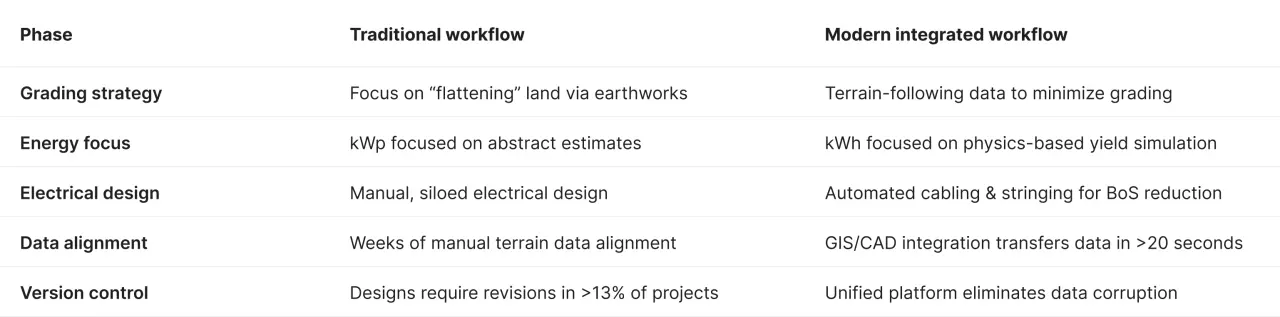
Modern integrated workflows replace costly land alteration with terrain-aware engineering to preserve natural site topography and improve yield accuracy.
Developer tip
Don't size your battery based on a simple percentage of solar nameplate capacity. Use nodal LMP data and historical curtailment trends to find the "economic sweet spot" for storage duration (e.g., 2-hour vs. 4-hour) to ensure the highest possible Internal Rate of Return (IRR) for your tax equity partners.
Project maturation & contractual finalization
Quick take
Contractual alignment fails when technical designs and legal agreements are mismatched. To secure financing, developers must provide design-backed EPC pricing and transparent "Digital Twins" that allow auditors and investors to verify project bankability with absolute certainty.
Between finalizing a high-fidelity 3D design and signing the final financing documents, developers must navigate a high-intensity period of contractual alignment. This step ensures that every technical optimization is mirrored in the legal "value chain" to eliminate the risk of late-stage project failure.
Design-backed Engineering, Procurement & Construction (EPC) execution: In 2026, banks require EPC prices to be "backed by design". Automated BOMs from unified platforms serve as the final procurement list, eliminating the cost overruns associated with manual takeoffs.
Power Purchase Agreement (PPA) yield optimization: Utilizing 3D digital twins to accurately model yield allows developers to fine-tune Power Purchase Agreements. This ensures production forecasts (P50 and P_90) align with buyer guarantees, protecting margins from under-performance penalties.
Independent Engineering (IE) audit acceleration: Developers provide auditors with a transparent digital twin—a 3D replica that allows for the verification of shading, slope tolerances, and yield assumptions in days.
Notice To Proceed (NTP) certainty: Integrated risk monitoring ensures all "Notice to Proceed" conditions—including environmental certificates and utility "Leave to Construct" approvals—are finalized, making the project truly "shovel-ready".

This framework identifies the technical documentation required to bridge the gap between engineering design and financial bankability.
Developer tip
Accelerate your IE audit by providing a transparent "digital twin." This 3D replica allows auditors to verify shading, slope tolerances, and yield assumptions in days rather than weeks, significantly reducing the time to reach financial close.
How are solar projects developed for financial close?
Timeline progress: 100% | Milestone: Construction | Focus: Installation accuracy
Developers oversee technical validation of "as-builts". Ensuring physical construction aligns with the financing simulations maintains performance standards for tax equity partners.
Quick take
Financial close fails when late-stage design shifts invalidate earlier financial models. Success requires "bankable" engineering packages—underpinned by digital twins and automated documentation—to satisfy the rigorous due diligence of lenders and tax equity partners.
Reaching financial close requires moving from a conceptual proposal to a "bankable" engineering package that satisfies the rigorous due diligence of lenders and tax equity partners.
The traditional workflow
Traditional development was inherently reactive. Design shifts late in the development cycle frequently invalidated early financial models, forcing developers to restart the bankability validation process from scratch. This manual, fragmented approach lacked the transparency needed for swift capital deployment.
Critical failure points
Uncontrolled changes: Design shifts during the construction transition without strict oversight can invalidate tax equity agreements.
For 13% of the industry, half of all designs require major rework due to late-stage errors or data mismatches. [2025 State of Solar Development Report]
The modern development standard
To reach a successful financial close in 2026, developers must provide "unusually clear technical documentation" that mitigates the "Pre-construction Valley of Death" risks:
Final validation with digital twins: Modern software creates a virtual replica of the plant, including true layout, terrain, and module configurations. This ensures that the solar energy yield assessment matches the stated EPC price and equipment specifications required by investors.
Automated documentation: Institutional partners require traceable and comparable material quantities. Modern workflows automatically generate the Bill of Materials (BOM) and Single Line Diagrams (SLD) directly from the final layout, eliminating manual entry errors that invalidate bankability validations.
N-1 contingency verification: In 2026, "investor readiness" means proving the site can handle grid stress. Modern tools use critical energy/electric infrastructure information (CEII)-protected data to simulate how a project operates during peak load or grid failures, securing investor trust in long-term performance.
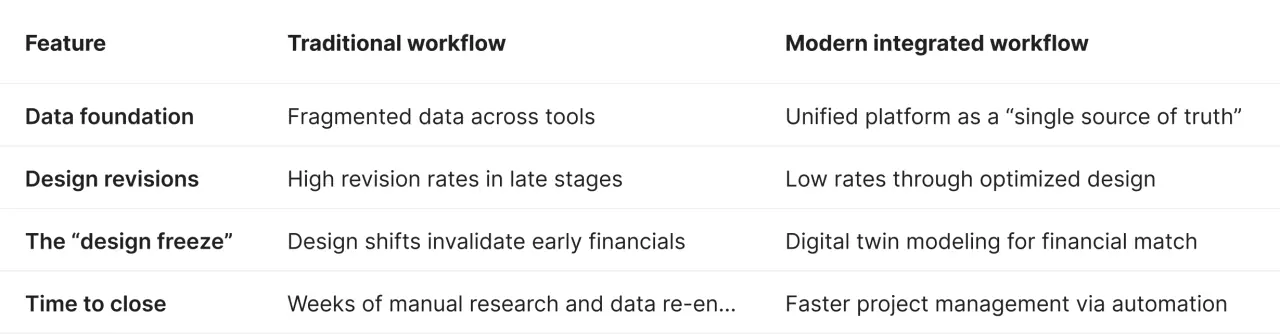
Adopting a "Bankable by Design" approach ensures that early-stage financial models are protected from late-stage design shifts.
The "bankability" checklist: Mandatory documentation for financial close
To reach financial close, the following must be aligned within a "single source of truth":
Executed PPA: Aligned with P50/P90 yield predictions.
Interconnection Agreement (IA): Validated by ISO-aligned power flow studies.
Fixed-Price EPC contract: Backed by automated, design-level BOMs.
IE report: Independent validation of shading, yield, and slope tolerances.
Site control: Verified title/lease documentation integrated with hazard analysis.
Developer tip
Ensure the "design freeze" is absolute by automatically generating your Single Line Diagrams (SLD) and Bill of Materials (BOM) directly from the final layout. This eliminates manual data entry errors that could invalidate bankability validations during the final high-stakes due diligence of tax equity partners.
How to deal with labor shortages in solar power project development
Quick take
Labor shortages have evolved into a systemic risk, with a 2026 shortfall of 53,000 workers in the US alone threatening project bankability. To scale, developers must transition from reactive hiring to "force-multiplier" technology and internal apprenticeship ecosystems to secure critical tax credits.
In 2026, labor availability has become a primary determinant of project success. With installation targets rising worldwide, the industry's workforce is failing to keep pace, creating a bottleneck that risks both national deployment goals and individual project margins.
Impact on the solar project development process
The labor crunch impacts every phase of the development lifecycle, leading to several critical bottlenecks:
The management gap: Recruitment is most difficult for technical and leadership roles, where expertise in high-quality engineering is non-negotiable.
Regulatory compliance risk: Current US mandates require 15% of total labor hours to be performed by qualified apprentices. Failure to meet these thresholds jeopardizes the federal tax credits essential for project economics.
Bankability erosion: Labor instability now joins grid congestion and supply chain volatility as a top-tier risk factor during project finance and due diligence.
Increased project delivery risk: Interconnection and supply chain instability are now joined by labor availability as a primary risk factor in determining project bankability.
Tactics to tackle the labor challenge
To mitigate these shortages, solar developers and EPCs are shifting toward internal workforce cultivation and high-tech efficiency tools.
1. Internalizing the workforce pipeline
Rather than relying on third-party providers, Tier-1 developers are building internal training ecosystems.
Workforce cultivation: Aggressive recruitment of veterans and workers from the fossil fuel sector provides a stream of personnel with transferable technical skills.
Formal apprenticeships: Establishing structured programs ensures teams meet the 15% labor threshold required for full tax credit eligibility.
Portfolio partnerships: Developers and EPCs are sharing labor across multiple projects, reducing "ramp-up" delays and providing regional stability for workers.
2. Deploying "force-multiplier" technology
Automation and digital tools allow smaller teams of expert journey-level workers to oversee larger groups of semi-skilled laborers.
Automated design & site tracking: Utilizing site-tracking software and AI-driven automated design tools allows engineering teams to complete in minutes tasks that traditionally took hours, such as layout optimization and performance simulations.
Drones & remote assessment: Drones are now standard for surveying and mapping, replacing the need for manual, in-person site assessments and reducing labor hours.
Modular systems: The adoption of factory-assembled racking and plug-and-play wiring harnesses reduces the requirement for highly skilled electricians on-site, allowing for faster SNAP-in placement by general laborers.
A solar project developer’s best-practice checklist
Milestone: 10% – Interconnection
Focus: Electrical capacity & nodal viability
Grid-first screening: Validate nodal capacity and thermal constraints via ISO-aligned injection studies before acquiring land.
Economic nodal analysis: Use Locational Marginal Pricing (LMP) and basis risk data to ensure long-term revenue viability at the chosen node.
Milestone: 30% – Preliminary
Focus: Site capacity & financial feasibility
Automated constraint mapping: Identify environmental hazards and filter out unusable "slivers" across thousands of parcels simultaneously.
Transparent landowner engagement: Build trust by providing personalized reports with high-fidelity parcel boundaries and buildable area analysis.
Proactive zoning mitigation: Analyze specific land-use categories early to predict and bypass potential permitting roadblocks.
Unified data environment: Maintain a single source of truth to eliminate data corruption and "version control chaos" across teams.
Milestone: 60% – Permitting
Focus: System optimization & asset bankability
Early detailed design: Adopt high-fidelity 3D modeling and slope-aware layouts early to prevent costly late-stage redesigns.
N-1 contingency simulation: Prove investor readiness by modeling grid stability under peak stress or equipment failure conditions.
Slope-aware optimization: Utilize terrain-following algorithms to minimize expensive earthworks and preserve natural grading.
Physics-based yield modeling: Forecast energy production using 3D digital twins that account for specific terrain shading and albedo.
Hybrid scalability: Integrate BESS charge/discharge modeling early to mitigate curtailment and negative pricing risks.
Milestone: 90% – Preconstruction
Focus: Safety, compliance & design freeze
Contractual alignment: Ensure your automated Bill of Materials (BOM) serves as the technical foundation for fixed-price EPC agreements.
Apprenticeship compliance: Track labor hours meticulously to satisfy the 15% qualified apprentice threshold required for full tax credits.
Automation for efficiency: Deploy AI-driven design tools to multiply technical bandwidth and overcome regional labor shortages
Conclusion: Future-proofing your 2026 portfolio
The transition from "flatland thinking" to a unified, grid-first strategy isn't just a technical upgrade—it’s a financial necessity for project bankability. In a landscape defined by 80% project failure rates and tightening labor markets, the "fail fast" approach ensures capital is only committed to the most viable assets.
To execute this roadmap, developers need more than just general-purpose software; they require a "single source of truth" that bridges the gap between land acquisition and high-fidelity engineering.
By adopting the right tools early, developers and companies like New Leaf Energy are able to cut dev time by 50%: they eliminate design revisions, automate complex compliance tasks, and, ultimately, accelerate the path to financial close.
Ready to transform your development workflow?
Explore the suite of specialized tools designed to handle the complexity of modern utility-scale solar.