
Customer stories
How Schletter made 350 solar projects a year easier to design with PVcase
August 14, 2026


Client
Trinasolar
Location
China / Global
Industry
Renewable Energy Semiconductor Manufacturing
Employees
10,001+
Founded in 1997, Trina Solar Co., Ltd. is a global clean energy company spanning solar PV, energy storage, system solutions, and digital energy services. Its portfolio includes the R&D, manufacturing, and sales of PV modules, a broad range of storage solutions for utility-scale, commercial and industrial, and residential applications, as well as system solutions such as trackers and distributed and centralized generation projects. Trina Solar also provides digital energy services, including O&M, microgrids, solar-plus-storage integration, and grid services such as virtual power plants and electricity trading.
Andrés Salas
Pre-sales engineer EMEA, Trinasolar
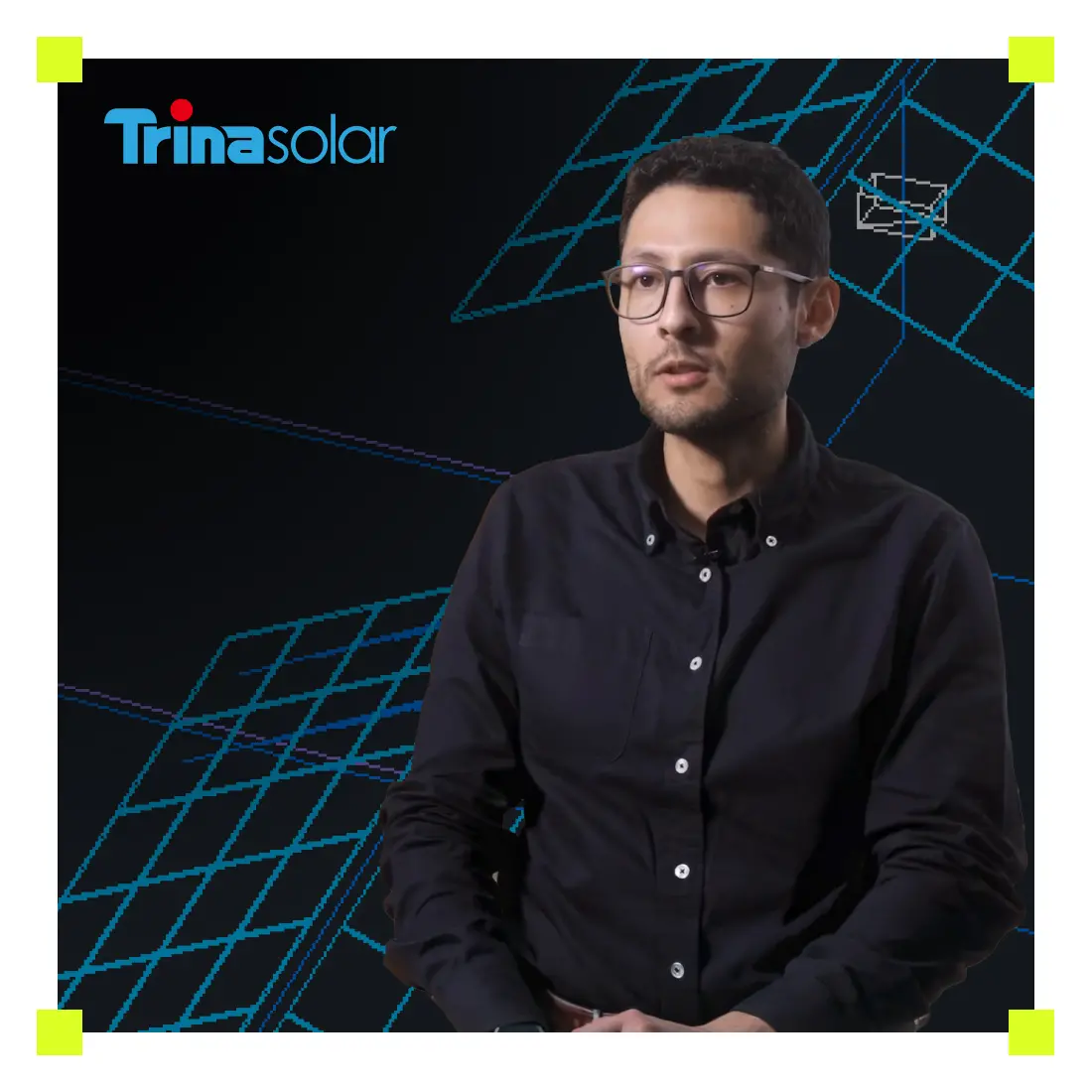
As utility-scale solar projects become more complex, Trinasolar needed a faster, more reliable way to understand how mounting systems would perform across diverse terrain while minimizing redesign later in the project lifecycle.
Every site presents a different combination of slopes, elevation changes, and natural constraints. For Trinasolar, understanding how tracker and fixed-tilt systems would interact with those conditions was critical — not only for engineering accuracy but also for helping customers understand what would actually be built.
The team was looking for a way to visualize projects in three dimensions, assess how structures adapted to natural terrain, and identify where grading or earthworks would be required before projects progressed further.
Terrain-related issues discovered late in development often lead to unnecessary engineering work. Steep slopes, flood-prone areas, or other site restrictions can force layouts to be revisited after significant time has already been invested.
Rather than reacting to these issues later, Trinasolar wanted to identify them while projects were still taking shape, allowing engineers to focus only on layouts that were technically viable.
Using PVcase Ground Mount, Trinasolar validates terrain conditions early, enabling engineers to identify site constraints, compare more design options, and make informed decisions before detailed engineering begins.
Today, Trinasolar uses PVcase Ground Mount to analyze topography while projects are still in development. By combining terrain analysis with slope assessment, collision detection, and earthworks evaluation, engineers gain an early understanding of how mounting structures fit each site. This enables the team to identify unsuitable areas sooner and reduce the likelihood of redesign later in the project lifecycle.
Reducing engineering effort has also given Trinasolar more flexibility during the design process. According to the team, PVcase has reduced solar plant design time by nearly 50%. Instead of producing a single solution, engineers can evaluate multiple alternatives and compare which option best meets both customer requirements and long-term project objectives.
As the business continues to grow, Trinasolar also relies on PVcase Academy to help new engineers become productive more quickly. The combination of focused training and an intuitive interface has shortened the onboarding process, allowing engineers with no previous PVcase experience to begin working on real projects in roughly half the time.
Andrés Salas
Pre-sales engineer EMEA, Trinasolar
For Trinasolar, earlier terrain validation has become not only an engineering exercise but a way to make faster, more informed project decisions.
By identifying site constraints before detailed engineering begins, the team can reduce redesign, evaluate more design alternatives, and give customers a clearer understanding of how their projects will perform in real-world conditions.
Looking ahead, Trinasolar plans to expand its use of PVcase beyond terrain analysis by incorporating advanced capabilities such as electrical design and shading analysis, helping provide an even more comprehensive view of project performance throughout its lifecycle.
By bringing terrain validation into the earliest stages of project development, Trinasolar has reduced solar plant design time by nearly 50%. Rather than spending engineering hours revisiting layouts after site constraints emerge, the team can identify issues sooner and use that time to evaluate multiple design alternatives that better meet customer requirements.
PVcase's intuitive interface, combined with PVcase Academy's focused training, has helped Trinasolar cut onboarding time for new users in half. Engineers with no previous PVcase experience can become productive faster and begin contributing to live projects much sooner, supporting the company's continued growth.
Beyond time savings, Trinasolar has strengthened its ability to make informed engineering decisions from the very beginning of a project. Earlier visibility into slopes, flood-risk areas, collision points, and earthworks requirements helps the team eliminate unsuitable layouts before detailed engineering begins, reducing redesign and providing customers with greater confidence in the proposed solution.
Turn complexity into clarity and confidently move your solar project forward with one powerful PVcase workflow.