Blog
Why team collaboration breaks in solar projects
September 1, 2026
PV Insights


EXECUTIVE SUMMARY:
Solar project software fragmentation forces senior engineers to act as manual data processors between disconnected site selection, CAD, and yield tools, eroding IRR and slowing asset divestment. True bankability requires a unified digital thread to enable "fail-fast" development.
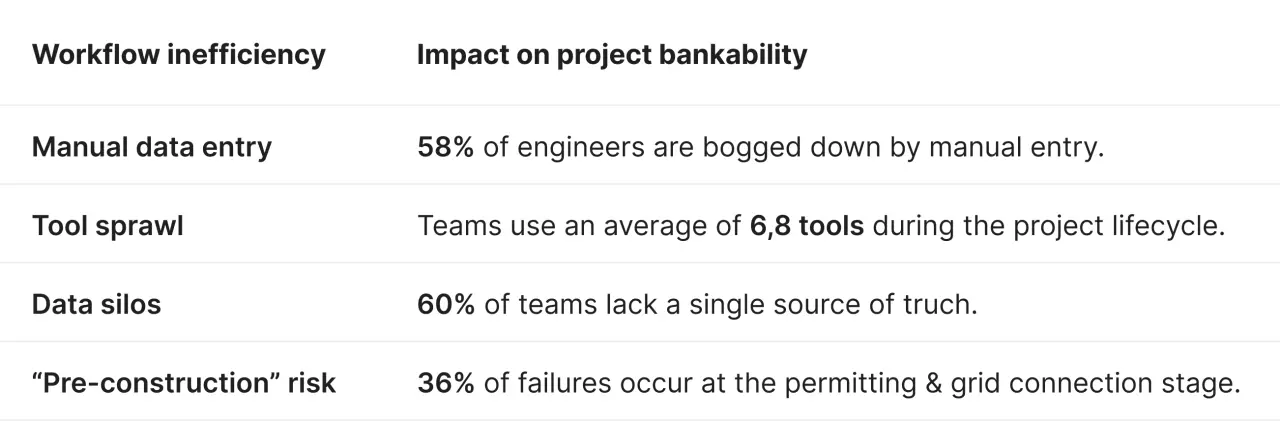
Table 1: The compounding cost of fragmentation: How tool sprawl and data silos directly impact project bankability and engineering efficiency. Source: The state of solar project development report.
In the race for global decarbonization, speed to technical certainty is a key metric of success. Yet, beneath aggressive pipelines lies a systemic friction: solar project software fragmentation.
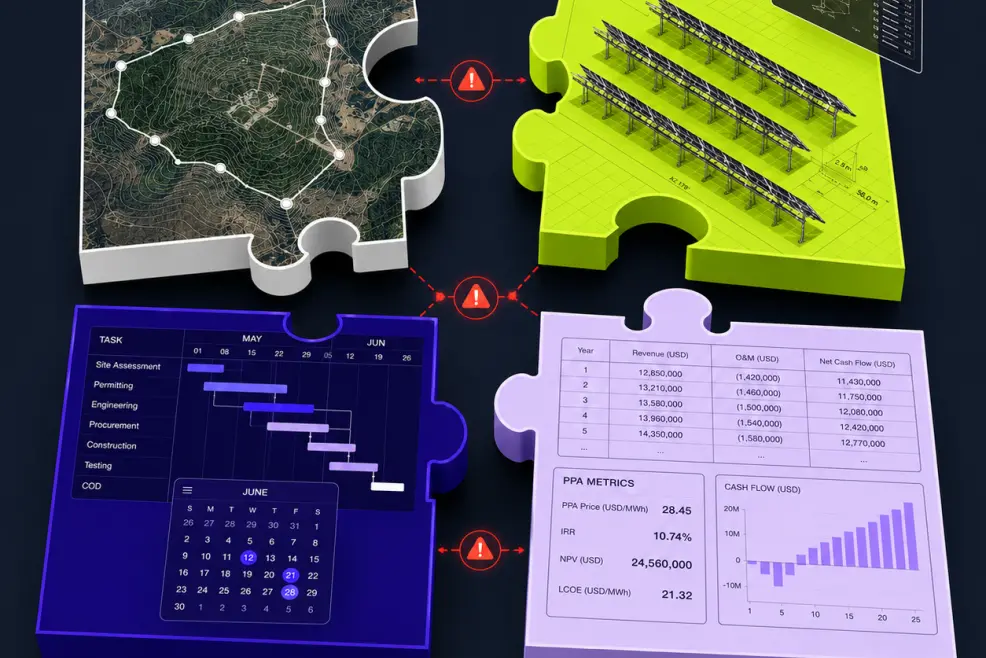
As teams scale, they face siloed technical data across disconnected tools. This lack of a cohesive digital thread introduces multi-million dollar risks, erodes IRR, and creates opaque workflows that blinds developers from live data and can lead to late-stage abandonment.
To maintain bankability, the industry must move beyond individual tool capabilities towards a unified technical ecosystem.
Fragmentation breaks the "digital thread," turning every tool-to-tool handoff into a potential point of failure where data integrity is compromised. Even when using purpose-built software, technical data is often trapped in isolated environments.
For example, a technical design completed in CAD is usually not natively linked to energy yield simulators or financial modeling tools. This is only compounded by the high number of tools on average on each project.
The result is a reliance on manual glue in engineering workflows, where the solar project development process is hindered by the lack of a digital thread failure in solar design.
31% of solar development teams use more than 6 tools per project
QUICK TAKE
Manual data re-entry between desktop CAD and web-based tools causes physical data degradation. These "hard breaks" lead to geospatial misalignment and model decimation, risking multi-million dollar procurement mistakes and late-stage rework.
Typically, a project begins with site assessment data delivered in KML or Shapefile formats. Engineers are then forced to manually reconcile these geographic layers within AutoCAD, a transition from land acquisition data to design that creates an immediate risk of geospatial misalignment. This initial "hard break" in the digital thread often results in uncontrolled solar project version changes before a single panel is even placed.
The misalignment is only worsened when transitioning designs to yield tools. Engineers drafting high-fidelity layouts in desktop CAD — such as PVcase Ground Mount — are frequently forced to manually re-enter critical parameters like pitch, clearance, and tracker types into web-based tools or PVSyst. When technical parameters are "transcribed" rather than synced, the project moves from engineering-grade reality into a zone of high-stakes speculation.
Manual "bridge work" between specialized tools creates a high probability of technical errors that compromise project bankability. When designers are forced to export data between these silos (e.g., CAD to energy yield data fidelity gaps), the project suffers from physical data degradation:
Forced model decimation: Reducing technical fidelity to fit external software limits.
Orientation mismatches: 3D layout breakdowns during data loss CAD to PVSyst transfer.
Geospatial misalignment: Risking automated solar BOM generation errors.
Software crashes: Caused by incompatible 3D data formats.
These workflow issues force engineers into the role of manual data processors, heightening the risk of human errors worth millions of dollars.
55% of solar professionals cite software compatibility issues as a primary point where they get bogged down.
[The 2025 state of solar project development]
QUICK TAKE
Fragmented workflows force expensive technical assets to perform clerical tasks like manual Excel exports. This "talent drain" inflates soft costs, reduces project IRR, and drives significant engineer burnout across the industry.
At many firms, highly paid engineers spend hours manually extracting attributes from CAD into Excel spreadsheets. This is done simply to compare 10 to 20 different layout iterations for non-technical stakeholders who cannot access the primary design files.
Furthermore, because teams often lack a company-managed database for PAN and OND files, designers must repeatedly enter solar panel models and specifications for every single project.
On top of that, teams often rely on a process where engineers export PDFs, mark them up in basic image editors, and email them back and forth. This forces senior leads to spend technical hours deciphering vague instructions.
These manual workarounds are not limited to fragmented software stacks. They also emerge when general-purpose software is used for specialized solar workflows, forcing engineers to supply the project context that the underlying tools cannot understand.
63% of solar professionals are bogged down by bottlenecks in their workflows.
[The 2025 state of solar project development]
The use of senior technical talent for manual tasks significantly inflates the hidden soft costs in utility-scale solar projects, directly reducing the internal rate of return (IRR). Engineering firms effectively pay premium salaries for work that adds no design value.
Additionally, when technical leads spend hours as manual data processors for component specifications, they cannot focus on higher-level optimization. This creates a linear process that cannot scale, as discussed in the recent Watt Matters podcast episode on the state of solar development.
The burden of these fragmented workflows is also a primary driver of solar engineer burnout. The resulting frustration and mental fatigue of bridging technical gaps through repetitive data entry and "clerical" engineering lead to high turnover rates and a significant loss of institutional knowledge — which further destabilizes project timelines.
QUICK TAKE
Relying on static SharePoint data rooms prevents "fail-fast" decision-making. Slow due diligence and opaque design histories lead to strategic paralysis, delaying divestment and leaving developers vulnerable to 2026 market volatility.
The combined weight of data risk and labor inefficiency prevents developers from making rapid, informed decisions. Without integrated tools, teams screen sites using static, outdated maps rather than real-time simulations.
For example: Greenfield developers selling "ready-to-build" projects often rely on static SharePoint VDRs. These non-interactive environments prevent potential buyers from conducting thorough due diligence quickly, slowing down the divestment process.
When design history is opaque, developers cannot pivot. This leads to the "rework trap" in solar workflows where projects require massive revisions because the technical "truth" was not synced across documentation.
This lack of a unified digital thread also creates a significant competitive disadvantage. While the current market demands agile site verification, fragmented data rooms keep teams stuck in weeks of manual evaluation.
This inefficiency is compounded by misaligned priorities; a lack of alignment on project goals — often exacerbated by fragmented communication — bogs down the overall development workflow.
24% of projects fail at the feasibility stage, often because technical or financial risks were not visible during initial site selection.
[The 2025 state of solar project development]
For greenfield developers, fragmented data delivery directly hinders the ability to successfully sell assets.
Due diligence bottlenecks: Buyers struggle with static, non-interactive project files.
Extended timelines: Revenue realization is delayed by weeks of manual verification.
Market volatility: Slow teams lose their first-mover advantage to more agile, integrated
QUICK TAKE
Eliminate "manual glue" by adopting a unified digital thread. Prioritize tools with native CAD-to-yield integration, automated interconnection screening, and live data environments to ensure technical fidelity and enable rapid, "fail-fast" project iteration.
To transition from identifying these systemic risks to mitigating them, teams must implement a technical strategy that replaces manual coordination with a unified, high-fidelity digital infrastructure.
Fragmentation often starts with data scattered across local drives, emails, and isolated cloud folders . A unified environment ensures that technical and commercial teams operate from a single "version of the truth".
Centralize technical assets: Move to a platform that handles live technical data, preventing "sync conflicts" and broken external references (xrefs).
Democratize visibility: Use tools that allow non-technical managers to view live 3D designs.
Standardize documentation: Implement a centralized changelog to preserve the "basis of design."
The goal is to reclaim the high-value time of senior engineers.
Automate layout comparison: Replace manual Excel extraction with automated dashboards for side-by-side iteration analysis.
Digitalize review loops: Move away from the "PDF wall" toward interactive redlining pinned to live coordinates.
Standardize component databases: utilize a company-wide, vetted database for hardware specifications (PAN/OND files).
True efficiency is found when technical parameters flow natively between specialized tools.
Link design and yield modeling: utilize software that allows CAD design parameters (pitch, clearance, orientation) to flow directly into yield simulators.
Sync design and finance: Integrate BOM generation so a layout change instantly updates the financial model.
Preserve technical fidelity: Ensure data transfers do not require model decimation.
See how Goldbeck Solar reallocated 30% of engineering time to value-added tasks with an integrated platform.
Grid-first screening: Use automated interconnection analysis during site selection to disqualify high-cost nodes.
High-resolution terrain analysis: Identify slopes and hazards for hundreds of parcels at once.
Rapid iterative due diligence: reach a definitive "no" on unviable projects in 20 minutes rather than six months.
Follow our proven guide to streamlining solar projects with early-stage software to find out more.
The industry is reaching a tipping point. The "manual glue" that held projects together during the early solar boom is now the primary friction point preventing the scale required for the energy transition.
Firms that continue to absorb the "fragmentation tax" of manual data reconciliation will find their margins squeezed beyond viability by more agile competitors who have already automated away these soft costs.
To thrive in this scenario, developers need more than just better tools; they need a way to thread them together into a unified solar engineering workflow.
97% of solar engineers say they would be interested in an end-to-end platform that helps the solar industry optimize the project development process every step of the way.
[The 2025 state of solar project development]
Learn how solar teams reduce risk and accelerate project development using a single, end-to-end PVcase platform.