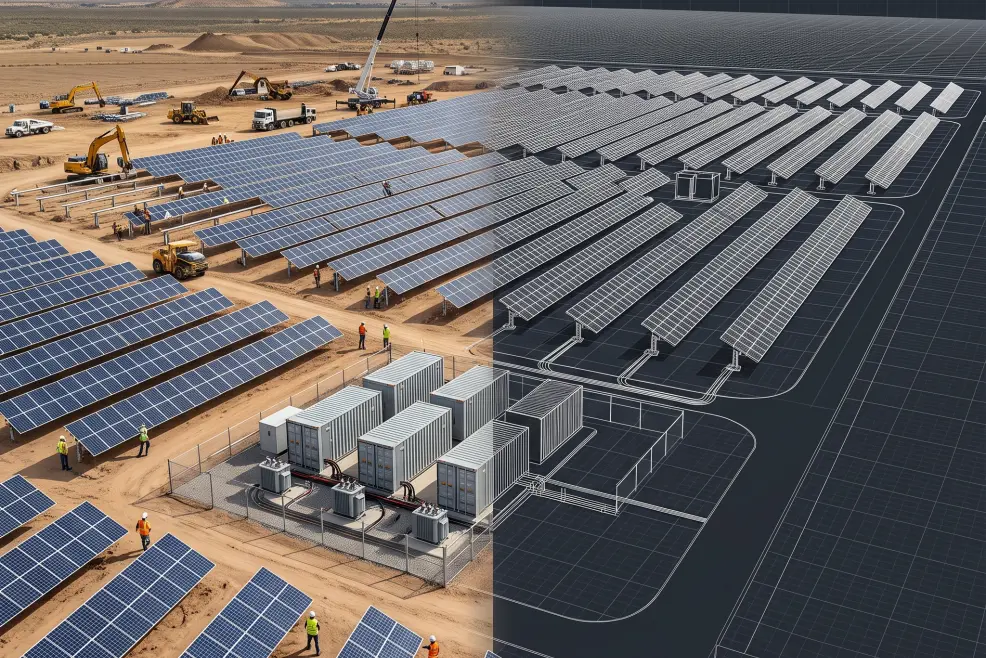
Lower upfront fees often mask a "rework tax," as limited technical depth leading to high redesign rates can erode a project's Net Present Value (NPV). High-quality engineering software pays for itself by eliminating the data friction and manual workarounds common in fragmented, budget-friendly workflows.
Virto CAD vs PVcase Ground Mount: a technical comparison


Max HailerContent project manager
April 10, 2026
PVcase Products
Executive summary
When evaluating Virto CAD vs PVcase Ground Mount, the distinction lies in engineering depth and utility-scale solar readiness. While Virto offers a multi-purpose CAD bundle, PVcase delivers the advanced civil analysis, BESS integration, and terrain fidelity required to eliminate the "rework tax" inherent in complex utility projects.
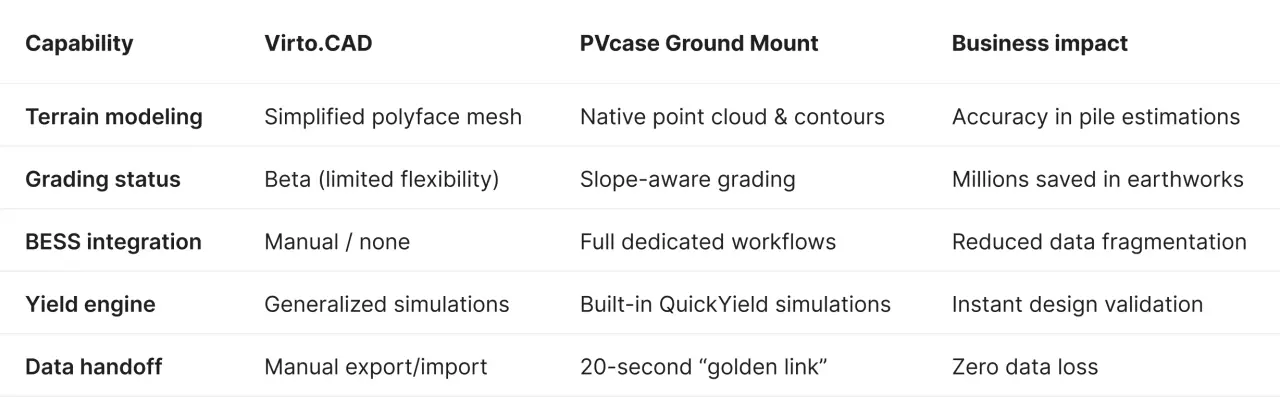
The difference between Virto CAD and PVcase at a glance
Table of contents
- Why low-cost solar software means higher project soft costs
- Ensuring construction accuracy with 1:1 terrain fidelity
- Maximizing CAPEX via variable table heights and “construction-ready” piling
- Optimizing LCOE through is range-based project iteration
- The need for native BESS design integration
- Eliminating “indicative guesswork” with built-in QuickYield simulations
- Ensuring the "golden link" between GIS and CAD
- High-performance UX as a strategic asset for engineering teams
- When to choose Virto CAD vs. PVcase Ground Mount
- Why unrestricted scalability wins
Why low-cost solar software means higher project soft costs
Quick take
Lower upfront licensing fees often mask a "rework tax" that erodes project NPV. High-quality engineering software pays for itself by eliminating the 25% redesign rate common in fragmented workflows.
Budget-friendly tools like VirtoCAD often lead with compelling price points. By operating on BricsCAD, they allow firms to bypass expensive AutoCAD subscriptions.
However, for the veteran project manager, this choice is a risk assessment.
The Virto.CAD gap
While VirtoCAD provides the flexibility to handle both C&I and utility-scale projects in one tool, the "savings" are often offset by systemic inefficiencies:
Rework tax: A lack of technical depth creates a fragmented solar workflow with manual workarounds and data friction that erodes project margins.
Support limitations: More limited support resources and help centers can halt production for days during critical project windows.
Performance ceilings: The software often bogs down on large drawings due to heavy CAD object generation, leading to lag and slower response times.
Tiered paywalls: Accessing the full range of utility-scale functionalities requires upgrading to expensive higher-tier packages, which can exceed €4,000 per year.
PVcase strengths
According to our 2025 State of Solar Project Development Report, 52% of solar professionals report that over 25% of designs require significant revisions. PVcase is engineered to solve this lack of efficiency.
Elite support: Global native-speaking experts provide 5-minute response times to keep engineering pipelines moving.
Operational fluidity: Superior memory management ensures a fluid experience even when handling massive utility-scale files.
PRO TIP
Audit your project history from the last 12 months: how many billable hours were lost to manual redesigns or "forced, expensive version upgrades" to unlock capacity?
Ensuring construction accuracy with 1:1 terrain fidelity
Quick take
Forcing high-resolution survey data into simplified polyface meshes degrades design precision. PVcase maintains 1:1 data integrity to ensure your digital twin matches the physical site.
Professional-grade engineering surveys arrive as complex, high-fidelity datasets. Forcing this granular data into a simplified polyface mesh environment for layout purposes introduces immediate geometric inaccuracies. These errors ripple through the entire design process, leading to incorrect pile height estimations and significant grading miscalculations.
The Virto.CAD gap
Virto's reliance on simplified topographical modeling creates a significant bottleneck for utility-scale accuracy:
Data degradation: Virto mainly relies on polyface meshes, which are less friendly to common survey formats like point clouds or contour lines.
Accuracy bottlenecks: By relying heavily on satellite data via integrations like PlexEarth, the tool often lacks the resolution required to capture localized terrain variations accurately.
PVcase strengths
PVcase utilizes advanced 3D topographical modeling to generate terrain-following layouts. This level of utility-scale constructability ensures designs mirror natural land contours precisely without "forced flattening" in CAD.
1:1 terrain fidelity: Engineers can work directly with native high-fidelity survey data, ensuring the digital twin mirrors the physical site without data loss.
Construction-ready layouts: The ability to generate true terrain-following layouts leads to accurate pole length calculations that match real-world conditions.
Learn more how topographical integrity enables great designs on good sites.
PRO TIP
Check your topographical data workflow: is your survey data being "dumbed down" into a mesh? If your tool cannot natively process point clouds or contour lines, you are introducing pile height errors before you even place a module.
Maximizing CAPEX via variable table heights and “construction-ready” piling
Quick take
Utility-scale civil design must move beyond surface slopes. By treating table height as a variable variable, engineers can "engineer out" earthworks while automating pile lengths—slashing execution time by 50% and eliminating manual fieldwork.
Traditional solar design often relies on "flat-land" thinking, forcing fixed table heights onto complex terrain. This approach triggers massive, unnecessary earthworks or forces engineers to abandon profitable "diamonds in the rough" land. True construction ready ground mount design involves producing a digital twin so accurate that manual on-site adjustments are virtually eliminated.
The Virto.CAD gap
While VirtoCAD advertises civil tools, its current capabilities focus almost exclusively on surface table slopes rather than the ground itself.
Unstable civil tools: At the time of research, Virto’s ground grading feature was in a beta stage and failed to work during professional testing.
Limited terrain analysis: The tool does not provide true terrain analysis beyond handling table slopes, leaving a significant gap in site evaluation.
Fixed height constraints: Virto lacks the specialized optimization to adjust table heights to reduce grading, forcing a more reactive civil approach.
PVcase strengths
PVcase Ground Mount provides a production-ready civil toolkit designed to follow land contours rather than flattening them.
Optimized table placement: PVcase uniquely optimizes table placement height specifically to reduce required ground grading.
Automated pile calculations: Height optimization feeds directly into automated pole length calculations based on high-fidelity 3D meshes.
Learn how precision engineering translates to ROI in our case study on ground grading.
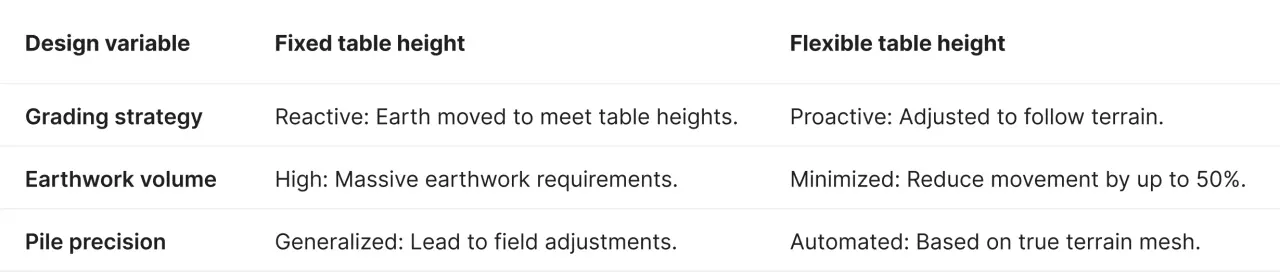
Earthwork volume vs. flexibility.
PRO TIP
Audit your most recent site construction report: what percentage of project delays were caused by manual pile height adjustments or unforeseen slope issues?
Optimizing LCOE through is range-based project iteration
Quick take
Settlement is the enemy of yield. Utility-scale developers must test multiple orientations and Ground Coverage Ratios (GCRs) to find the "sweet spot" where total capacity and energy yield are maximized without ballooning construction costs.
Finding the optimal Levelized Cost of Energy (LCOE) requires testing a spectrum of design variables. Minor adjustments in table placement or shading allowances can significantly swing a project's financial viability, yet most legacy workflows treat these as static decisions rather than a range of possibilities.
The Virto.CAD gap
Virto’s current architecture limits the engineer's ability to perform rapid sensitivity analysis during the critical early design phases.
Static design limitations: Virto does not offer a "sweep" type of analysis, forcing engineers to rely on a single best-guess design.
Missing the "sweet spot": The time-consuming nature of manual iteration often results in teams settling for a "good enough" layout rather than one optimized for maximum yield.
Increased technical debt: Settling for sub-optimal layouts can lead to perceived underperformance once the site is operational.
PVcase strengths
Our solar farm design software transforms layout design from a manual chore into a strategic exploration of site potential.
Instant sensitivity analysis: The capacity iteration tool allows engineers to navigate a range of design options instantly, rapidly comparing multiple layouts against specific terrain.
Yield-optimized capacity: Engineers can utilize unique optimizations, such as permitting a controlled percentage of shading, to aggressively increase total site capacity.
Faster decision cycles: Reducing analysis time from days to minutes empowers teams to meet tight cluster submission windows with stronger applications.
Learn how to master these workflows in our webinar on PVcase Ground Mount’s capacity iteration.
PRO TIP
Are your engineers manually rebuilding layouts one-by-one to test different GCRs or tilt angles? If your software forces you to restart from scratch for every minor variation, your team is likely settling for the first "viable" design they find rather than the most profitable one.
The need for native BESS design integration
Quick take
Battery energy storage systems (BESS) are no longer "bolt-on" features; they are fundamental to grid viability. Integrated design ensures that site grading, cable management, and Single Line Diagrams (SLDs) account for the rigorous technical requirements of high-capacity storage from day one.
Designing solar and storage in silos creates a "blind spot" in your project's financial and physical modeling, often leading to costly manual workarounds or unbuildable layouts during the construction phase.
The Virto.CAD gap
VirtoCAD’s current architecture lacks the dedicated infrastructure required for modern hybrid solar plants.
Missing scope: Virto currently offers no dedicated tools for BESS-specific cable runs, SLDs, or grading.
Underestimated civil costs: Without BESS-specific grading features, developers cannot accurately estimate the earthworks required for battery pads.
Simplified electrical modeling: Relying on basic Y-connectors rather than customizable harness systems limits the ability to optimize DC collection.
PVcase strengths
PVcase Ground Mount treats storage as a primary design element, providing the granular control required for utility-grade compliance.
Unified civil & electrical design: Ground Mount provides dedicated BESS workflows, including specialized grading and cable runs.
Advanced harness customization: PVcase offers deeper customizability for harness electrical systems, covering a broad range of manufacturer-specific configurations.
Accelerated permitting: Automating SLD generation ensures documentation is ready for investor due diligence or regulatory review.
Optimized space utilization: By integrating storage from the outset, developers can better navigate setbacks and hazards, maximizing the buildable area and revenue potential.
PRO TIP
Are your engineers manually calculating BESS cable runs? A tool that lacks specialized storage workflows and utility-grade labeling automation introduces massive technical risk during the permitting phase.
Eliminating “indicative guesswork” with built-in QuickYield simulations
Quick take
While generalist tools rely on static averages or external exports to measure each design’s energy yield, PVcase Ground Mount features QuickYield—a built-in simulation engine that provides high-fidelity energy estimates directly within your CAD workflow to validate site viability instantly.
In utility-scale development, waiting weeks for a third-party yield report to find out a layout is sub-optimal is a risk most project managers can no longer afford. Integrated simulations allow you to iterate ground-coverage ratios (GCR) and orientations while seeing the immediate impact on production and project bankability.
The Virto.CAD gap
Virto’s current architecture creates a simulation bottleneck by lacking integrated, high-fidelity yield tools:
Workflow disruption: Engineers must often export data to external, third-party software for energy modeling, increasing the risk of data loss and slowing down decision cycles.
Static assumptions: Without a built-in engine, "good enough" layouts are often designed using generalized averages that fail to capture localized irradiance patterns on complex slopes.
Indicative risk: Relying on basic indicative energy estimates leads to a significant "uncertainty gap," often resulting in multi-million dollar redesigns once professional modeling is eventually performed.
PVcase strengths
PVcase Ground Mount utilizes QuickYield to bridge the gap between design and performance estimation:
Integrated decision support: Perform production simulations directly on your 3D terrain mesh to validate energy potential before moving to detailed engineering.
High-fidelity terrain awareness: Unlike generalist tools, QuickYield accounts for your specific layout geometry and terrain contours to provide accurate shading and yield feedback.
Bankable iteration: Rapidly compare multiple layout scenarios to find the "sweet spot" where total capacity and energy yield are maximized without increasing site CAPEX.
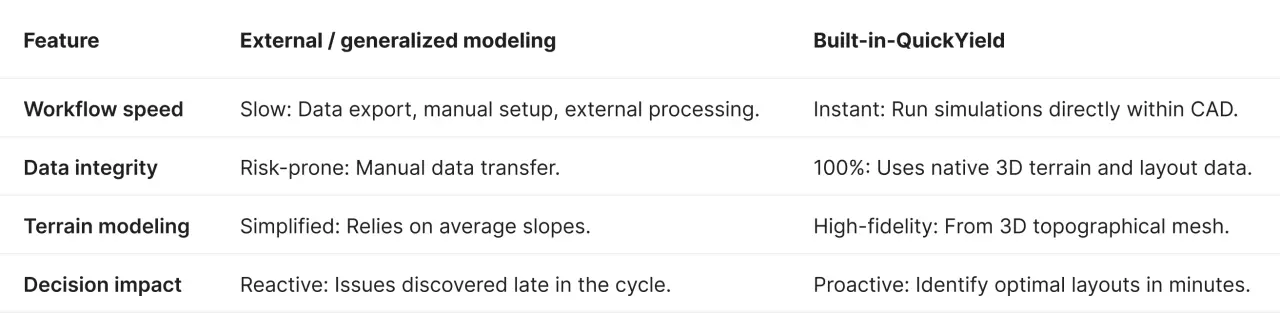
Energy yield modeling comparative.
PRO TIP
Is your energy forecast based on a series of generalized averages? If your yield engine cannot model localized irradiance patterns and 3D shading in high-definition, your production estimates are essentially educated guesses.
Ensuring the "golden link" between GIS and CAD
Quick take
A "golden link" provides a direct, automated vertical integration that preserves high-fidelity site data between GIS and CAD environments. This connection serves as the primary defense against manual entry errors that can compromise project CAPEX.
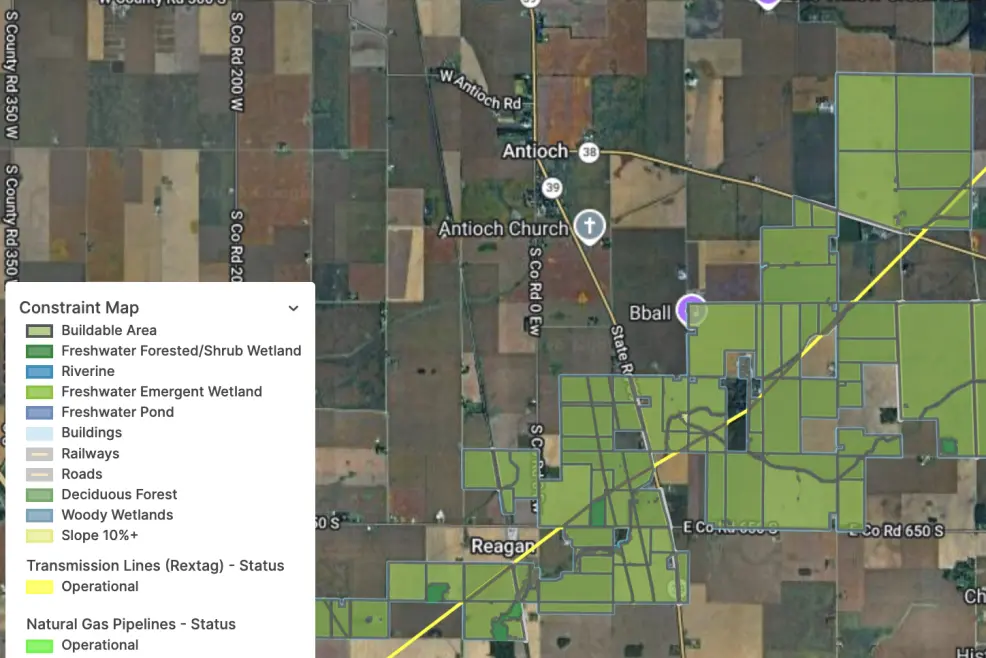
Topography, parcel boundaries, and environmental constraints must be securely transferred from site selection to engineering without manual intervention. Without this vertical integration, utility-scale projects face significant "data risk," where inconsistencies introduced during manual movement degrade the entire project lifecycle.
The Virto gap
Virto’s workflow relies on an integrated but less direct handoff, which can introduce friction and potential technical risks:
High data risk: Manually moving information between disconnected tools increases the likelihood of errors and inaccuracies.
Degraded precision: The lack of a seamless handoff can lead to the loss of critical details, such as subtle topographical variations.
Fragmented accountability: Siloed tools often force teams to work in isolation, creating misalignments during financing or permitting.
PVcase strengths
PVcase utilizes a robust vertical integration that allows for a seamless transition from site selection to detailed engineering.
20-second data handoff: Engineers can move critical data from the site selection phase into the CAD environment in seconds.
Preservation of data integrity: Automated integration eliminates manual data entry, ensuring accuracy throughout the transition.
Immediate terrain-based design: Because topography and geolocation are perfectly preserved, engineers can move instantly into advanced terrain-following layouts.
Learn how to secure your project lifecycle in our webinar on understanding and eliminating data risk.
PRO TIP
Time your current workflow: how long does it take to move site selection GIS data into your CAD environment with 100% data integrity?
High-performance UX as a strategic asset for engineering teams
Quick take
Budget software often imposes a "clunky" tax on your team, where poor CAD memory management leads to engineering burnout and operational delays. A fluid, utility-scale UX acts as a force multiplier, keeping teams in a "flow state" even when handling massive 100MW+ projects.
The efficiency with which a CAD solar solution handles the thousands of individual components of a utility-scale project determines your "scalability ceiling"—the point at which the software either empowers the engineer or becomes an obstacle to progress.
The Virto gap
VirtoCAD’s architecture often struggles under the weight of large-scale utility project requirements, impacting both technical performance and user experience:
The "lag" factor: Users often experience a less fluid performance compared to PVcase, with frequent lag during standard operations.
Memory saturation: The software generates dense row numbering and highly defined modules that saturate CAD memory.
System bottlenecks: Heavy objects remain in memory even when visualization is reduced, frequently causing the software to "bog down".
Inconsistent interface: The user interface is limited and less intuitive, featuring structural inconsistencies across windows and a lack of helpful visualizations to present project changes clearly.
PVcase strengths
PVcase Ground Mount is engineered with a significantly higher ceiling for memory management, designed specifically for the rigors of day-to-day utility-scale usage.
Operational fluidity: By using a "lighter" UX and optimized object generation, PVcase handles massive utility-scale files effortlessly.
Engineering "flow state": A software interface that minimizes technical friction allows engineers to maintain focus on design rather than fighting the tool.
Rapid competency: The intuitive design allows new users to become productive in just two weeks.
See how users compare the two platforms on G2 to understand the real-world impact of UX on productivity.
PRO TIP
How much time does your team lose to AutoCAD lag or "application freezing" during layout regeneration? If your engineers are waiting for the software to catch up with their design changes, you are suffering from a productivity drain that scales with the size of your project.
When to choose Virto CAD vs. PVcase Ground Mount
Quick take
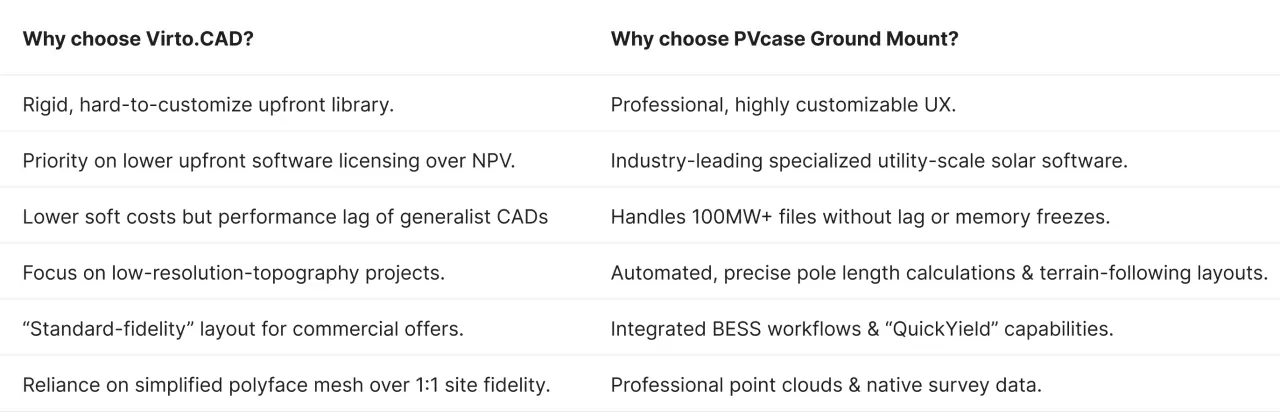
Choose Virto.CAD for preliminary, budget-conscious layouts on low-resolution terrain where upfront license costs outweigh long-term precision.
Select PVcase Ground Mount for high-fidelity, 100MW+ utility-scale engineering, professional survey integration, and integrated BESS workflows that maximize project NPV and construction readiness.
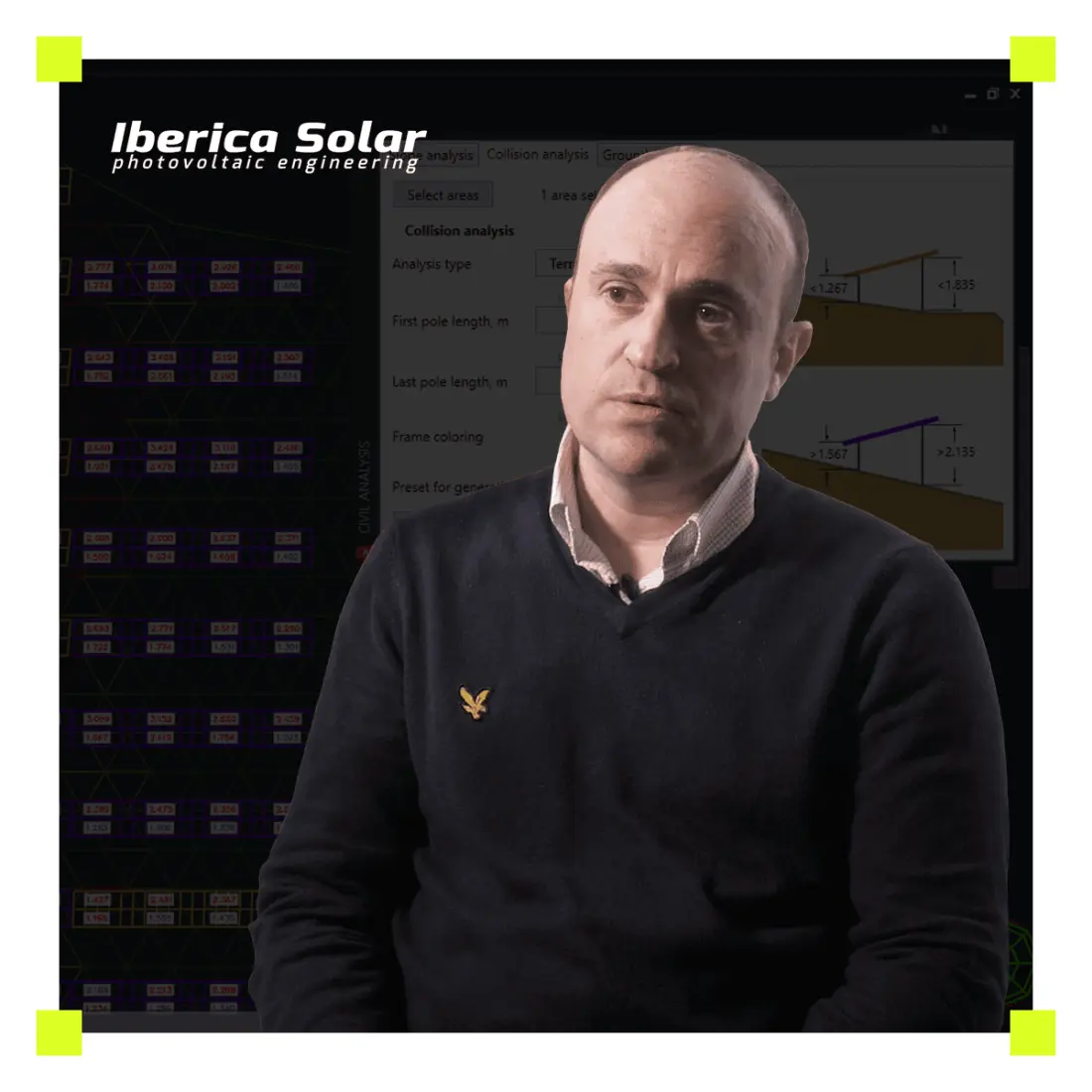
”While the difference for small plants may be smaller compared to manual methods, for very large plants, PVcase is indispensable.”
David Velasco
Industrial Engineer
Why unrestricted scalability wins
Many solar tools utilize tiered paywalls. You pay for the license, then pay again to unlock the "Advanced" project size or "Enterprise" C&I features. PVcase provides full power right out of the box, ensuring that as your portfolio grows, your software overhead remains predictable and your engineering remains uninterrupted.
Read how New Leaf Energy leveraged unrestricted scalability to streamline their development pipeline.
See it for yourself
Discover why PVcase has become an industry standard through automation and scalability.