Blog
Virto CAD vs. PVcase Ground Mount: a technical comparison
April 10, 2026
PVcase Products

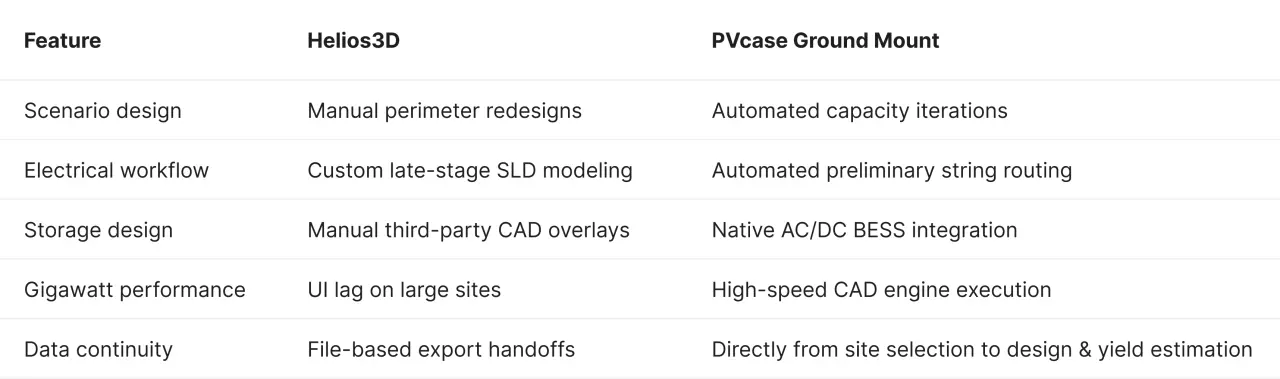
Utility-scale solar project development lives in a volatile environment: grid queues, land availability, and market conditions can change at any time.
It starts with the site selection: commercial agility and competitive speed are critical because site viability is a moving target. Developers need to generate, evaluate, and modify layouts quickly to be able lock down site control and queue positions ahead of competitors while minimizing wasted pre-construction capital.
However, this speed usually comes at the cost of data corruption. When engineering teams need to re-enter data across different, fragmented software throughout the solar project, transfer errors inevitably occur. In turn, these lead to late-stage redesign cycles, which threaten to delay Notice to Proceed (NTP), and erode profit margins.
Thus, the key aspect to look for when comparing solar farm design software is a balance of speed, agility, and de-risked development — ensuring teams can adapt to shifting constraints quickly while mitigating project failure before capital is committed.
QUICK TAKE
Helios 3D requires manual perimeter redrafts, while PVcase Ground Mount automates scenario testing to accelerate site design optimization and financial feasibility.
Helios 3D’s core strength lies in its terrain-driven approach. By using TIN surface-based mapping, it places PV arrays with exact geographic fidelity, ensuring table geometry aligns directly with actual site topography. For civil designers working on complex terrain, this structural accuracy makes it easier to spot slope thresholds and constructability risks early, before redesigns get expensive.
But this topographic precision comes with a catch: it is built on static geometry. Running rapid trade-off analyses — adjusting target MW, ground coverage ratios, or panel density — requires designers to manually redraw array boundaries and re-execute placement rules across individual sub-areas, creating three bottlenecks:
Manual perimeter reconfiguration: Rebuilding layout boundaries by hand for every capacity scenario stalls early-stage feasibility workflows.
Segmented placement overhead: Applying table parameters sub-area by sub-area creates unnecessary engineering backlogs.
Slow scenario testing: Labor-intensive manual setups limit the number of design variations a team can evaluate within tight land option agreement windows.
PVcase Ground Mount’s features enable a proactive, value-engineering process, by allowing engineering teams to evaluate structural density, DC/AC ratios, equipment selection, and preliminary production metrics without redrafting the site model in CAD.
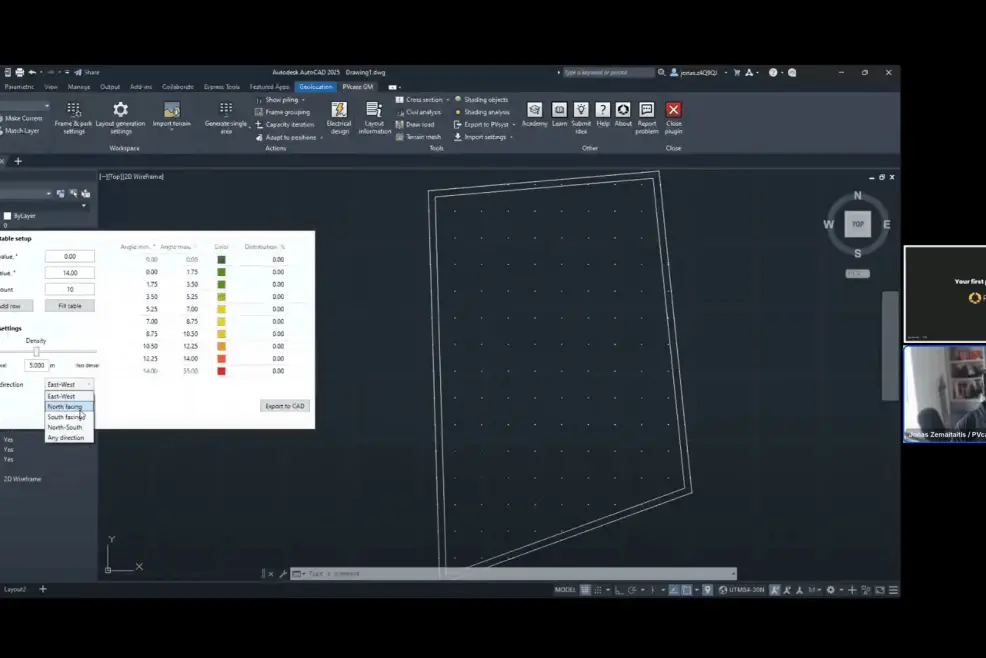
Automated scenario generation: Designers specify target MW thresholds, spatial density targets, or module configurations, allowing the system to generate optimized layout variations automatically.
Side-by-side capacity comparison: Engineering teams can evaluate density, equipment selection, and capacity trade-offs in minutes rather than days.
Faster design convergence: Automating layout variations allows development teams to lock in optimal land use and capacity targets faster, eliminating manual drafting rework.
Ultimately, this accelerates design convergence. It eliminates manual drafting rework, optimizes land-use efficiency, and gives developers immediate visibility into project financial viability before committing capital to detailed engineering or formal interconnection filings.
To see how this works in practice, watch our webinar on automated PVcase Ground Mount Capacity Iteration.
PRO TIP
How many hours does your team take to adjust a full layout when a landowner reduces your buildable area boundary? If a single revision consumes several days, your workflow might be delaying procurement, stalling permitting, and eroding project margins.
QUICK TAKE
Helios 3D offers detailed late-stage SLD control, whereas PVcase automates preliminary string routing to eliminate early engineering drafting bottlenecks almost entirely.
A robust automated preliminary electrical workflow speeds up early feasibility, allows faster iterations, and helps standardize outputs across designers.
Helios3D handles string inverter routing natively — including multiple MPPT tracker support and input balancing — and generates a configurable single-line diagram (SLD) through a structured electrical tree. This gives senior electrical engineers the precise drafting control they need during late-stage detailed design.
The trade-off is efficiency. Forcing manual electrical mapping into early-stage site screening creates an immediate bottleneck. Teams end up wasting time stringing blocks, placing equipment, and mapping inverter inputs before basic site viability is even confirmed.
Drafting dependencies: Manual string mapping during early layout phases creates a bottleneck that delays preliminary electrical feasibility reviews.
Inconsistent outputs: Standardizing electrical drafting outputs across multiple designers or offices becomes difficult when routing is executed manually.
Slower BOS estimation: Manual string mapping delays initial balance-of-system (BOS) cost checks, exposing project budgets to late-stage cost revisions.
PVcase Ground Mount elevates preliminary electrical design into an automated, bankable engineering checkpoint:
Automated string routing: Automatically places components, routing strings, and calculating DC runs directly from layout geometry.
Standardized deliverables: Automated workflows standardize electrical design outputs across design teams, maintaining quality control as engineering operations scale.
Rapid feasibility checks: Automating preliminary stringing speeds up early feasibility evaluations, allowing teams to pass clean electrical assumptions directly into preliminary yield simulations.
This translates into less hours of manual CAD drafting, optimized DC cable quantities and minimized voltage drop risks.
Furthermore, rapid feasibility checks indirectly accelerate pre-construction timelines, prevent expensive downstream redesigns, and ensure financial models reflect physical site reality.
Check out our on-demand webinar on preliminary electrical generation to discover how automated stringing workflows eliminate drafting backlogs and keep preliminary production models aligned with physical site constraints.
PRO TIP
How many hours does your team take to adjust a full layout when a landowner reduces your buildable area boundary? If a single revision consumes several days, your workflow might be delaying procurement, stalling permitting, and eroding project margins.
QUICK TAKE
Helios 3D encounters interface UI latency on gigawatt sites, while PVcase delivers high-speed CAD engine execution for rapid real-time layout updates.
Helios 3D incorporates robust civil analysis tools directly into its layout environment, including surface water runoff mapping, drainage screening, and 2D contour line generation from topographic meshes. These civil screening features allow engineering groups to identify erosion risk zones and water accumulation paths across large utility-scale sites.
Yet processing multi-hundred-megawatt utility-scale projects within dense CAD environments frequently taxes computing performance. Recalculating complex surface meshes and array geometries on gigawatt-scale sites can cause interface latency and UI lag during repeated layout updates.
Interface latency: Recalculating complex surface meshes across large land areas in legacy CAD plugins can trigger UI lag during layout adjustments.
Workflow interruptions: Performance bottlenecks during repeated layout iterations increase turnaround times for engineering updates.
Cognitive load: Slow software response times distract designers and increase operational risk during high-volume design updates.
PVcase Ground Mount removes placeholder assumptions, erases version control errors and guarantees that every project deliverable meets the same internal quality control bar.
Tool responsiveness: Stronger runtime performance during repeated layout iterations and large-project execution.
Smoother iteration cycles: High-speed processing enables near-instant feedback as designers adjust boundaries, target capacities, or ground clearance parameters.
PRO TIP
Does your CAD software maintain smooth UI responsiveness during real-time layout updates on large projects? If it doesn’t, your projects might be losing vital data or bypassing quality checks.
QUICK TAKE
Helios 3D presents a steep learning curve, whereas PVcase features an intuitive interface that slashes onboarding time from months to weeks.
A software’s user interface is not merely cosmetic — not even in solar design. User-friendly UIs have been proven to lower cognitive load, improving productivity and reducing errors and inconsistent workflows.
Helios 3D offers a deep feature set designed for CAD power users who need granular control across every design variable. The platform is packed with detailed dialog boxes and complex configuration menus—ideal for experienced operators who want to tweak every knob.
The flip side is operational risk. High software complexity means a steep learning curve and long onboarding times for new hires. For growing development teams trying to scale engineering operations quickly, that complexity turns into an immediate bottleneck with three strands:
Steep learning curve: Complex user interfaces increase training overhead for new design hires, slowing down team scaling efforts.
Operational risk: Heavy reliance on single power-users creates single-point-of-failure risks for key project deliverables.
Inconsistent design standards: Differing levels of software proficiency across designers lead to variable output quality.
PVcase Ground Mount cuts training time from months to weeks, enabling developers and EPCs to scale engineering throughput rapidly without sacrificing output quality.
It also ensures quality standards across distributed engineering teams, remote offices, and external sub-consultants, eliminating errors in single-line diagrams (SLDs) or bills of materials (BOMs).
Streamlined UI: Modern, intuitive user interface that reduces visual clutter and daily user friction.
Faster onboarding: Lower cognitive load allows new engineering hires to achieve proficiency quickly, accelerating team scaling.
Standardized execution: Clear visual workflows enforce design consistency across distributed engineering teams.
PRO TIP
How many weeks does it take to train a junior designer to generate a standardized utility-scale layout independently? If your onboarding process exceeds 4 weeks, it might have a visible impact on your project pipeline.
QUICK TAKE
Helios 3D lacks native BESS storage design, forcing third-party overlays, while PVcase seamlessly integrates AC/DC-coupled battery systems into unified solar layouts.
Natively integrating AC- and DC-coupled BESS within CAD allows engineers to route collection lines and configure battery containers alongside PV arrays in a unified workspace, ensuring layouts align with grid interconnection standards.
Helios3D focuses strictly on core PV array placement, structural table geometry, and terrain analysis. But as co-locating energy storage becomes standard practice for utility-scale assets, legacy solar software falls flat—lacking native workflows for integrated storage design.
Designing hybrid projects (PV + BESS) in tools built solely for standalone solar forces engineers into third-party CAD overlays and manual block placement, which triggers these risks:
Disconnected tools: Managing hybrid assets with standalone CAD overlays creates spatial disconnects between the PV array and storage blocks.
Manual cable routing: Hand-drafting DC and AC collection runs between BESS units and substations increases drafting errors.
Workflow fragmentation: Exporting storage assumptions outside the primary CAD workspace complicates overall balance-of-plant planning.
PVcase Ground Mount mitigates pre-construction redesign risk and preserves project bankability for co-located projects by seamlessly unifying land use, electrical design, and interconnection compliance into a single workspace.
Integrated BESS layout: Native workflows to incorporate both AC-coupled and DC-coupled battery energy storage systems directly into the project workspace.
Hybrid design readiness: Developers can configure storage assets alongside PV arrays within a unified coordinate workspace, simplifying hybrid site development.
Grid-ready layouts: Standardized storage modeling ensures hybrid assets align with evolving grid interconnection requirements and revenue-stacking strategies.
PRO TIP
Can your design software natively calculate AC and DC collection cable runs for BESS containers inside the same CAD environment as the PV array? If it can’t, your project might be suffering under uncaptured thermal derating, inaccurate data, and costly delays.
QUICK TAKE
Helios 3D relies on disconnected file exports, whereas PVcase connects site screening, CAD design, and yield simulation into one seamless toolchain.
Connecting site screening, CAD layout design, and bankable yield simulation within a unified ecosystem maintains data integrity across development phases.
Helios3D supports standard export capabilities, including file transfers to PVsyst, post coordinate tables, and WebGL-based 3D scene visualizers for external project review. These exports allow teams to pass layout data into downstream analysis tools or present layouts in web browsers.
The problem is the disconnected workflow. Moving project files between unlinked software packages introduces a high risk of errors at every handoff, for instance:
Format conversion errors: Repeatedly converting file formats between site selection, CAD drafting, and energy simulation tools risks data corruption.
Disconnected assumptions: Mismatched layout parameters between engineering phases create costly rework during late-stage diligence.
Handoff friction: Manual file transfers between development stages delay overall time-to-NTP.
PVcase connects tools across every stage of the project lifecycle—from initial development site screening PVcase Prospect to detailed CAD design PVcase Ground Mount and bankable yield simulation PVcase Yield. In practical terms, this means:
Data integrity: Platform continuity eliminates manual file conversions, ensuring consistent design assumptions from development to financial close.
Accelerated time-to-NTP: A connected toolchain reduces handoff friction across project stages, shortening overall development timelines.
Watch our webinar on eliminating data risk in renewable projects to explore how uncorrupted toolchains prevent costly late-stage redesigns and accelerate overall time-to-NTP.
PRO TIP
Are you losing billable engineering hours converting design files back and forth between site screening, CAD, and yield software? Your disconnected tool stacks might be causing redesigns and data loss.
QUICK TAKE
Choose Helios 3D for custom civil terrain drafting; select PVcase Ground Mount for high-velocity portfolio scaling and de-risked automated project development.
For development and engineering teams evaluating Helios 3D alternatives, the choice comes down to operational priorities and project complexity and pipeline. While both Helios 3D and PVcase Ground Mount bring real utility-scale engineering capabilities to the table, their underlying design philosophies serve completely different workflows
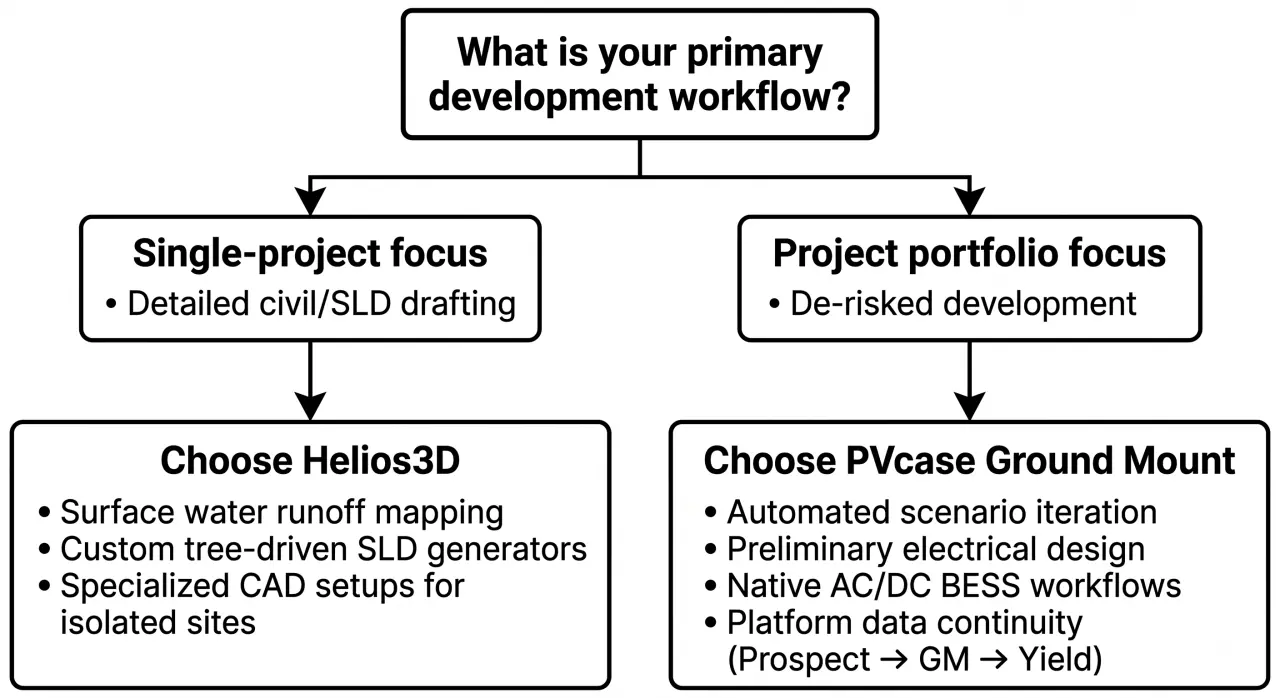
Require specialized civil screening features, such as built-in surface water runoff and terrain drainage mapping.
Rely on a tree-driven single-line diagram (SLD) builder with custom block symbol libraries managed by senior electrical specialists.
Utilize outsourced, photorealistic 3D visualization rendering services for public hearing presentations.
Manage sites that exhibit highly variable micro-topography requiring dedicated Multi-MPPT balancing tools.
Manage high-speed project pipelines that require agile scenario iterations and automated target MW trade-off analyses.
Need to automate preliminary electrical routing to eliminate drafting bottlenecks during early feasibility reviews.
Develop hybrid PV + BESS storage assets requiring unified spatial and electrical modeling.
Prioritize quick onboarding and standardized engineering quality across growing teams.
Develop projects through its entire lifecycle, from site selection to energy yield calculations.
Ultimately, the choice between Helios3D and PVcase Ground Mount ultimately comes down to a fundamental trade-off: niche CAD customization versus de-risked, smooth development.
If your priority is surviving today's volatile development environment, PVcase Ground Mount is the answer. It balances speed and precision with risk-reduction to enable teams to adapt to shifting land, design, and overall project requirements before any capital is committed.