Blog
PVcase Prospect vs. Paces: a technical benchmark
June 30, 2026
PVcase Products


EXECUTIVE SUMMARY
Due to the grid's congestion, energy and data center projects often face unexpected multi-million dollar network upgrade costs during interconnection. Evaluating grid capacity with ISO-aligned modeling on day one prevents developers from wasting capital on unviable land and potentially breaking project economics.
Imagine trying to teach a monkey to recite Shakespeare while standing on a high pedestal.
Most people will start by building the pedestal first. But the pedestal is a trap.
This popular business analogy reflects the erroneous approach of many teams, who will prioritize the easy, tangible task first. If you do that, you risk wasting resources only to realize too late that the core challenge — teaching the animal to speak — is impossible.
Solar, energy storage, and data center site selection has long suffered from this exact "pedestal-first" fallacy.
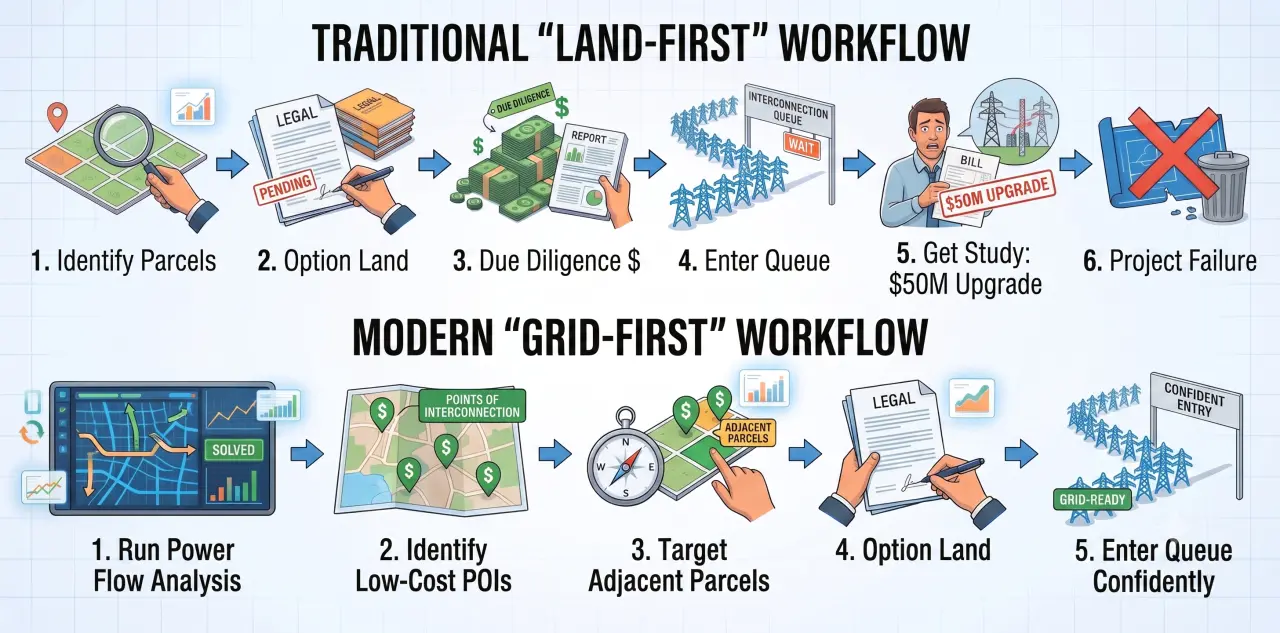
Developers traditionally screen sites by looking for land first. They evaluate acreage, proximity to transmission, parcel ownership, zoning, and environmental/physical constraints. They build a beautiful, highly detailed site pedestal. Only then do they look at the grid.
When they finally enter the interconnection queue or pay a consultant to run a power flow study, they discover the local substation bus is severely constrained, triggering a $50 million network upgrade bill. The monkey cannot speak, the project dies, and the upfront development budget spent on due diligence is completely lost.
QUICK TAKE
Traditional land-first siting ignores grid bottlenecks until formal utility studies reveal that new connections trigger mandatory network upgrade bills that shatter the planned budget.
Securing a ready-made point of interconnection (POI) with immediate, unconstrained capacity has become a rarity in the United States.
The influx of load from data centers, the electrification of cars and appliances, and generation from renewable energy has bottlenecked the transmission network, forcing developers to bear the financial burden of upgrading grid infrastructure to accommodate their projects.
To understand why these costs surface, developers must look at the specific modeling that grid operators use to evaluate new interconnection requests.
Grid operators bear the responsibility of maintaining absolute system reliability. Transmission networks must remain in near-perfect equilibrium at all times. To do this, they apply the following formula:
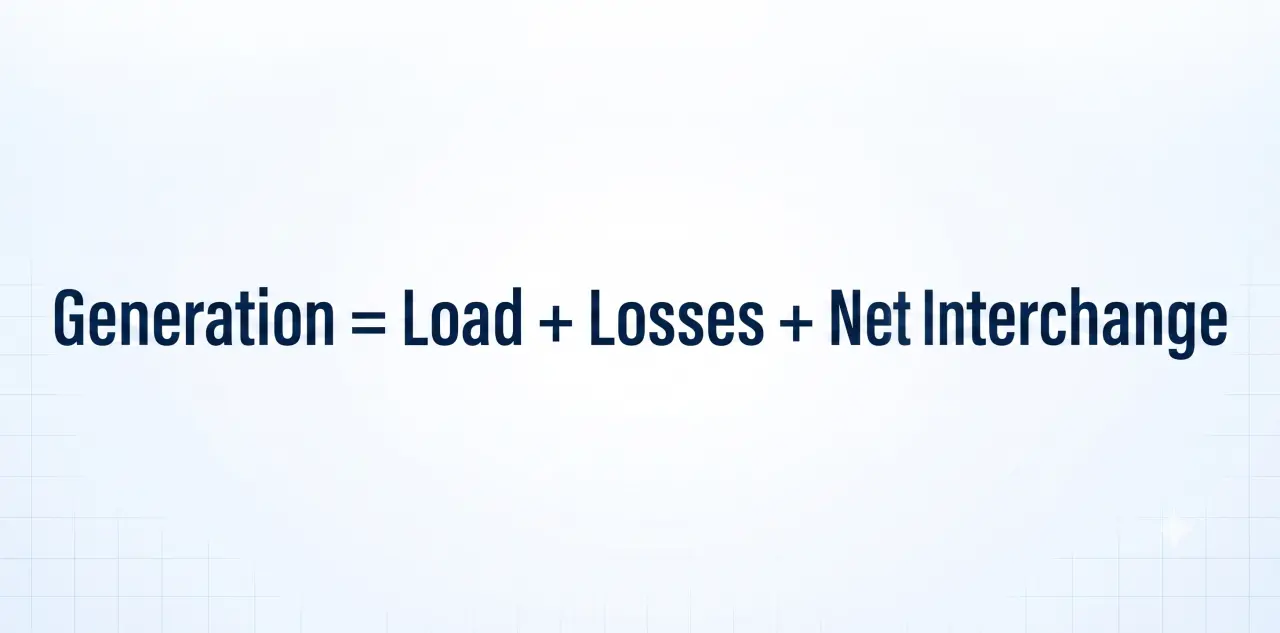
Since every new generation asset or a data center load affects this delicate balance, the grid operator runs rigorous planning reviews to evaluate the system-wide impact for every connection.
To build these complex simulations of the power grid, utilities project regional electricity demands for each season over a ten-year planning horizon. RTOs continuously validate these baselines by mapping generation capacities, load curves, and physical system topology.
Virtual versions of the grid, known as base cases, serve as the digital sandbox for these planning studies. Operators compile current and planned grid infrastructure (and their equipment ratings), planned generator retirements, and factor in long-term firm commitments to transfer power across regional boundaries.
The grid operator doesn’t just want to make sure the grid remains reliable in perfect circumstances, they also have federally mandated standards to ensure the grid can handle one-off equipment issues without triggering cascading blackouts. To plan for this, utilities evaluate system performance in response to a single, abrupt disturbance through N-1 contingency analysis: a core protocol testing whether the network can survive the sudden loss of a critical piece of equipment, like a transmission line or substation transformer.
These virtual models must pass strict acceptance criteria across three technical dimensions:
Dynamic response: The system must remain stable in the critical milliseconds after a fault occurs as transient voltage changes ripple through the network.
Steady-state settlement: Once the system settles, all physical equipment must remain within their rated thermal capacities.
Voltage limits: Voltages must stay within strictly defined, acceptable ranges under both dynamic and steady-state conditions.
Grid operators perform these massively complex simulations on a system-wide level. This is necessary because a new project can trigger stability violations or require thermal equipment upgrades on components located dozens of miles away from the initial point of interconnection. For instance, one North Dakota developer recently found they had to upgrade power infrastructure nearly 1,000 miles away in Missouri.
If these contingency simulations reveal that a proposed interconnection violates any of the acceptance criteria, physical grid improvements become mandatory. The grid operator then assigns the developer the financial responsibility for these network upgrades to prevent systemic instability.
Once the grid operator identifies a specific bottleneck, the mitigation pathways generally fall into two categories:
Build net-new infrastructure: Constructing entirely new substations or transmission lines to redistribute power flow, relieve congestion, or feed new load centers.
Upgrade existing infrastructure: Replacing existing grid components — such as reconductoring lines, upgrading transformers, or installing higher-rated substation breakers — with higher-capacity equipment.
The grid operator ultimately determines which mitigation strategy is technically required, and issues the corresponding upgrade bill to the developer.
To evaluate these grid constraints effectively before committing capital, developers can consult our guide to identifying quality capacity analysis.
QUICK TAKE
Grid upgrade costs jump non-linearly. Exceeding grid capacity by just one megawatt can lead to severe reliability violations and millions in unexpected utility infrastructure fees.
The non-linear nature of grid upgrades, which do not scale proportionally with a project’s megawatt (MW) capacity, heightens the financial risk of these studies.
Instead, the grid behaves like a series of thresholds. A developer might design a solar-plus-storage project that maximizes the generation for a particular site design. However, crossing a threshold of indeterminate project size by even 1 MW can suddenly trigger a reliability violation during an N-1 simulation.
Overstepping this small (invisible) mark can instantly saddle a project with millions of additional dollars in mandatory utility upgrades — such as rebuilding an entire substation bus or re-conductoring miles of transmission line — shattering the project's financial viability.
Beyond this, crossing additional upgrade thresholds introduces severe timeline risks that frequently end up being the deal-breaker for data center and energy developers. High-voltage transmission equipment, such as large substation transformers and specialized switchgear, suffers from unprecedented manufacturing backlogs. Procurement lead times for these components now routinely stretch between three to five years.
Consequently, a threshold breach does more than just damage project economics. It halts development of the project entirely. Even if a well-capitalized developer decides to absorb a multi-million dollar upgrade fee to secure a vital point of interconnection, the years spent waiting for utility hardware delivery will tank the asset's net present value.
For hyperscale facilities racing to secure first-mover market advantages, these supply chain delays destroy commercial viability.
As the grid constantly changes, so do its upgrade costs. They are tied to ever evolving ISO/RTO base cases that change constantly based on many variables:
Organic load growth, as collective energy needs grow and shift over time.
The exact position and capacity of other projects ahead of yours in the interconnection queue.
Scheduled transmission upgrades managed by regional utilities.
Formal generation retirements (such as aging coal plants shutting down) across the region.
Thus, a POI that appears viable in March can become infeasible by September simply because a project ahead of you in the queue modified its design or pulled out, potentially shifting upgrade costs onto subsequent applicants.
QUICK TAKE
Generators pay proportionally allocated costs of shared grid upgrades, whereas large-load data centers increasingly face total upgrade costs to ensure localized system deliverability.
The financial impact of network upgrades depends heavily on whether you are developing generation/storage assets or large-scale power offtake facilities (large loads). Grid operators calculate these financial responsibilities for generators as proportional allocated costs.
However, large loads are increasingly having to pay for total costs. While some grid operators still lack formal large-load cost responsibility policies, utilities are moving away from socialized large-load upgrade costs — raising electricity prices to fund system additions driven by data centers. According to the Smart Electric Power Alliance's DELTa database, 104 large-load tariffs and service rules are now pending or active across 37 states.
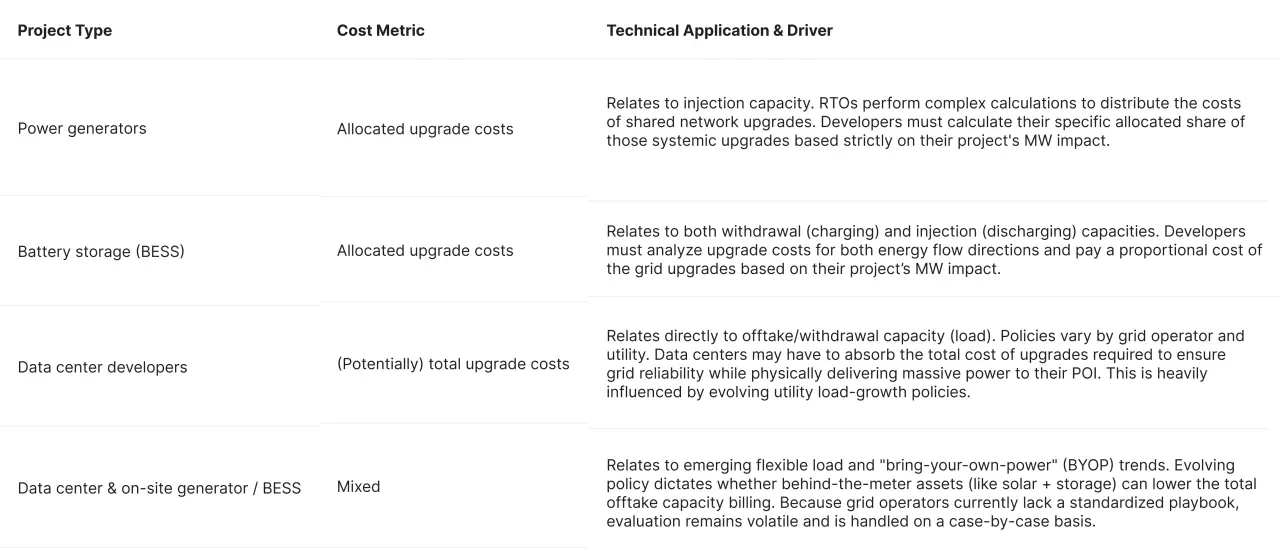
When submitting an interconnection application, developers must choose between two broad categories of interconnection services (firm deliverability or non-firm deliverability). Depending on which type they apply for, it can greatly impact upgrade costs they will be responsible for:
NRIS (Network Resource Interconnection Service): This represents firm deliverability. It ensures that your project can inject or withdraw power even during peak grid strain without causing constraints. Because it guarantees grid access, NRIS triggers the highest volume of modeled constraints, requiring developers to fund substantial network upgrades to mitigate them.
ERIS (Energy Resource Interconnection Service): This provides non-firm deliverability on an "as-available" basis for generators. ERIS generator projects connect to the grid with lower upfront upgrade costs but are subject to frequent, active curtailment by the grid operator during periods of high congestion.
While ERIS connections are only for generators, some grid operators are experimenting with flexible load policies, curtailment-based connections for large loads, though utility policies remain fragmented.
QUICK TAKE
Land-first screening creates queue dead-zones where teams waste due diligence budgets on unviable sites before discovering upstream transmission constraints through slow consultant reports.
The lack of early-stage, engineering-grade grid analysis in traditional site selection creates an inefficient workflow that actively damages project pipelines.
Developers traditionally screen sites using a "land-first" approach — evaluating acreage, proximity to lines, ownership, or permitting/zoning. Going back to our analogy: they build the pedestal first.
This creates a ‘queue dead-zone’: teams might commit significant capital to secure land options and submit queue applications blindly.
Additionally, while developers aren't financially responsible for pre-existing utility upgrades, choosing a substation or line with a backlog of planned updates may delay your interconnection — leaving your project at the mercy of component lead times.
Thus, because development teams are effectively throwing darts in the dark, they spend hundreds of thousands of due diligence dollars on engineering, environmental assessments, legal fees, and site control negotiations for sites that are fundamentally unviable.
When the official grid study (or a consultant-run power flow study) finally reveals a massive upgrade bill, the developer abandons the site. This late-stage attrition destroys developer pipelines, burns capital, and misses market windows.
Historically, engineering-ready power flow studies and upgrade estimates required weeks of manual grid research, one-off consultant studies, or waiting out the long timeline of official grid operator initial studies.
Even those teams using basic site-screening software are exposed to their search limitations: While they can see where transmission lines and substations are physically located, they cannot search or filter an entire region of POIs by headroom capacity and the upgrade costs to achieve that available capacity first.
Instead, the teams must manually select a single POI, order an isolated, pay-per-study report, and wait. If that study reveals a prohibitive upgrade cost, the team is forced to return to the drawing board, repeating a slow, expensive trial-and-error loop.
Some solutions providers attempt to provide grid insights but misleadingly rely on highly simplified, non-system-wide “8-bus” models that ignore potential grid constraints (and thus upgrade costs) that a project may trigger far away on the grid. These lead to false-positive headroom capacity and upgrade cost estimations, tricking developers into thinking a POI is open when it is electrically choked upstream. It’s critical that any power flow studies mimic the exact grid operator modeling methodologies, including doing system-wide N-1 studies - regardless of the massive modeling computation required.
Conversely, platforms offering high-quality transmission analysis often fail to integrate those power insights into the broader site selection and evaluation process.
Once you identify 15 potential points of interconnection, it is crucial to follow a scalable process to locate potential parcels in the right zones and analyze:
site developability
proximity to critical infrastructure (fiber/gas)
public sentiment
permitting
landownership
power prices
energy yield
the litany of other due diligence line items that ultimately come together to make a site work.
These grid-only solutions leave you with the inverse problem: a great grid node without a pursuable site.
Fragmented software and processes like these force development teams to stitch together disparate sources, significantly slowing down the site evaluation process and increasing the risk of human error.
Watch our webinar "Demystifying interconnection studies for project developers" for a break down of the fundamentals of grid analysis with real-world examples.
QUICK TAKE
Modern site screening requires platforms that run ISO-aligned power flow studies across thousands of nodes to right-size projects and identify upgrade costs before committing capital.
When a developer receives a surprise network upgrade bill late in the development cycle, the financial consequences cascade across the entire business.
By the time a project enters the definitive phase of an interconnection queue, the developer has already spent capital on land options, civil engineering, environmental permitting, and local zoning approvals. If an unworkable upgrade bill kills the project, all of that upfront investment is lost.
To prevent speculative projects from clogging queues, RTOs and ISOs have instituted study deposits and financial withdrawal penalties.
If a developer must withdraw a project due to a surprise $50 million upgrade bill, they face cash penalties simply to exit an unviable queue position.
Utility and data center projects operate on tight financial models where the internal rate of return is calculated down to basis points. Because grid upgrade costs are non-linear, a projected $2 million substation connection can soon morph into a $20 million network upgrade obligation.
QUICK TAKE
Surprise upgrade bills can potentially erase project returns, forfeit queue deposits, and waste spent due diligence capital.
To eliminate late-stage interconnection surprises, modern renewable and data center developers are adopting a "power-first" approach that evaluates grid capacity and both total network upgrade costs (for data center loads) and allocated costs (for generation and storage) at any POI in the grid, for any proposed project size from day one.
In practical terms, “power-first site selection” means mirroring the exact modeling logic used by ISO and RTO.
This requires teams to conduct system-wide N-1 contingency analyses built on current base cases, which include:
Active and queued projects ahead in the interconnection queue.
Planned utility transmission projects.
Scheduled regional power plant retirements.
Instead of evaluating sites individually, developers use advanced platforms to screen thousands of POIs simultaneously. Simply by filtering POIs by available capacity and estimated upgrade costs first, they can quickly eliminate unviable candidates before spending any due diligence capital on adjacent land.
To avoid crossing the thresholds that trigger massive network upgrade costs, developers need upgrade cost visibility to iterate project sizes.
By adjusting generator or battery storage sizes on the fly, they can find the precise "sweet spot" where project scale meets peak profitability.
Once a viable POI is selected, and the project sizing is confirmed, converting grid data into documentation ready for land owners, investors and grid operators becomes a bottleneck for many teams.
Modern site selection platforms allow instant export of detailed reports describing modeled grid constraints, estimated upgrade costs, transparent methodologies, and the necessary data to ensure a smooth transition to the next stages of the project.
Check out our webinar "Transmission Planning 101 for Project Developers" to learn how scalable grid capacity analysis can boost your project's chances of approval .
Chasing land options before facing a chronically constrained grid will never be a cost effective strategy. To survive in today's constrained power market, developers must invert this workflow.
PVcase Prospect makes power-first site selection achievable and scaleable. Its ISO-aligned, system-wide power flow studies, granular grid upgrade forecasts and integration of proprietary GIS layers with non-public fiber/gas networks and public sentiment analysis enable you to identify true headroom, right-size project capacity, and de-risk early-stage due diligence before sinking capital into failed land options.
In other words: it ensures you’re building a pedestal for a monkey that can actually speak.
To see a full breakdown of the platform's early development workflow, read our case study on early data center development with PVcase Prospect.
Discover how the platform's grid capacity analysis works and start boosting your project's chances of success.