Blog
LandGate vs. PVcase Prospect: data center interconnection
February 9, 2026
PVcase Products


EXECUTIVE SUMMARY
This technical benchmark evaluates the operational differences between PVcase Prospect and Paces for utility-scale solar and data center projects. While Paces relies on rigid automation and bespoke power flow studies, PVcase Prospect’s unified project development platform enables true scalability across the entire energy project site selection process.

Traditional siting tools focus strictly on isolated spatial data, whereas an integrated site selection platform lowers risk of failure while allowing to scale the process.
When you choose a site selection platform, one of the most important questions is: How well does it scale when your project pipeline grows? For utility-scale solar and data center projects, software scalability equals project development scalability, which means two things: the tool must unblock interconnection from the start while handling complex requirements without losing technical accuracy and development oversight.
Simple background automation works well if you only look at single-parcel sites. And paying for one-off power flow studies is only cost-effective if you are only doing late-stage grid evaluation for a site that already passed initial interconnection analysis. But these are hardly efficient if you have to screen more parcels and sites for a growing number of projects.
Achieving true scalability requires unified due diligence. In practical terms, this means keeping grid capacity modeling, land analysis, and conceptual design inside one integrated workspace. It allows your development team to adopt a “fail fast, succeed faster” approach, testing trade-offs and filtering out bad prospects early.
Ultimately, it ensures you keep your budget predictable and grow your project pipeline with viable sites.
Quick Take
PVcase Prospect provides instant, nationwide power flow modeling right in your site selection platform. Paces treats grid analysis as an add-on, requiring expensive manual requests for each POI you want to screen.
Interconnection constraints are the primary barrier to scaling clean energy pipelines and large-load data center infrastructure. This puts developers at the risk of spending months locking down land only to find out later that the target substation has insufficient injection or offtake capacity or requires millions (or hundreds of millions) in grid upgrades, wasting time and money.
The way around this is power-first site selection: finding and weeding out unviable grid connection points immediately, long before starting to look at potential parcels, talking to landowners, or investing in additional site due diligence.
Relies on a pay-per-study power flow study cost model where users buy an individual POI report at a time with an expected three-to-five day delivery. While offering high-quality power flow analysis and late-stage study customization options — like high-scrutiny N-1-1 contingency analysis or custom load profiles — this fee structure has clear issues: It forces users to pick potential sites first and pay to have them tested with no guarantee of a ‘hit’.
In other words: Paces prioritizes siting factors other than the interconnection potential, which is essentially the project development equivalent of throwing (expensive) darts in the dark.
Provides instant, nationwide power flow studies built directly into your site selection software – not as a disconnected, one-off report request.
This means siting teams can:
Run unlimited site searches to find substation buses and transmission lines.
Find POIs with sufficient injection or withdrawal capacity headroom.
Identify substation buses and transmission lines within their network upgrade budget.
Choose ERIS/NRIS deliverability scenarios to see firm or non-firm service levels instantly.
Execute and complete the searches with zero turnaround time.
Additionally, the PVcase Prospect’s natively integrated power flow studies model N-1 contingencies and follow the unique grid operator methodologies so you can see the same interconnection evaluation and upgrade cost estimates that you’d get by the grid operator when submitting a project to the queue.

Pay-per-POI models lead to capital wasted on unviable sites, while regional/national subscription-tier modeling offers infinite scalability.
Pro tip
How many one-off power flow studies are you paying per year? If your process relies on more than just a few individual consulting studies, you cannot target grid-first site selection strategies without massive sunk costs.
Quick Take
PVcase Prospect enables developers to review and evaluate sites at every stage of the site selection screening process with dynamic, manual filters. With Paces, you lock in your development criteria upfront without the ability to review and evaluate sites dynamically to weigh tradeoffs.
Modern site selection of data centers and utility-scale solar is a balancing act between complex grid, topographic, regulatory and civil trade-offs. Following a “fail fast” discovery process, developers must approach site screening as an active workspace to quickly iterate on search requirements including:
interconnection tradeoffs
constraint mapping requirements
design considerations
market analysis
This allows them to holistically find and evaluate hidden sites that others miss.
Paces maximizes software automation by locking in search requirements upfront and then processing the site search and analysis in the background. These searches can take up to 30 minutes, locking the users out of the intermediate evaluation. The software then produces a final shortlist of potential sites.
While this approach may be workable for small community solar sites, it creates hidden challenges and risks for utility-scale and data center sites – especially without any “perfect” sites left. When the search parameters are set upfront, users are blinded to high-potential sites that are 90% viable and could easily work with minor configuration changes. Conversely, they may get too many false positives if they are overly generous with the site requirements.
Additionally, because spatial processing runs go unsaved, users lose their tracking history and cross-parcel refinement steps completely.
Delivers complete transparency and review and refinement capabilities over the entire evaluation process. This enables you to maintain oversight to evaluate complex site tradeoffs:
interconnection risk and POI selection
proximity to critical infrastructure (fiber routes, gas pipelines, IXPs, and more)
regulatory/community sentiment tradeoffs
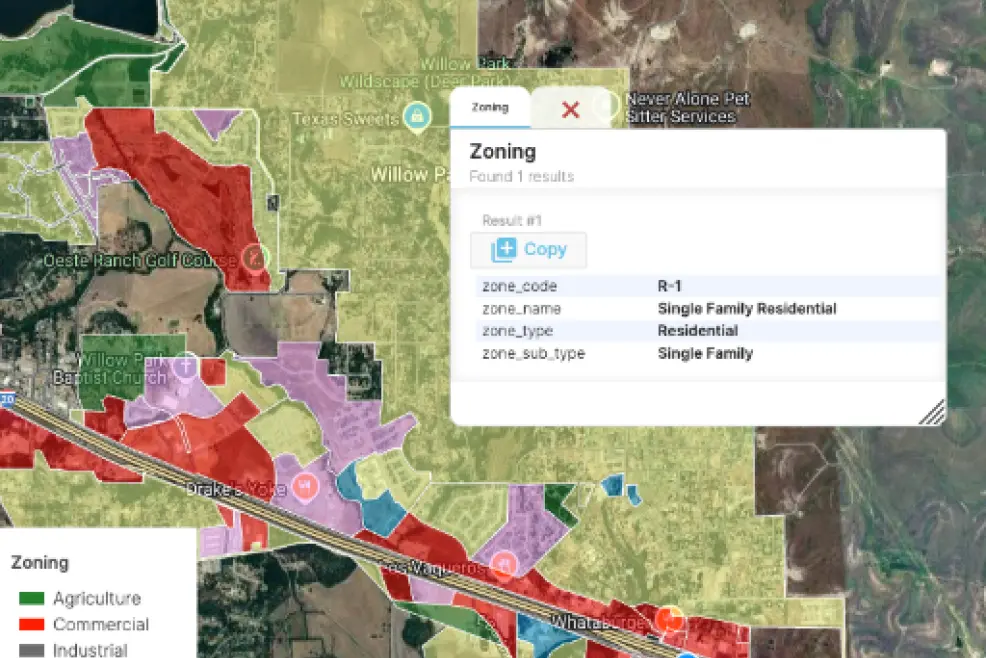
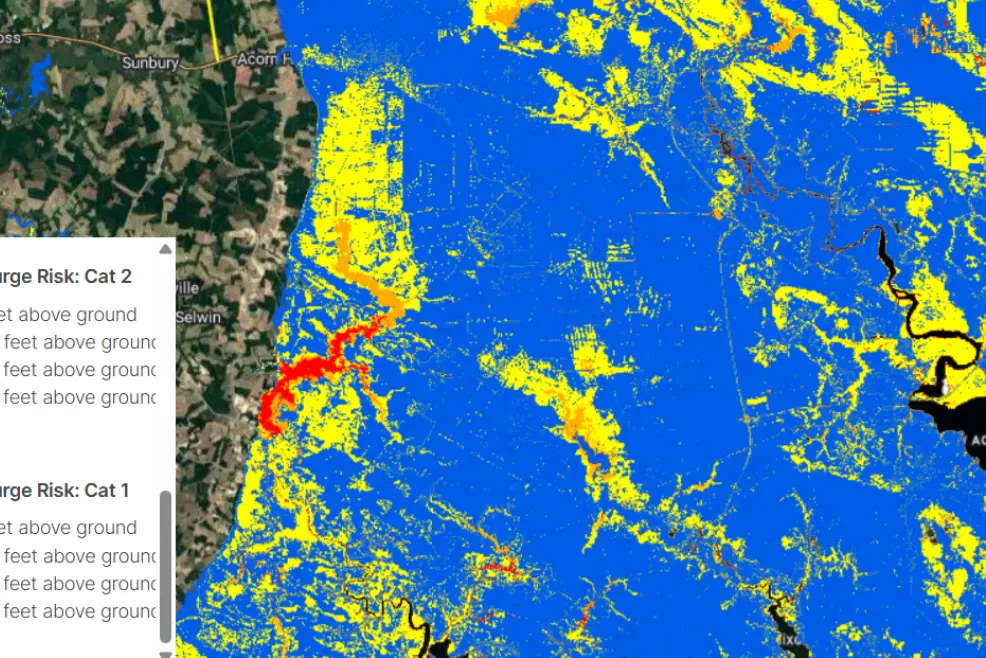
geotechnical/environmental hazard parameters & climate-adjusted flood risks
power market pricing impacts
These can all be assessed and adjusted on the fly.
For large-scale projects requiring extensive acreage, you can combine distinct land tracts across separate landowners into a single site boundary or play around with different site configurations to create unique solutions.
Additionally, PVcase Prospect saves and stores your campaign at each stage, letting your team validate near-match properties or play around with tradeoffs to uncover hidden sites instead of letting rigid prerequisites discard quality opportunities.
Pro tip
Can you review and refine results at each step of the project development funnel? If your screening platform locks you into rigid automation, your team is probably blind to the intermediate stages of a search.
Quick Take
PVcase Prospect combines preliminary layouts, data center test-fits, and 20-second CAD exports into one workspace. Paces contains no native design modules, forcing manual file conversions across separate tools.
After initial site selection, most developers have to bring in a separate toolstack or engineers to start understanding preliminary site design and actual site feasibility. This means moving spatial data back and forth between isolated tools, which creates additional bottlenecks and leads to manual errors and human entry mistakes that delay project delivery timelines.
Even when a site passes the first viability checks and the project is handed to the engineering team, the process of configuring the files for import into a CAD-supported design tool only compounds the costs of renewable energy software fragmentation.
Modern development requires everyone involved in the project to use shared data structures and compatible tools.
Focuses exclusively on early-stage constraints and contains no native PV design, or structural data center test-fit capabilities.
To complete preliminary layout and design due diligence, users need to purchase a separate design software, entirely disconnected from the siting tool — which entails manually exporting site files and long delays for even basic design feasibility. On top of having to manage multiple, separate software contracts and licenses, development and engineering teams are thus forced to face extra work to configure the design import and, consequently, high data loss risk.
Combines site selection, preliminary design, and engineering checks into one workspace.
Solar siting teams can thus generate conceptual PV layouts for potential sites to estimate early DC capacity and energy yield calculations. This helps you quickly assess financial potential, without relying on separate teams or third-party tools before investing in more due diligence for a site.
For data center projects, the platform has a built-in Data Center Builder capability that lets you quickly overlay structural infrastructure test-fits onto your parcels. This way, you can see how a campus would fit on the actual site and generate quick renders and layouts to share with stakeholders – all from one platform.
Beyond that, PVcase Prospect ties the early development phases together by ensuring site selection and design software use the same data formats. Siting details — including parcel boundaries, terrain mesh details, environmental hazard constraints, and buildable areas — can be exported directly into native CAD design software (PVcase Ground Mount) in under 20 seconds.
This direct connection keeps all your spatial data perfectly intact, eliminates manual rework and data loss.
Pro tip
How often do your teams send a site to an engineer only to have to go back to the drawing board to rethink the site or pursue additional acreage? If your tool stack is fragmented, you run the risk of losing project momentum and capital margins in site rework and manual data processing tasks.
Instead of looking at a checklist of separate features, the best way to decide which platform suits you more is to look the exact types of projects you develop and how your team is built.
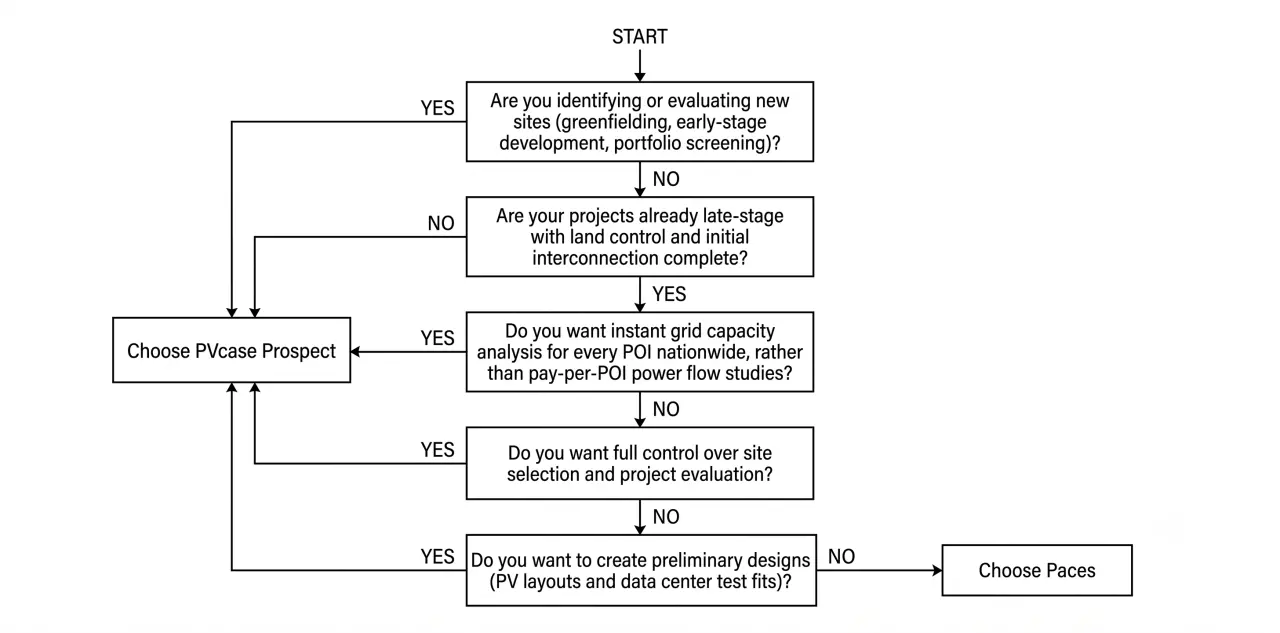
Any development framework requiring a grid-first approach, interactive, high-volume prospecting, or preliminary design test-fits naturally relies on centralized workflows.
Your firm only buys one-off, late-stage utility-scale solar or data center projects that already have land control and have passed initial interconnection analysis.
Your utility-scale or data center project is already locked down, but you need custom power flow studies for the target point of interconnection — such as multi-year load ramps or N-1-1 grid contingency runs.
You only develop single-parcel, distributed generation projects that do not require complex site configurations, multi-parcel sites, or evaluating challenging site tradeoffs.
You have a small team and are comfortable outsourcing development strategy and site selection decisions to a software company.
You want maximal automation/minimal clicks in a software and only want to see final results.
Your company does any volume of greenfielding or initial site selection for utility-scale solar or data center projects .
Your development strategy requires a grid-first site selection approach to avoid significant sunk costs and wasted time on projects that won’t pass interconnection.
You want to evaluate preliminary PV designs and yield without having to go to a separate tool or go back and forth with a separate team/contractor to quickly test out the campus layout and generate images for early conversations.
You want to be able to create quick data center test fits and generate conceptual designs/renderings without buying a separate software or relying on a separate team.
You want full review and control over every stage of your project funnel and the ability to evaluate all parcels in your portfolio at any stage
Ultimately, the choice comes down to whether you need your development process and costs to scale alongside your pipeline ambitions. Only a platform that natively integrates grid modeling, real-world constraints, market analysis and preliminary design can prevent you from outgrowing your software stack and avoid sunk costs along the way.
PVcase Prospect ensures your development team works fast, with precision and is highly efficient.
To see how these capabilities translate to real-world siting, explore our case study on early data center development with PVcase Prospect: a step-by-step breakdown of the platform's workflow evaluating grid capacity, parcel buildability, infrastructure access, and local zoning risks for a 200 MW project in Columbus, Ohio.
PVcase Prospect unifies grid-first site selection and engineering validation to scale your project development.