
Customer stories
How North American Data Centers screens land using the same criteria buyers do
October 21, 2026

Power, land, water, fiber, and zoning remain central to data center site selection. But technical feasibility is only part of the early development picture. A candidate site can satisfy today’s requirements while public concerns gather momentum or new local rules alter what development would require.
Our analysis of data center community sentiment examined why local opposition has become a development challenge. With the ‘why’ resolved, the next question is ‘how’: how can origination teams assess that risk early enough to inform site prioritization in an efficient way?
The answer requires visibility into both what stakeholders are saying and how local authorities are responding.
Quick take: Current rules show what applies now; local pressure shows what could change next.
While immediate rules and conditions determine what a developer can do today, public concern can influence the conditions a project encounters before it reaches approval. Given enough popular pressure, it can completely change what the developer will be able to do tomorrow.
Looking only at current rules therefore risks origination teams being blindsided by a dynamic environment.
However, public controversy alone does not establish how a project will be affected. Strong opposition may remain part of the local debate without producing new restrictions, while an ordinance or moratorium can materially alter development even when public discussion is limited.
Thus, origination teams need to understand both the pressure forming around data center development and whether that pressure has begun to affect government decisions, actively distinguishing current requirements from developing risk.
Quick take: PVcase Prospect connects county-level sentiment, stakeholder evidence, and policy records within the same early-stage screening workflow.
PVcase Prospect provides public debate and local and state regulation data as two complementary layers within the same siting environment.
Community Sentiment organizes the available evidence about how data center development is being discussed within a county. It provides:
A sentiment score and AI-generated overview of the local discussion.
Stakeholder voices showing who is participating and whether their position is supportive, opposed, neutral, or mixed.
Attributable statements that reveal the concerns and arguments behind the overall signal.
Source documents that teams can consult for greater context.
Policy Insights surfaces the formal measures shaping data center development within the same county. It provides:
Ordinances, regulations, policies, and moratoriums relevant to data center development.
Jurisdiction labels identifying whether a measure applies at the municipal, county, or state level.
Status information showing whether it is proposed, pending, active, or expired.
Relevant dates, summaries, and source links for further investigation.
Origination teams can use these layers after an initial technical screen identifies promising markets or candidate sites. They can compare county-level conditions across a broader search area, open individual county records to examine the evidence, and determine where community or policy factors require additional diligence.
The same workflow can also support inbound and existing pipeline opportunities. Teams can review whether local concerns or policy activity affect the assumptions behind a site and decide whether to:
Continue advancing the opportunity.
Investigate specific requirements or stakeholder concerns.
Involve policy or community-engagement teams.
Adapt the siting or development approach.
Prioritize another candidate area.
However, the true value of this workflow depends on the breadth, recency, and traceability of the data behind both layers.
Quick take: Production data combines broad sentiment coverage with source-linked policy evidence that teams can revisit as conditions change.
PVcase Prospect aggregates and structures information from news coverage, government publications, meeting records, and other local sources. Production data queried on October 28, 2026 demonstrates the scale of this research.
The records include direct quotations as well as attributable paraphrases, votes, rulings, supporter arguments, critic concerns, and other documented positions. Each statement is classified by topic and sentiment, allowing the county view to connect an overall signal with the evidence beneath it.
Both datasets are refreshed monthly. The refresh begins on the first day of the month, with updated results generally published in PVcase Prospect during the first week. This gives teams a repeatable way to revisit candidate areas as local discussions and policy records develop.
Quick take: Williams County shows how combined evidence changes the questions an origination team asks before advancing a candidate area.
Consider an origination team that has surfaced a technically promising land in Williams County, North Dakota. Its technical screen has identified a viable combination of power access, developable land, fiber proximity, and project economics strong enough to justify continued diligence.
The team proceeds to test whether it can be advanced, what conditions it must satisfy, and whether the additional diligence remains commercially justified.
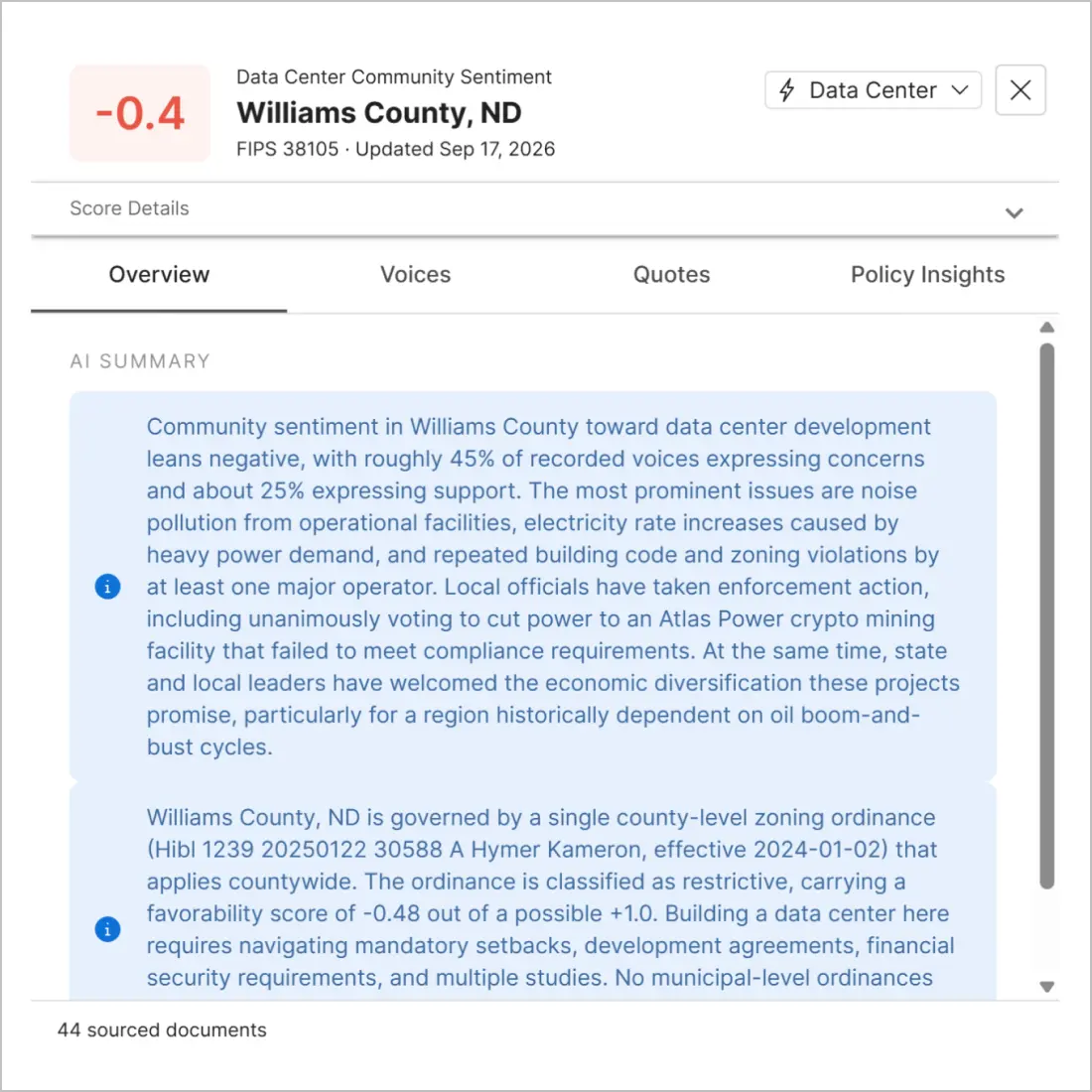
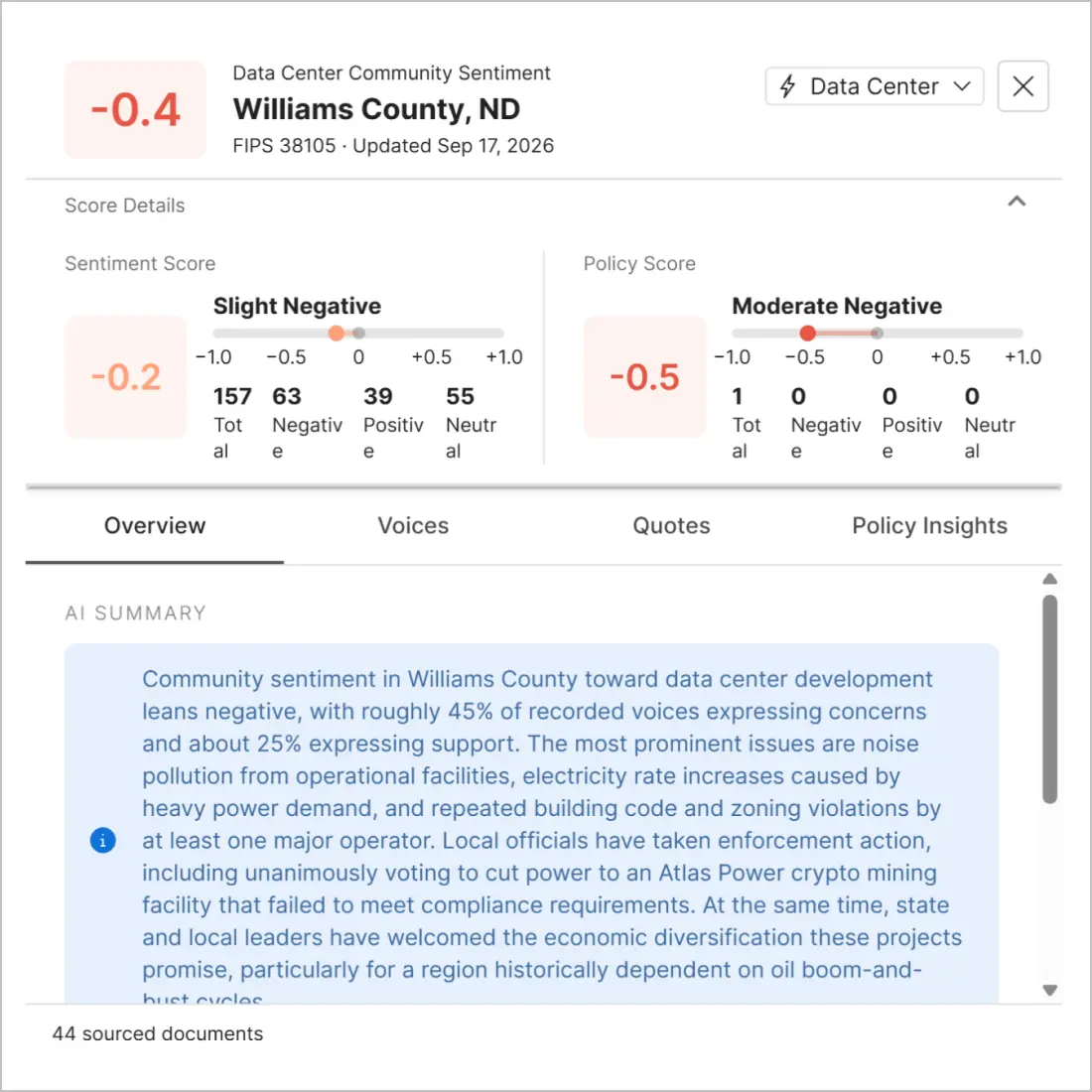
In the PVcase Prospect snapshot updated September 17, 2026, Williams County carried an overall indicator of -0.4. The Score Details view separated that result into a slightly negative sentiment score of -0.2 and a moderately negative policy score of -0.5.
The overview surfaces several issues shaping the county discussion, including operational noise, electricity costs, compliance, zoning, and demands for greater transparency. It also captures support for the economic diversification that data center investment could bring to an area historically exposed to oil-sector cycles.
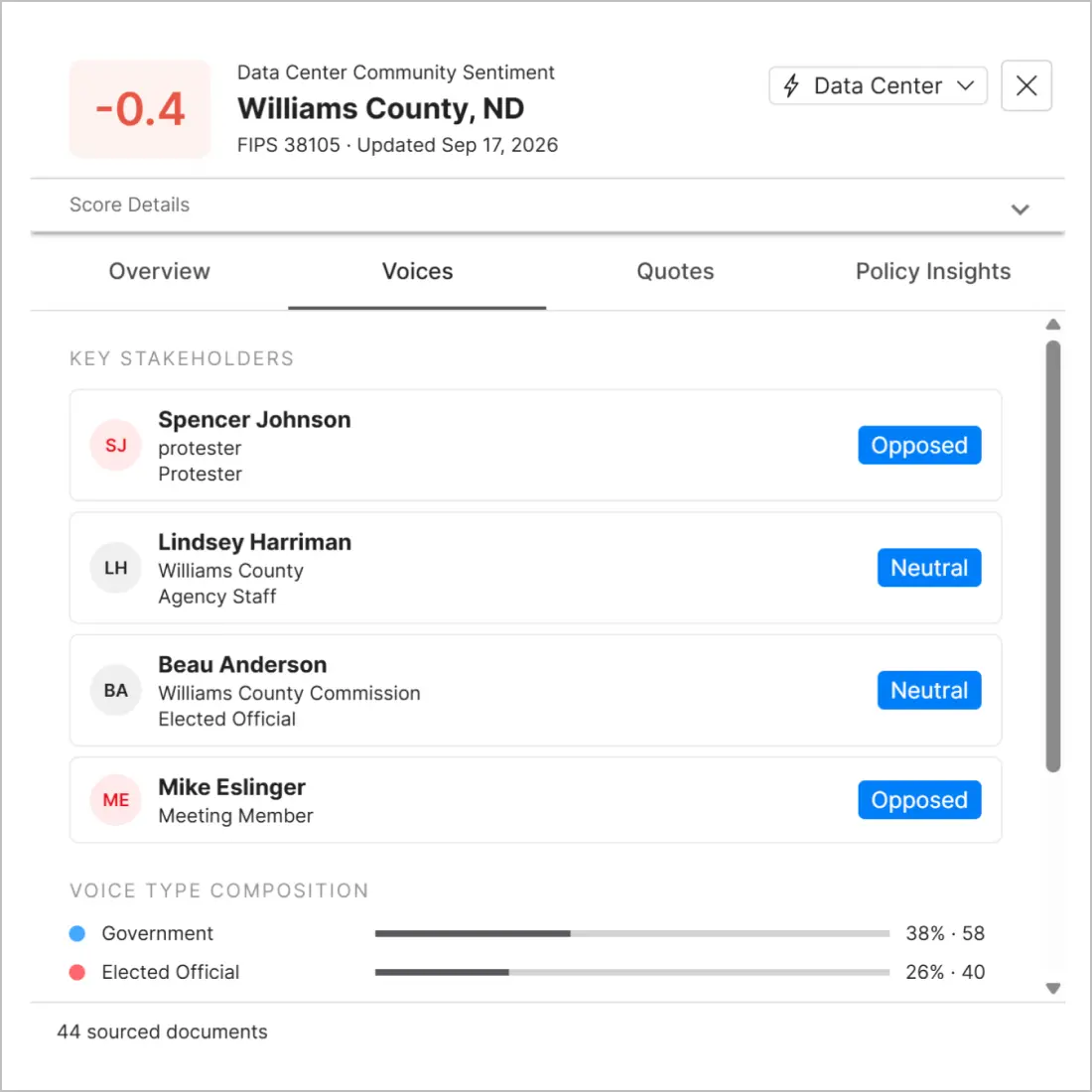
The Voices view adds another level of context. Government sources accounted for 38% of the displayed voices, while elected officials represented 26%.
The stakeholder records show opposed protest voices alongside neutral positions from county staff and an elected official. That distinction prevents the negative county signal from being interpreted as a uniform institutional position.
It tells the origination team where targeted engagement may be needed, while Policy Insights shows the requirements that directly affect site viability.
Policy Insights reveals that the discussion is not purely theoretical. Williams County has an active county ordinance regulating data centers. Ordinance No. 2024-01-02, adopted in January 2024, classifies data centers as conditional industrial uses in Heavy Industrial districts and establishes requirements including:
A one-mile setback from homes, schools, places of worship, public parks, and other sensitive properties
A three-mile setback from an existing data center
Supporting studies and documentation, including noise and power information
Road, drainage, screening, security, and electrical standards
A development agreement and financial security connected to installation, maintenance, and reclamation
Quick take: Earlier context helps teams compare diligence burdens, direct engagement, and protect development resources before deeper commitments.
Community and policy evidence does not replace the technical work of data center site selection. It makes that work more complete by adding local development conditions to the same early-stage decision.
For origination and site-selection teams, that supports several practical actions:
Prioritize stronger opportunities: Compare candidate areas using technical constraints alongside community and policy context.
Direct deeper diligence: Identify the counties, measures, and stakeholder concerns that require closer investigation.
Improve internal coordination: Give policy, government affairs, community engagement, and engineering teams a shared evidence base.
Strengthen outreach: Enter local conversations with a clearer understanding of the issues already receiving attention.
Protect development resources: Reduce the time spent pursuing sites whose local requirements or friction materially weaken their viability.
This is particularly valuable during greenfielding, when teams may be evaluating large geographies and need consistent criteria for narrowing the search. It’s also useful for existing pipeline sites, where a new ordinance or a change in local discussion can alter the assumptions behind an earlier decision.
Quick take: PVcase Prospect makes early community and policy screening repeatable across a larger development pipeline.
Community opposition and policy change have become too consequential to leave until late-stage diligence. Like power availability, they now belong at the beginning of data center site selection.
PVcase Prospect makes this practical across an entire project pipeline. It makes the analysis of fast-changing community and policy conditions repeatable across an entire project pipeline, helping origination teams make faster, better-informed, and more consistent decisions about which opportunities to advance, investigate further, or leave behind.