
Negative coverage of data centers has increased fivefold since 2020. Only in the last year, negativity doubled from 16% to 37%. This highlights the end of the "honeymoon" phase for AI infrastructure in many U.S. markets.
A $64 billion blind spot: why local sentiment is key to data center development
PVcase data analysis quantifies the growth of community pushback against AI infrastructure and emphasizes the relevance of sentiment insights.

April 2, 2026
Industry Trends
Executive summary:
Local sentiment has shifted from a secondary concern to a major engineering constraint. In this "Saturation Phase," community opposition over noise and resources is the primary driver of project rejections, making a Social License to Operate essential for infrastructure viability.
The findings at a glance
Data center media coverage has exploded 95x since 2018, while negativity has doubled to 29%.
114 new opposition coalitions have formed nationwide to fight the deployment of AI infrastructure in their communities.
With 87% of quotes being negative, noise is the most uniformly hated topic
Mississippi (78%), Wyoming (74%), and South Carolina (69%) are the states with the most positive sentiment.
Our research in numbers
254148
quotes analyzed
53
states and territories covered
100+
distinct media sources
Table of contents
- How community sentiment moved from latent to critical risk
- What are the reasons for the growing concern?
- Where is the friction highest?
- The disconnect in the data center controversy: industry vs. public
- How can developers mitigate sentiment risk with PVcase Prospect?
- Why stewardship is the future of data center development
- Methodology
The recent surge of data center projects has hit a formidable roadblock: the human element. Our study of thousands of media quotes testifies to the increasing public concern against data centers, causing projects to be withdrawn or delayed throughout the United States.
Integrating sentiment intelligence into the site selection process has become both a necessity and a competitive advantage for hyperscale developers.
How community sentiment moved from latent to critical risk
Summary:
Negativity toward data centers more than doubled throughout 2025, leading to delays, rejections, and year-long moratoriums that strand capital in mid-development.
In the early stages of the AI boom, data center projects were often welcomed for their tax contributions. However, our analysis highlights a dramatic shift in 2025 as sentiment moved from latent acceptance to critical resistance, where local consensus has become a critical factor for project development.
The yearly dataset reveals a hardening of public stance, as negative coverage has increased 5 times since 2020. It reflects a fundamental transformation in how the American public views these facilities.
This trend is particularly striking in the month-by-month breakdown of 2025:
January 2025: Negativity sat at a manageable 16%.
June 2025: Negative sentiment climbed to 24% as the "AI summer" intensified resource concerns.
December 2025: Negativity peaked at 37%, more than doubling in a single calendar year.
This is manifested in the rapid formation of opposition groups, which find increasing social support; for instance, a single petition against a data center rezoning in Franklin County, Missouri gathered 1,400 signatures in just 72 hours.
Beyond that, the shift is having very real consequences. Prompted by this opposition, lawmakers in at least 11 states have introduced legislation for temporary bans or moratoriums on new developments. Among the most cited arguments is the need to study the growing impacts of data centers on electricity costs and the environment.
Developer’s edge:
Thriving in this landscape requires abandoning 'by-right' permitting and transitioning to an integrated, scalable approach to data center site selection that accounts for social license as a critical engineering constraint.
What are the reasons for the growing concern?
Summary:
Noise pollution is the primary driver of public hostility (87% negativity), followed closely by concerns over property devaluation and environmental justice.
The growing opposition is not a single-issue movement but a convergence of concerns regarding noise, environmental impacts, and power consumption. Our research identified specific flashpoints where negativity reaches overwhelming levels.
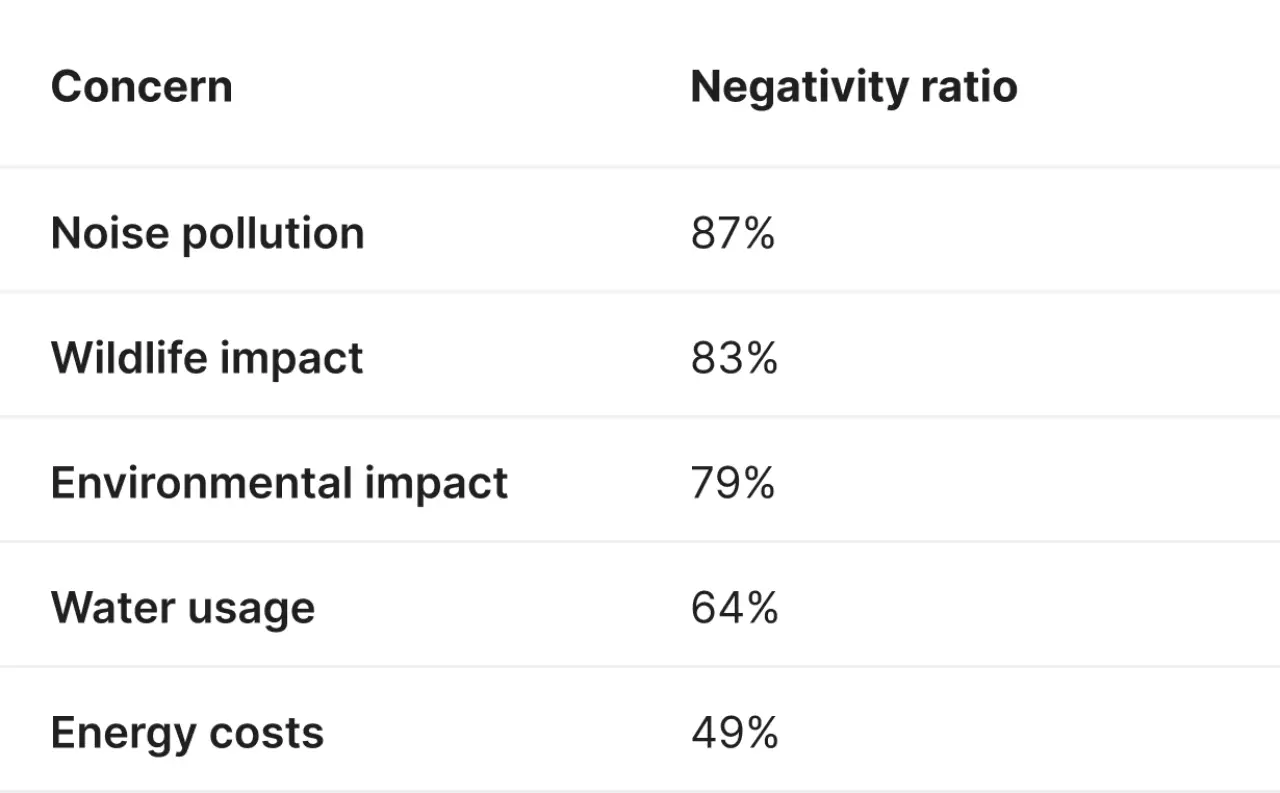
Top concerns by % negativity
Noise pollution: the psychological and physical flashpoint
Noise remains the undisputed #1 flashpoint, holding an 87% negativity rating in public record and media coverage. Residents describe the low-frequency hum of high-capacity HVAC systems not as a mere nuisance, but as a constant psychological stressor that interferes with daily life.
Acoustic intensity: Backup diesel generators, essential for 24/7 reliability, can produce noise levels between 85 and 100 dB(A)—a level comparable to a jet engine at takeoff.
Health: Chronic exposure to high-decibel noise can lead to sleep disruption, high stress, cardiovascular issues, and respiratory diseases.
“The people that live around here, their property is not just worth less. It’s worthless. They cannot sell their property even if they wanted to because nobody wants to live next to this constant noise.”
— Nannette Samuelson, Hood County Commissioner
Water consumption and environmental protection
Data centers are increasingly viewed as "resource-ravenous," with water scarcity holding a 78% negativity rating. The environmental impact extends from local aquifers to the broader climate transition.
Massive consumption: A single medium-sized data center can require up to 110 million gallons of water annually for cooling, equivalent to a small town.
The AI "bait-and-switch": Despite public commitments to "net-zero," surging AI demand has forced some utilities to delay the retirement of fossil fuel plants or revive mothballed coal and gas units to maintain 24/7 power.
Air quality and public health: On-site diesel generators emit nitrogen oxides (NOx) and fine particulate matter (PM 2.5), which are linked to increased rates of asthma and respiratory issues in nearby communities.
Contamination concentration: When water is cycled through server systems to absorb heat, evaporation occurs while nitrates remain, significantly increasing their concentration. In some instances, polluted water returned to wastewater systems has reached levels as high as 56 ppm—eight times the safety limit established in regions like Oregon.
The impacts on groundwater are not merely hypothetical; they are documented realities for communities neighboring these facilities. In Newton County, Georgia, residents living near a Meta data center construction site reported severe water quality issues starting in 2018, where sediment leached into private wells.
This forced families to spend at least $5,000 on repeated appliance replacements in 2019, 2021, and 2024, as their taps were reduced to "mere trickles" of unusable water.
“Should data centers exist in the desert? In a year when farmers are being paid not to farm because of a lack of water, any use of our water for corporate interests over human need is unethical.”
— New Mexico resident on Los Lunas facility on Facebook
Direct-to-ratepayer costs: the financial burden
A primary economic driver of negativity (49%) is the perception that local residents are subsidizing Big Tech’s expansion. Local leaders now rank energy affordability as their constituents' top concern.
There is a growing fear that massive grid upgrades required for data centers will lead to higher electricity bills for local families, which has been proven true in some cases:
Power price surge: Wholesale electricity costs are 267% higher than they were five years ago in areas near data center clusters.
Capacity hikes: In parts of Ohio and Maryland, residential bills are projected to rise by $15 to $18 per month solely due to the capacity market spikes driven by data center loads.
$9.3 billion capacity spike: Research into the PJM mid-Atlantic grid found that 70% of last year’s increased electricity cost was the direct result of data center demand.
This financial pressure has given rise to the “BYOE” rallying cry—“Bring Your Own Energy”—as advocates demand that data centers generate their own power rather than drawing from shared, overburdened grids.
This hallmarks the shift towards the power-first era of data center projects, where the facility acts as a grid partner rather than just a consumer.
Developer's edge:
By identifying whether a specific community prioritizes noise mitigation or water preservation, teams can tailor engineering solutions and communication strategies to address the most potent local triggers proactively.
Where is the friction highest?
Summary:
Development friction follows a "saturation cycle" where initial economic excitement is replaced by a "sacrifice zone" narrative as residents feel the cumulative impact of multiple projects.
Sentiment is not uniform across the U.S. Our research highlights a geographic divergence based on project density and local political priorities.
Most positive states: Mississippi, Wyoming, and South Carolina (Initial "Honeymoon" phase).
Most negative states: West Virginia, Delaware, and Kansas ("Saturation" phase).
Nowhere is this divide more visible than in the states of Texas, currently in a growth-oriented "Honeymoon" phase, and Virginia, which has entered a stage of "Saturation" where friction is at an all-time high.
The "honeymoon" vs. "saturation" cycle
Development friction typically follows a predictable lifecycle. In the early stages, local governments and residents prioritize the immediate economic benefits, such as construction jobs and property tax windfalls.
Texas: In markets like Dallas and Austin, data center demand is booming, with 575 MW of absorption in the first half of 2025 alone. Because land is plentiful and the grid is independent (ERCOT), projects are often greeted with optimism as "clean" industrial investments.
Virginia: As the "Data Center Capital of the World," Northern Virginia has reached a tipping point. The region hosts 349 facilities in close proximity, leading to visible grid strain and a 25.6% share of total state energy demand. This density has transformed once-latent support into organized, sophisticated opposition.
The "sacrifice zone" narrative: a warning for developers
The data introduces a critical sociopolitical term that every developer must understand: the Sacrifice Zone. This widely used concept (appears in 15 states) describes the growing public perception that certain communities — often rural or lower-income — are being "sacrificed" for the digital convenience and economic prosperity of others.
The sacrifice paradox: When projects promise financial gain to a county but fall on a specific neighborhood to bear the 24/7 noise and pollution, the "Sacrifice Zone" narrative gains traction, frequently leading to project termination.
Bipartisan pushback: This narrative has bridged traditional political divides, uniting rural conservatives protecting their land with urban advocates fighting environmental racism.
“We cannot be half community and half an industrial park. We cannot be half a safe haven for families and half a sacrifice zone for economic development.”
— Loudoun County resident
The epicenter: Virginia’s reform coalition
Virginia serves as the global blueprint for what happens when the "Sacrifice Zone" narrative takes hold. The emergence of the Data Center Reform Coalition—a group of over 20 grassroots organizations—has successfully pressured local boards to deny rezoning requests that were once considered "by-right" successes.
Even in Republican strongholds across the state, the backlash is reshaping local politics. As reported by Fortune, the fight over data centers is turning local elections into referendums on "rural preservation" versus "big tech". Developers are finding that traditional political alliances are crumbling under the weight of constituent pressure to protect the "Goldilocks" balance of their communities.
Developer's edge:
Comparing current site prospects against the "saturation" markers of Northern Virginia allows teams to identify over-concentrated regions, helping teams pivot to high-growth, low-friction areas.
The disconnect in the data center controversy: industry vs. public
Summary:
Developers and individual citizens are living in two different realities, with industry optimism being drowned out by a 6:1 negative sentiment ratio among local residents.
The divide is reflected in the chasm between the groups shaping the data center narrative: the industry is essentially talking to itself, while the public is listening to a completely different set of concerns.
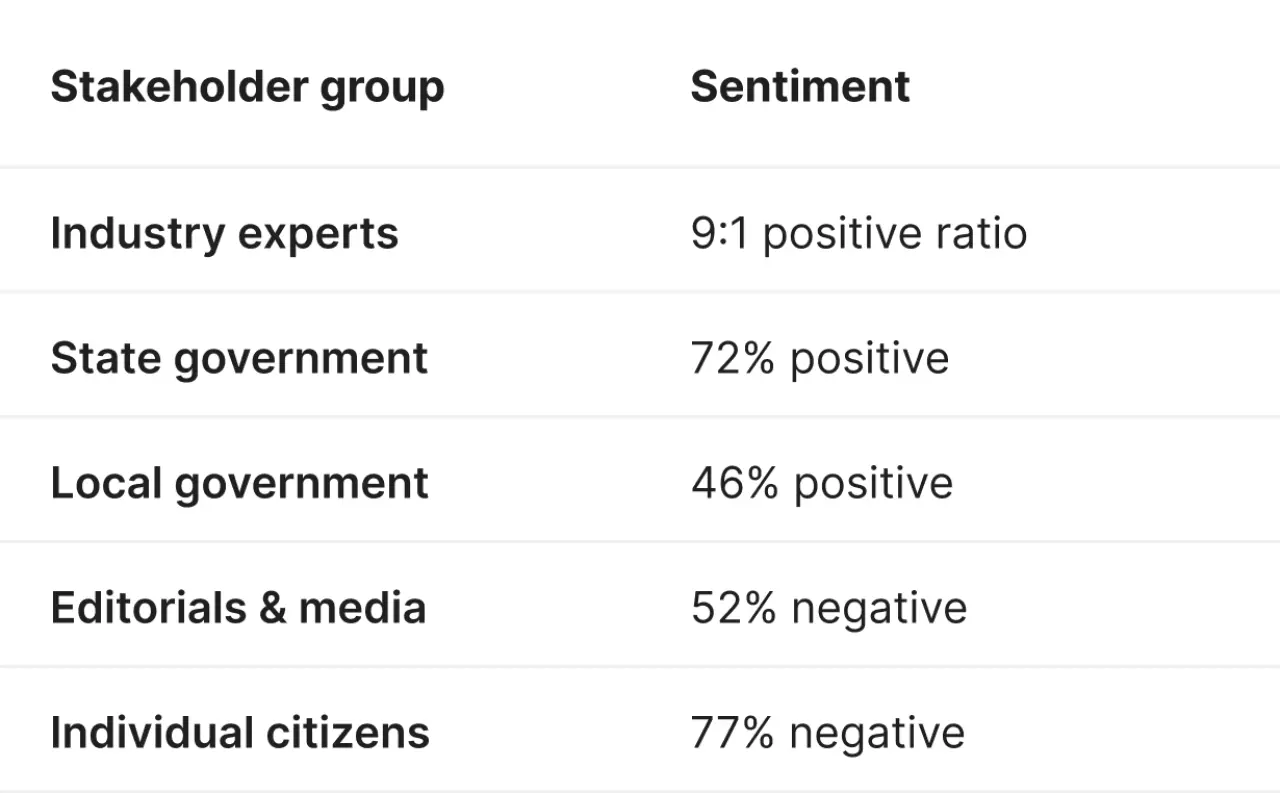
The sentiment landscape is sharply bifurcated by stakeholder group:
Industry optimism: the tech-first narrative
The industry remains overwhelmingly positive, focusing on the essential role of data centers as the "backbone" of the modern economy and the AI revolution.
According to our analysis, support for data center development is primarily generated by:
Renewable Energy Data Centers: Projects that integrate directly with on-site or dedicated green power sources to mitigate grid strain.
Colocation Facilities: Multi-tenant sites that are seen as more efficient uses of industrial land compared to single-user hyperscale "monoliths."
High Performance Computing (HPC): Facilities dedicated to scientific research and advanced modeling, often perceived as having higher societal value.
Cloud Infrastructure: The fundamental utility providing the backbone for modern digital life, generally viewed more favorably than speculative AI training sites.
Data Center Efficiency: Discussion of proprietary cooling technologies and LEED-certified designs that reduce the facility's environmental footprint.
Developers have good reasons for this optimistic outlook: as the industry moves to solve widespread concerns like noise pollution through advanced acoustic engineering, it demonstrates resilience and responsiveness.
The economic paradox: jobs vs. subsidies
However, this positivity is frequently siloed within professional circles, failing to address the visceral fears of those living near proposed sites. This is most clearly seen in the economic paradox that pits jobs against subsidies.
The reality for many residents is that while a facility might cost $1 billion to build, it may create 1500 construction jobs, but only 30 to 50 permanent ones. Furthermore, as found in the study and corroborated by Bloomberg research, the massive tax breaks used to lure these "job-light" facilities are often seen as a wealth transfer from local taxpayers to trillion-dollar tech companies.
The government and editorial split: state ambition vs. local reality
If the industry is united in its optimism, that’s not the case for the government and the media. Our study highlights a massive 26-percentage-point "governance gap" between state and local leaders.
State-Level Ambition: State governments typically view data centers as strategic assets, often passing legislation to streamline permits and offer aggressive tax incentives to remain competitive in the "AI arms race".
Local-Level Accountability: Local officials sit on the "front lines" of community anger. They are the ones who must answer for noise complaints and water scarcity fears. This pressure explains why local positivity has plummeted to just 46%, leading to the moratoriums seen across the US.
The Editorial Shift: Media analysis has turned sharply critical, with 52% negative sentiment. Editorials are increasingly focusing on "The Bait and Switch" narrative, questioning whether the environmental and utility costs are worth the promised fiscal rewards.
Developer's edge:
Teams that track the 26-percentage-point "governance gap" can predict when a local board is likely to break from state-level "pro-growth" incentives and proactively address local concerns before a moratorium is imposed.
How can developers mitigate sentiment risk with PVcase Prospect?
Summary:
Developers must transition from reactive damage control to proactive, data-driven community alignment using tools that surface local opposition before capital is committed.
To solve the $64 billion blind spot and navigate the transition from a "Honeymoon" to a "Saturation" cycle, data center developers require a new category of engineering-grade data: Social License Intelligence.
PVcase Prospect is currently among the only site selection solutions for the data center industry that includes a dedicated Data Center Community Sentiment Analysis layer. Our solution enables developers to visualize regional sentiment patterns during early-stage site analysis, ensuring that multi-million dollar capital commitments are aligned with local reality.
The platform provides a competitive advantage in the pre-interconnection phase through several key capabilities:
AI-driven record aggregation: The system leverages AI to aggregate, surface, and summarize vast amounts of unstructured data, including municipal records, county-level meeting notes, and hyper-local news articles.
Digital discourse monitoring: By analyzing all public records — including town council notes and other online publications — the tool identifies the "velocity" of local opposition.
Sentiment-aligned site analysis: The layer allows users to read through summarized key details of local support or resistance, enabling a deeper understanding of the "why" behind regional sentiment.
Project success optimization: By aligning development with community sentiment during early site analysis, the platform minimizes delays in high-friction areas while fast-tracking sites with strong local backing.
Ultimately, PVcase Prospect stands out as the only solution that equips digital infrastructure developers with the right tools to de-risk their projects early: community sentiment data, climate hazard layers, power flow-based capacity analysis, fiber data, and more.
For a comprehensive roadmap on managing these variables, download our guide on scaling up data center siting in the power-first era.
Why stewardship is the future of data center development
Our research is unequivocal: the industry has reached a turning point where technical excellence must be matched by community stewardship. Hyperscalers and developers now have an obligation to act as intentional neighbors, ensuring that the infrastructure of the future is built upon a foundation of local trust and transparent planning. Proactively addressing concerns — not as an afterthought, but as a core project requirement — is the only way to ensure the sustainable growth of the AI era.
By evolving from reactive damage control to proactive, data-driven stewardship, the industry can bridge the "voice gap" and turn the current climate of resistance into a collaborative path forward.

Secure data center sites that actually work
Replace surface-level site screening for buildable, power-ready data center sites with PVcase Prospect.
Methodology
Summary:
Our methodology uses Natural Language Processing (NLP) to convert 254,148 unstructured data points—from town hall transcripts to mainstream news outlets —into a quantitative metric by classifying the sentiment and topic of every stakeholder's voice.
This study represents the most comprehensive analysis of data center community sentiment to date. Aiming to capture the public discourse in detail, our methodology utilizes a granular classification system across four primary dimensions:
Voice Type: Who is speaking, including industry, government (state vs. local), organized community groups, individual citizens, and editorial analysis.
Sentiment Analysis: Positive, negative, neutral, or mixed.
Topic Mapping: The specific subject matter driving the narrative (water consumption, noise pollution, zoning, etc).
Geographic Attribution: Mapping every data point to the county and state level.
The analysis covered 254,148 specific quotes from 53 states and territories. These were drawn from a massive variety of public and private channels, including:
News articles
Government reports
Public meeting transcripts
Website entries
However, the dataset reveals a significant imbalance in whose voice is represented in the media.
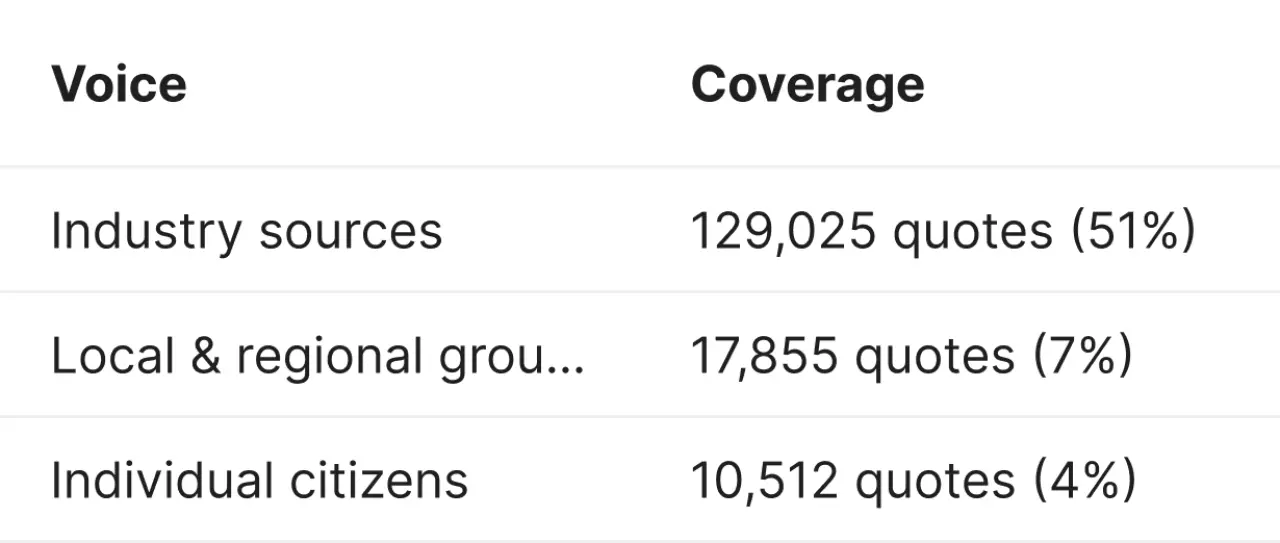
This voice imbalance reflects media coverage patterns rather than underlying public opinion: Industry sources are more accessible to journalists, while citizens tend to speak primarily at public meetings.