
Blog
Fail fast, succeed faster with early-stage solar software
November 14, 2024
PVcase Products

EXECUTIVE SUMMARY
Unmanaged version overview in the solar project development process drives silent data degradation across project handoffs, leading to million-dollar procurement errors. Establishing managed release boundaries and automated change history safeguards technical integrity , mitigates downstream asset risk, and protects long-term project bankability.
Solar asset profitability is increasingly dictated by the efficiency of pre-construction workflows, with soft costs consuming a high percentage of total project CAPEX. While corporate pipeline expansion remains strong, developers and engineering leads face an administrative and archival problem that risks project financial close: version control chaos.
When engineering technical data is separated from standard document tracking systems, subtle file discrepancies can compile into million-dollar procurement errors. Given the high risk of falling into this and other solar rework traps within legacy development, moving toward a centralized release infrastructure is the only way to guarantee data integrity and, consequently, project bankability.
QUICK TAKE
File forking: Concurrent edits prompt automated file duplicating.
Path breakage: Minor filename alterations immediately break absolute XREF paths.
Data corruption: Master layouts lose vital terrain and civil grading models.
To prevent software performance lag when modeling thousands of photovoltaic arrays across massive geographic layouts, utility-scale desktop CAD models rely on a complex, decentralized web of external references (XREFs).
Absolute boundary coordinates, high-resolution hydrology meshes, and shifting civil grading models are rarely housed within the main project .dwg file; instead, they are dynamically linked from external directories. The structural integrity of the entire engineering project thus depends on the absolute consistency of these file paths.
Standard enterprise network and cloud storage platforms completely lack block-level synchronization awareness for such heavy, binary CAD files. They are built to process sequential, text-based modifications. So, when internal design engineers, external civil subcontractors, or grid interconnection teams attempt to modify files within the same shared directory concurrently, the file server cannot merge their technical inputs.
To prevent data from being overwritten, the server defaults to an automated, unvetted duplication protocol. It generates separate, isolated file copies appended with individual usernames or corporate email addresses.
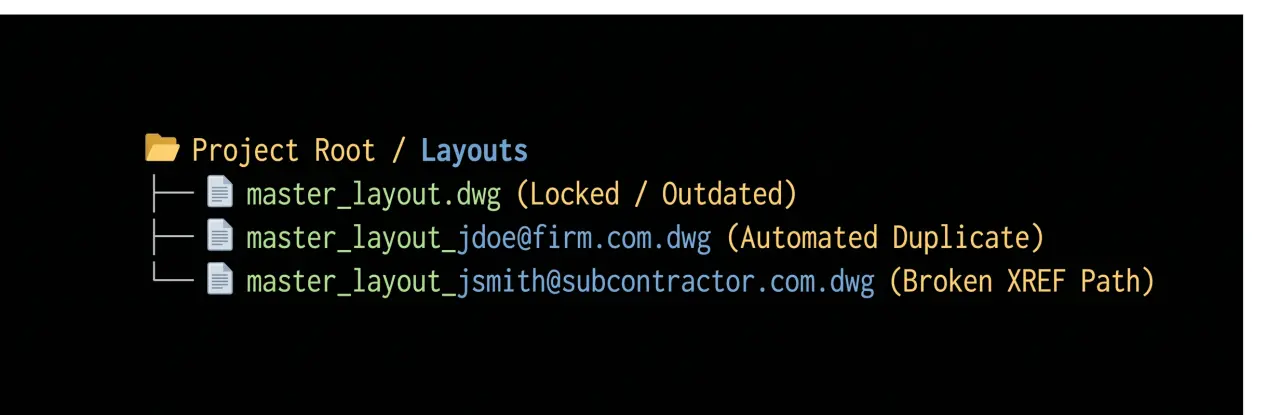
General purpose cloud folders unknowingly fork engineering layouts and sever external references.
However, in a standard solar project tree, changing even a single character in a file path triggers a severe chain reaction: as the desktop CAD master file looks for the original, unmodified file path, any technical edits — such as updated parcel markers or grading profiles — are trapped inside the renamed user file, the primary layout file continues to read the outdated path or throws a "Missing Reference" error.
Thus, relying on non-specialized solar software to coordinate these highly specialized assets leaves the door open to critical upstream and downstream calculation failures:
Vanished terrain data: After a file split, the underlying topography of a layout may disappear in the master file.
Flawed automated wire sizing: Cable runs and voltage drop calculations fail when detached from the true topographical distance and slope vectors.
Inaccurate block capacity allocations: Inverter and tracker configurations shift out of structural compliance without absolute boundary markers.
Mismatched bill of materials generation: Quantification tools pull from fragmented file states, embedding major discrepancies into the baseline hardware tally.
This forces design leads to spend hours manually re-mapping vectors instead of optimizing layout variants. For organizations that rely on office IT infrastructure to manage spatial design arrays, keeping an overview of updated versions can thus become an inefficient, time-consuming task.
"60% of solar professionals get bogged down by the lack of a single source of truth for all project related documents."
[The 2025 state of solar project development]
QUICK TAKE
Untraceable history: Missing automated timelines forces unsafe "Save As" hoarding to test variants.
Opaque tracking: Disconnected design histories obscure approved baselines and historical decision context.
The downstream effect of broken absolute reference paths is an unsustainable manual hoarding of historical files. In software engineering, teams use branch-based version control pipelines to test multiple code variations simultaneously without disrupting the master repository. In utility-scale development, engineers are forced to mimic this pipeline using a crude, high-risk workaround: the manual "Save As" function.
During the initial stages of layout generation, a design engineer must evaluate dozens of spatial variations to secure the highest possible direct current (DC) capacity and target an optimal ground coverage ratio (GCR). Because generic desktop CAD environments completely lack automated, solar-specific timeline mapping, every single configuration change requires a brand-new file save to preserve the engineer's work. Designers must manually branch files to test:
Tracker frame configurations: Assessing distinct structural tolerances and structural racking limits.
Pitch distances: Changing row-to-row spacing to manage early-morning and late-afternoon row shading.
Row orientations: Evaluating exact true-south alignments against terrain-following east-west variations.
Module power classes: Adjusting layouts to account for shifting physical dimensions and electrical string capacities from various manufacturers.
This technical friction forces teams into an unsustainable manual loop, directly compounding the consequences of solar software fragmentation across the engineering lifecycle.
Manual branching workflows rapidly snowball into severe directory chaos. Within weeks, a project folder fills with an untraceable web of binary assets named using arbitrary conventions.
Over a long, multi-year utility-scale project lifecycle — where design data regularly sits dormant for months during permitting or interconnection studies — the underlying reasoning that informed each individual variant might get lost to team handoffs or simply forgotten.
This opacity creates a blindness to track version history. Because there is no centralized change log linking these independent files, the organization loses the ability to audit the design timeline. Nobody can verify which file represents the true approved baseline, why specific spatial boundaries were adjusted, or which design attributes are currently active.
The risk peaks when a design revision is forced late in the development cycle, such as procurement requesting a sudden module swap due to supply-chain disruptions. Because the desktop CAD tree is completely isolated from downstream performance and commercial tracking systems, the version alignment snaps:
Obsolete financial boundaries: The standalone Bill of Materials (BOM) spreadsheet remains locked to an older file version, causing equipment quantity mismatches.
Stale simulation baselines: External yield models decouple from the physical layout alterations, distorting energy projections.
The ultimate rework penalty: Because the designer cannot look at a centralized timeline to trace which specific structural or property constraints shaped which historical file variant, they have to rebuild and redraw the entire layout completely from scratch.
Thus, if a designer is unavailable or leaves the company, historical context is completely lost. Without an automated framework to track why a specific layout variation was altered, version history becomes completely opaque, paving the way for late-stage construction errors.
"65% of solar professionals suffer from a severe lack of standardized processes."
[The 2025 state of solar project development]
QUICK TAKE
Data leaks: Unprotected drafts allow commercial teams to pull unvetted metrics.
Financial risk: Stale data feeds corrupt calculations, triggering downstream procurement errors and reworks.
Engineering files sitting unprotected on standard company drives without a managed release gate extend the risk even further. In the absence of a structured workflow where the technical lead explicitly controls version visibility, commercial teams pull inaccurate layouts from shared folders.
For instance, an unvetted revision with an obsolete module specification or an unoptimized tracker count can pull incorrect baseline numbers into an investment model, corrupting the financial calculations. Bidding or selling the project asset on inaccurate metrics triggers costly engineering rework and late-stage structural redesigns during construction.
To see how leading developers mitigate these handoff vulnerabilities, read how New Leaf Energy optimized engineering workflows to maintain absolute data integrity across complex pipeline handoffs.
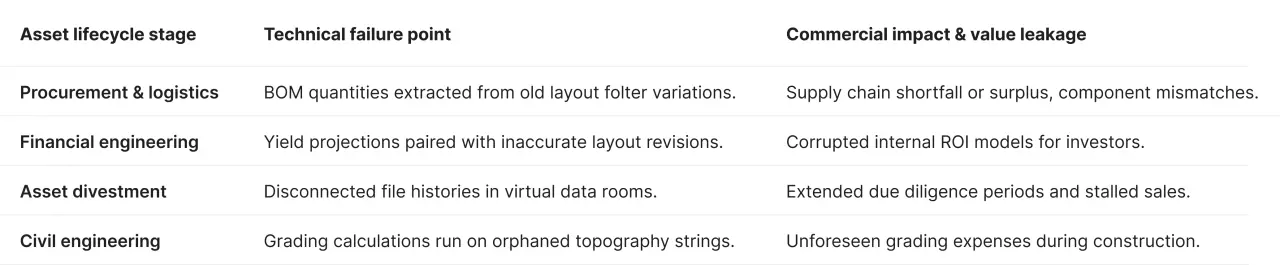
The financial and structural liabilities of layout files decoupled from commercial project management directories.
QUICK TAKE
Data safety: Standardized blueprints and access validation gates restore workflow visibility.
Risk mitigation: Centralized data controls completely block late-stage engineering redesign costs.
To avoid the financial risk of a compromised solar project version control and secure project bankability, developers must move away from general-purpose office infrastructure. Reaching that goal requires a standardized approach to spatial data management:
Eliminate independent storage silos: Host all electrical layouts, civil surfaces, and boundary files within a single solar workflow automation platform rather than scattered local network servers.
Maintain bidirectional layout association: Ensure that late-stage changes to baseline civil or topography references dynamically cascade to all active variant files.
Prevent cross-team layer disconnects: Link structural design properties directly to external coordinate references to maintain geometric absolute accuracy across external survey handoffs.
Separate draft stages from final assets: Establish formal publishing parameters that explicitly lock active engineering layouts away from non-CAD corporate users.
Enforce authorized signing protocols: Mandate that technical design leads must explicitly log and verify an asset variation before it can be used for procurement estimates.
Prevent premature data access: Block downstream supply chain teams from extracting unvetted Bill of Materials (BOM) metrics from standard active work folders.
Eliminate file nomenclature tracking: Replace manual filename manipulation structures entirely with centralized tracking timelines.
Mandate integrated technical data logging: Require each design version save to include clear, text-based logs detailing the exact spatial design updates.
Secure multi-year project continuity: Anchor specific engineering rationale directly to layout objects to preserve technical knowledge over long permitting or dormant phases.
Version control chaos is, in essence, a severe failure of data governance and document archiving at the institutional level that severely taxes project returns and long-term bankability. Continuing to run specialized project development across unvetted corporate directories leaves the door open to opaque solar workflows that blind project leaders and erode profitability.
As project scale, regulatory scrutiny, and supply-chain volatility continue to intensify, the organizations that thrive will be those that transition to an end-to-end, unified engineering methodology. Moving your pipeline to a unified architecture that natively prevents sync conflicts and locks absolute reference paths eliminating change orders, protecting structural trackability, and bringing projects safely to commercial operation.
“80% of solar engineers say they need to be able to work with one platform from start to finish for their solar development projects.”
[The 2025 state of solar project development]
Learn how solar teams reduce risk and accelerate project development using a single, end-to-end PVcase platform.