
Podcast
S1E4 | The foundation of utility-scale solar, with Alice Thomas & Seif Gomaa
December 15, 2025

EXECUTIVE SUMMARY
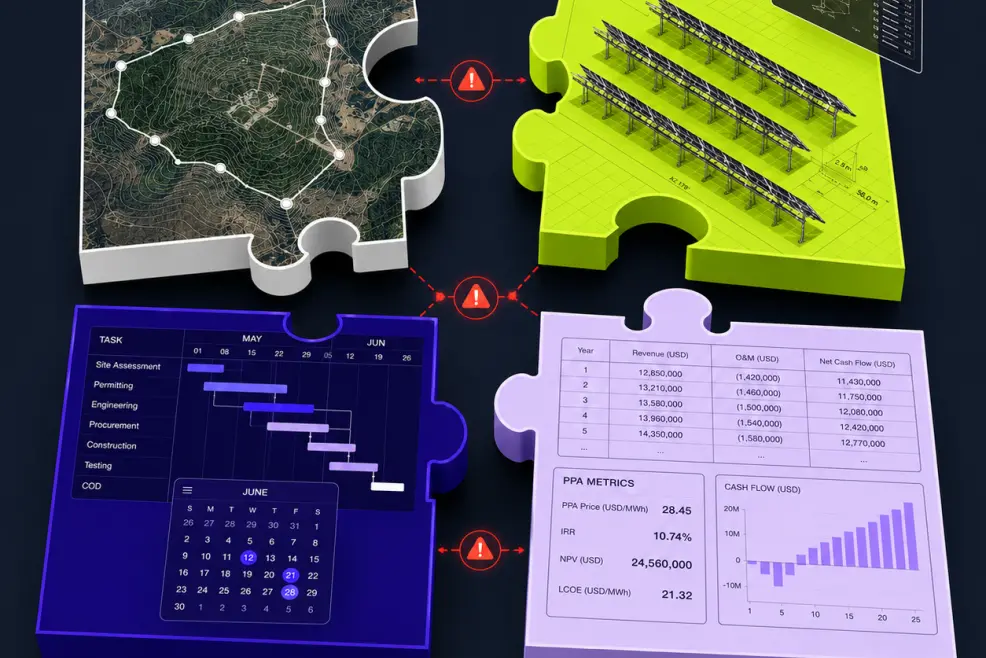
Opaque solar workflows disconnect layout design from project leadership, introducing financial risks that slowly add up and eat up project margins at every stage of development.
In most solar firms, decision-makers are locked out of the site selection, design, and yield simulation processes.
Because the single-user licenses for modeling and CAD software plus its required hardware are costly, it makes no financial or IT sense for developers or project managers to get these setups. The flip side is that the core data ends up trapped inside a silo throughout the solar project development process.
Since project leaders can’t directly access the design files themselves, they’re left to direct high-stakes portfolios using static screenshots, text emails, and stale data. Thus, they lose visibility over their project.
When this happens, these blind spots turn into compounding financial risks that quietly erode project margins at every stage of the project.
QUICK TAKE
As developers don’t have direct access to live, spatial and preliminary design files, their land campaigns and real estate choices rely on inexact, outdated data.
During the site screening process, a site's real capacity changes constantly as developers and engineers try to balance the land's topography against local grid capacity, environmental constraints, and optimal layout design.
Having no direct access to these live files, leaders lose the ability to follow a proactive "fail fast" strategy and end up adopting a reactive process. For instance, development directors and department heads spend dozens of hours a week in cross-functional alignment meetings. Yet they carry ultimate accountability for project margins and hitting deadlines on time.
Beyond that, they’re forced to routinely pull unverified spatial, design files, or flat PDFs from shared directories — or even use static screenshots or memory — to direct early land campaigns or high-stakes reviews.
So, project leaders may make binding real estate choices without a clear view of the parcel’s real capacity, only to end up chasing sites that are technically unviable or dropping cash on properties with hidden construction barriers.
Furthermore, while the lack of visibility surfaces during greenfield prospecting, its financial cost keeps adding up. Because these initial mistakes are locked in early, they follow the project straight into detailed engineering and permitting, forcing teams to constantly revise plans and burn capital to fix problems that should have been caught on day one.
60% of solar professionals claim they lack a single source of truth for all project related documents.
[The state of solar project development 2025-2026]
QUICK TAKE
A blind spot between active designs and financial spreadsheets forces development leads to guarantee project returns using trailing data, exposing them to late-stage cost overruns.
The risks of an opaque process triggers a cascading solar design version control failure that undermines the developer’s accountability. As a project advances, any single unaccounted design change can lead to mistakes during financing and procurement.
For instance, when teams build financing spreadsheets using unverified layouts, the input data for the Levelized Cost of Electricity and final IRR is therefore inexact. If the actual construction-ready costs turn out to be significantly higher than the projections initially indicated, the project's profitability collapses before construction ever begins — leaving the project leader to explain a sudden, late-stage margin drop to the investment committee.
Conversely, if the developer overestimates costs, the inflated projections will wreck the bidding strategy on tariff auctions or Power Purchase Agreement shortlists. Even if the project is secured, over-budgeting ties up millions in corporate capital or credit lines that could have been used for other projects.
The case is similar for procurement: once a supply agreement for equipment is closed, any mistake or inaccuracy in the Bill of Materials means the project manager has to face massive late-stage change orders and restocking fees.
Ultimately, this opacity forces development directors to assume professional and financial risk. They are put in the position of guaranteeing the viability of a project to executive stakeholders, while being entirely decoupled from the live engineering data that dictates whether those financial promises can actually be kept.
63% of professionals cite a lack of async communications as a major friction point.
[The state of solar project development 2025-2026]
QUICK TAKE
Handing prospective buyers flat PDFs forces them to spend weeks rebuilding the design from scratch, slowing down the sale and giving them an excuse to lower their offer.
The financial fallout of project opacity hits greenfield developers the hardest when trying to sell a "ready-to-build" project. At this stage, any profit depends on the speed with which the deal can be closed.
However, because buyers and their independent engineers can’t access the active project files, the sale might hit a wall. Developers end up uploading flat PDFs, spreadsheets, and static maps into a standard Virtual Data Room, leaving the buyers blind the exact data. To verify it, their teams have to spend weeks manually reverse-engineering the entire design from scratch.
This redundant work creates a few major problems project leaders:
The deal drags on: The longer the sale takes, the longer the developer is locked into an exclusive negotiation, leaving the project exposed to outside risks like interest rate hikes or sudden changes in grid rules that can ruin the deal.
A total lack of trust: When buyers have to guess how the numbers add up based on a few screenshots, they get nervous. Because they can't see the engineering team's original design logic, they will assume the worst and lower their valuation of the project to protect themselves.
Late-stage price chipping: If the buyer’s engineers find even a minor mistake or a steep slope while rebuilding the file — something the front office didn't catch because of the siloed workflow — they will use it as leverage to chip away at the final price or demand contract changes.
Even long-term owners cannot escape the risks of this data break. Before banks or equity partners release the construction loan for a project, they subject the design to the exact same independent engineering due diligence. A lack of absolute transparency stalls this broader financial close.
QUICK TAKE
Because the opacity of legacy workflows completely masks their true financial damage, leaders see no reason to disrupt the status quo with new tools.
Even when design engineers and technical professionals openly acknowledge the need for improved tools and processes, trying to update the company's software stack hits a major corporate bottleneck.
When leadership evaluates engineering workflows, they have to weigh the disruption of retraining staff and changing systems against the promised benefits of a new tool. But because the gap between live project data and presented files remains hidden, executives are unaware of the daily friction, manual workarounds, and data errors happening beneath the surface.
Many of these workarounds originate from the limitations of non-specialized solar software, which lacks the project-specific context required by complex engineering and development workflows.
This lack of awareness puts decision-makers in an abstract loop. They assume their current, slow-moving processes are just the standard cost of doing business, rather than recognizing them as a systemic drain on project velocity.
Because the opacity hides the bleeding, leaders can't see the necessity or the financial upside of adopting a new workflow. Ultimately, the pipeline stays stuck in an inefficient cycle because the people holding the budget cannot diagnose a problem that remains completely invisible to the front office.
65% of solar professionals cite a lack of standardized processes as a major bottleneck in their projects
[The state of solar project development 2025-2026]
QUICK TAKE
Restoring transparency throughout the project’s development requires a shift to a connected workflow that shares data automatically.
The lack of visibility is not solved by putting managers through CAD training or investing thousands in redundant software licenses. On the contrary, the solution lies in changing to a structured system built on four core pillars:
Create a unified data environment that welcomes everyone: The "PDF Wall" that stalls asset sales for greenfield developers and delays loans for long-term owners can only be broken by opening up access. Teams must replace flat maps and static screenshots with a single, secure location where authorized stakeholders can view live asset data. Giving project managers, lenders, and prospective buyers a simple, browser-based way to look at the project eliminates the need to spend weeks reverse-engineering files from scratch.
Enforce standardized processes across all teams: To help executives balance the disruption of a workflow upgrade against its actual payoff, the company needs transparent, repeatable workflows. Moving away from abstract debates over software features means setting clear, documented rules for how a project passes from one phase to the next. When the process is standardized and consistently applied, leadership can easily see exactly how a modern tool eliminates manual retyping and protects site margins.
Automate risk monitoring and reporting for decision-makers: To stop developers from accidentally chasing unviable land or getting hit with late-stage change orders, technical and regulatory risks must be tracked in real time. Instead of waiting for an engineer to discover a severe slope hazard or a zoning constraint and manually write a report, the system should catch these variables automatically. Providing leaders with automated alerts and actionable risk reports gives them the tools they need to follow a proactive "fail fast" strategy.
To find out how leading developers reduce manual tasks and fragmentation, and ensure a transparent workflow, read how Sol Source Power unified three separate solar development processes into a single digital ecosystem.
The early blind spots for managers and decision makers can quickly turn into cascading financial risks that quietly erode project margins at every single stage of the lifecycle. Trying to fix this by simply emailing more spreadsheets or holding more catch-up meetings only treats the symptoms of a broken system while leaving the underlying opacity completely intact. So does buying more GIS, CAD, or modeling software.
To scale safely and protect project returns, the solar industry can no longer rely on fragmented, siloed toolsets that keep the front office and the specialist teams in separate worlds.
The industry needs a new workflow standard — a unified solar development process engineered to seamlessly bridge the gaps between development stages and every project member.
97% of solar professionals say they would be interested in an end-to-end platform that helps the solar industry optimize the project development process every step of the way
[The state of solar project development 2025-2026]

Learn how the PVcase platform streamlines all stages of project development.