Blog
Virto CAD vs. PVcase Ground Mount: a technical comparison
April 10, 2026
PVcase Products

EXECUTIVE SUMMARY
PVcase and Enverus support solar development from site selection through engineering and energy analysis, but take different approaches. Compare their capabilities, workflows, and integration to understand where each platform excels and which better supports your team's development priorities.
Choosing solar development software involves more than comparing individual features — or even individual products. Developers need to consider how each platform supports decisions from the earliest stages of project origination.
Every stage of the solar project development process introduces new information, requirements, and risks that can challenge earlier assumptions and shape subsequent decisions. This makes the relationship between tools just as important as their individual capabilities.
So how do PVcase and Enverus compare across the solar development lifecycle? Let's examine their respective capabilities, the workflows connecting them, and the circumstances in which each platform may be the better choice.
QUICK TAKE
Enverus connects broad energy intelligence with solar development tools; PVcase emphasizes an integrated workflow through site selection and detailed design to yield estimation.
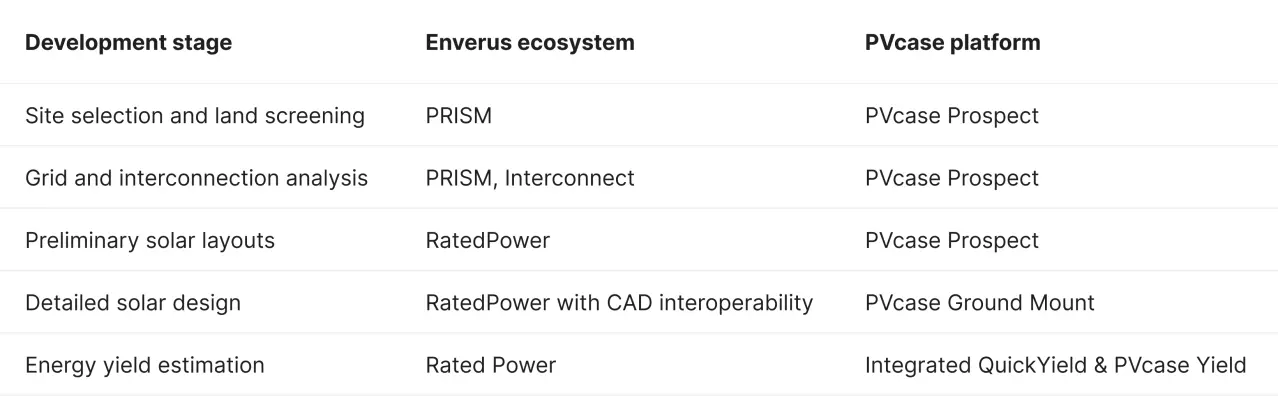
Enverus offers a broad ecosystem of energy intelligence and analytical tools. Its most relevant solutions for utility-scale solar development include:
Enverus PRISM: Broad energy market, infrastructure, and land intelligence.
Enverus Interconnect: Grid interconnection analysis.
RatedPower: Browser-based solar PV and battery energy storage system (BESS) design, engineering analysis, and energy simulations.
For utility-scale solar development, PVcase offers an end-to-end workflow through three complementary products:
PVcase Prospect for power-first site selection and early project evaluation
PVcase Ground Mount for CAD-based detailed solar engineering
PVcase Yield for energy production modeling.
Both ecosystems address multiple stages of solar development, but differ in how their tools support the progression from site origination to detailed engineering and energy assessment.
QUICK TAKE
Enverus PRISM provides broad energy intelligence; PVcase Prospect emphasizes grid-first solar site origination, land qualification, and project prioritization.
Enverus PRISM provides a broad energy intelligence environment for identifying and evaluating development opportunities. It brings together electricity market data, grid infrastructure, land characteristics, and project activity, allowing developers to assess potential sites within a wider energy-market context.
Its capabilities extend beyond conventional land screening. Developers can investigate grid conditions and interconnection opportunities, while its Renewable Sentiment functionality provides insight into county-level permitting restrictions, regulatory conditions, and community opposition. Enverus Interconnect adds specialized analysis for evaluating grid connection opportunities.
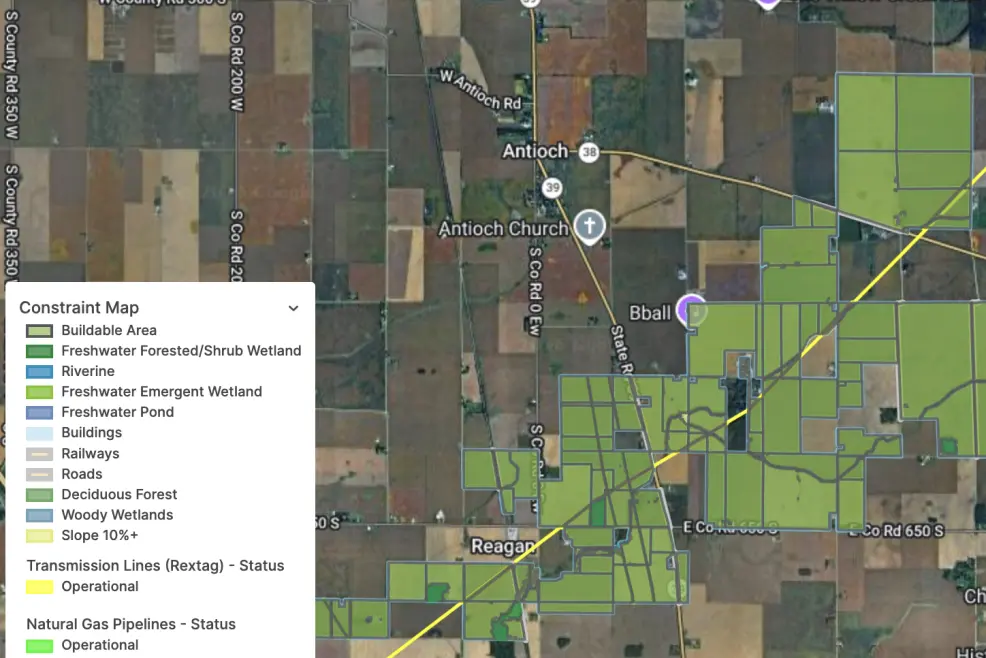
PVcase Prospect approaches site selection through a grid-first development workflow, helping developers identify suitable interconnection opportunities before evaluating surrounding land. Rather than displaying broad grid and parcel data, it supports the decisions involved in efficiently building and prioritizing a solar project pipeline:
Target viable interconnection opportunities: Evaluate available grid capacity, network constraints, and estimated upgrade costs before investing in land acquisition. Explore the advantages of PVcase Prospect's approach in our e-book, Capacity analysis: Why PVcase Prospect wins.
Qualify land around promising POIs: Automatically screen parcels against buildable-area requirements, environmental restrictions, setbacks, and other development criteria.
Prioritize development opportunities: Compare POIs using weighted capacity and cost criteria, while incorporating power-market intelligence and local community sentiment into site evaluations.
This approach has demonstrated practical value for developers. CleanChoice Energy used PVcase Prospect to identify promising grid connections before screening nearby parcels, reducing its reliance on expensive early-stage injection studies and focusing acquisition efforts on more viable opportunities.
QUICK TAKE
RatedPower combines solar design and analysis in a browser-based environment; PVcase Ground Mount enables CAD-native engineering as projects advance toward construction.
Enverus RatedPower is a cloud-based platform for solar PV and BESS design. It combines automated layouts, terrain analysis, electrical modeling, and energy simulations in a browser-based environment. Its Layout Editor allows engineers to refine project configurations and evaluate design alternatives without relying on a separate CAD application.
However, the greater precision and flexibility of dedicated CAD environments become particularly valuable when projects advance into detailed engineering.
RatedPower supports this transition through DWG export and reimport, allowing engineers to continue developing designs in CAD applications, although its own documentation acknowledges that complex geometry may require additional adjustments during the transfer.
PVcase Ground Mount takes a different approach by integrating specialized solar engineering tools directly into AutoCAD. Engineers can generate, modify, and document solar plant designs within the CAD environment, combining automated solar-specific functions with AutoCAD's broader drafting and editing capabilities.
In other words, engineers can work directly with project geometry, terrain information, electrical layouts, and technical drawings as designs evolve, avoiding the need to transfer files between design tools.
For a practical example, see how Zimmermann uses PVcase Ground Mount to improve terrain analysis, pile-length calculations, and solar design efficiency.
Additionally, for projects initially evaluated with PVcase Prospect, a dedicated export carries site boundaries, buildable areas, constraints, and terrain data into PVcase Ground Mount. This provides engineers with a starting point informed by earlier development decisions, without manually recreating those site inputs.
QUICK TAKE
RatedPower integrates energy simulation with browser-based design; PVcase connects rapid yield estimates with detailed, CAD-informed modeling for financial assessment.
Enverus RatedPower integrates energy yield estimation into its solar design platform. Its 3D simulation engine accounts for terrain, shading, bifacial irradiance, and electrical losses, allowing engineers to evaluate production as they refine plant configurations. RatedPower also provides probabilistic yield estimates and supports exports to PVsyst.
Despite these capabilities, PVsyst remains an important part of the financing workflow. RatedPower acknowledges that many customers continue using it to reconcile production estimates and prepare lender-facing P50, P90, and P99 reports.
PVcase supports energy assessment at different stages of solar development, from preliminary layouts to detailed engineering:
QuickYield: Available in PVcase Prospect and PVcase Ground Mount, it provides rapid, directional production estimates to help developers and engineers compare layouts before committing to detailed simulations. Learn more in our guide to accelerating solar design iteration with QuickYield.
PVcase Yield: Imports detailed PVcase Ground Mount layouts for higher-fidelity energy modeling, accounting for terrain, shading, bifacial performance, and electrical losses. This allows engineers to evaluate production using geometry and engineering inputs developed during detailed design.
For both financing and technical due diligence, PVcase Yield combines physics-based 3D ray tracing with probabilistic energy estimates, including P50, P90, and P99. Its results have been benchmarked against PVsyst in our PVcase Yield vs. PVsyst comparison of simulation methods and performance.
QUICK TAKE
Both ecosystems connect development tools, but PVcase carries precise site constraints into CAD-native engineering and links detailed designs to yield analysis.
As projects evolve, teams must preserve engineering information, coordinate revisions, and ensure downstream decisions reflect the correct design.
When those connections break, developers face several risks:
Data fragmentation: Manual transfers and incompatible formats can introduce errors or require repeated work. Explore the cost of fragmented solar software.
Limited project visibility: Disconnected information can leave teams making decisions without a complete picture of project progress. Learn about solar workflow opacity.
Cross-functional misalignment: Poor coordination between development, engineering, and commercial teams can delay decisions and create rework. See how collaboration breaks down in solar development.
Version-control problems: Conflicting layouts and outdated assumptions can undermine engineering consistency. Read about solar project version-control risks.
Enverus connects PRISM with RatedPower through a parcel-import workflow. Developers can identify suitable land in PRISM, transfer the selected parcel into RatedPower, and generate solar layouts, engineering designs, and energy estimates. RatedPower also supports DWG export and reimport when further CAD-based engineering is required.
PVcase provides a more CAD-centered development workflow. PVcase Prospect transfers site boundaries, buildable-area constraints, and terrain information into PVcase Ground Mount, allowing engineers to develop detailed solar designs directly in AutoCAD. These designs can then inform energy simulations in PVcase Yield, including supported electrical design inputs.
The difference is small but significant: PVcase enables engineers to build on established site constraints within AutoCAD, without transferring designs between a standalone solar design platform and CAD for further engineering.
In practical terms, this can mean less duplicated work, fewer opportunities for errors, and faster responses to project changes. If a grid constraint, terrain limitation, or equipment requirement forces a design revision, engineers can update the detailed layout within their existing CAD environment and use the revised design for subsequent yield analysis.
QUICK TAKE
Choose Enverus for cross-market energy intelligence, specialized interconnection studies, or browser-based design. Choose PVcase for grid-first site selection and connected CAD engineering and yield workflows.
Your business requires intelligence across multiple energy markets. Enverus PRISM brings together electricity markets, infrastructure, land, and project data to support investment and development decisions.
Specialized interconnection studies are a priority. Enverus Interconnect provides dedicated capabilities for evaluating grid connection opportunities.
You prefer browser-based solar design and simulation. RatedPower combines PV layouts, engineering analysis, cost estimation, and energy simulations without requiring AutoCAD as its primary design environment.
You want to build a solar project pipeline quickly and efficiently. Identify promising grid connections, screen surrounding land, and prioritize sites before committing resources to acquisition and development.
You need to assess project feasibility before detailed engineering. Create preliminary layouts and estimate potential energy production with PVcase Prospect, helping teams compare opportunities before advancing them.
You want to reduce rework between development stages. Carry site boundaries, buildable-area constraints, and terrain information into PVcase Ground Mount, where engineers can develop and revise designs directly in AutoCAD.
You want rapid yield feedback during development and detailed simulations as projects mature. QuickYield provides immediate production estimates within PVcase Prospect and PVcase Ground Mount, while PVcase Yield supports more detailed, physics-based energy modeling using engineered layouts.
The deciding factor is the development workflow your team needs. Enverus combines broad energy intelligence with browser-based solar design and simulation capabilities. PVcase offers a solar-focused path from site origination and preliminary layouts to detailed CAD engineering and energy yield analysis, helping teams preserve project information as development progresses.
PVcase connects the information developers need to make decisions throughout a project's lifecycle, from identifying viable opportunities to refining engineering designs and assessing expected energy production.
PVcase Prospect helps you turn your initial development strategy into a prioritized pipeline of viable opportunities, identifying where to focus resources before committing to individual sites.
PVcase Ground Mount lets you build directly on earlier site boundaries with greater engineering control, turning promising opportunities into detailed, construction-oriented designs.
PVcase Yield helps you assess the energy production of those detailed designs, refining earlier estimates to support investment decisions and stakeholder evaluations.
Together, these capabilities help developers reduce unnecessary rework, manage project risks, and make better-informed decisions as projects advance.